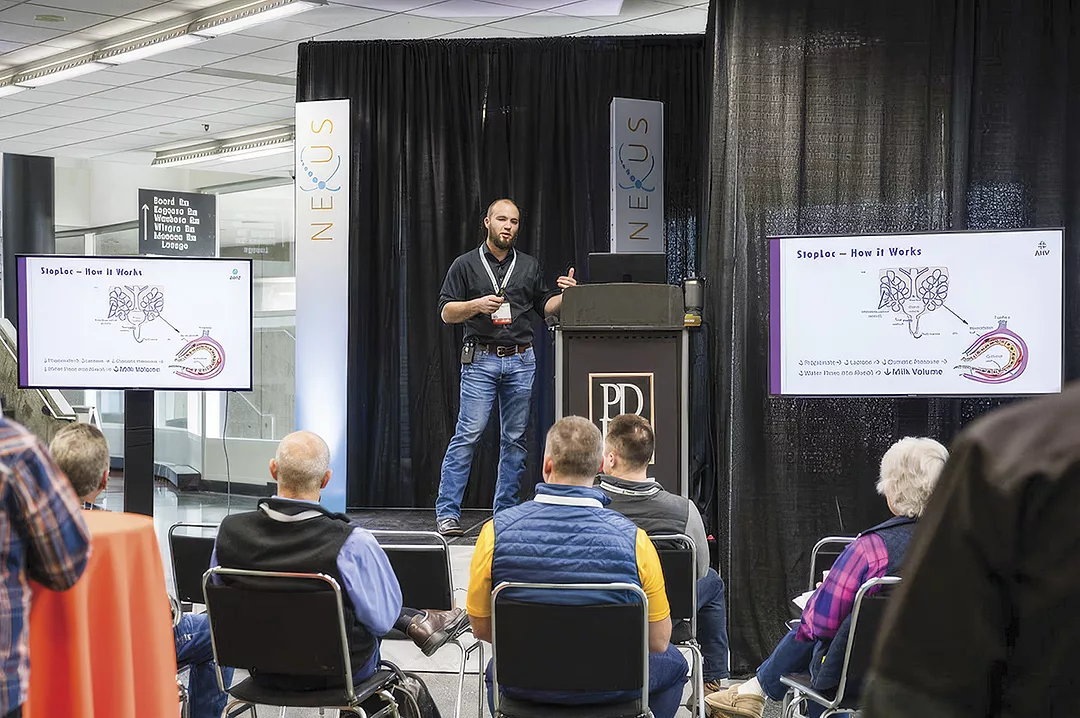
Administering cows an innovative technology in bolus form at dry-off has been shown to decrease milk production 50% to 60% in the first 24 hours after dry-off. Research on the new product – StopLac from AHV – shows it also doesn’t negatively impact the health of the cow or milk production in her next lactation.

“What this product is doing is drastically reducing the volume of milk production at the moment of dry-off,” says Dr. Chris Rock, an AHV technical service veterinarian.
Workers give cows four boluses immediately after the final milking, right before dry-off begins. The company provides a multidosing gun to give all the boluses at the same time.
The product works by temporarily influencing the production of propionate in the rumen. Propionate is one of the precursor molecules the rumen produces that eventually determines lactose and milk volume production. Less propionate equals less milk produced.
Once the boluses dissolve in the rumen, the active ingredients work through a method called quorum sensing to disrupt the communication methods of rumen bacteria that produce propionate. This disruption is temporary and lasts for only 48 hours.

Courtesy image.
Dr. Rock emphasizes that the product doesn’t kill any bacteria in the rumen or do any permanent damage.
“All we are doing is temporarily altering fermentation in the rumen,” Rock says. “That decreases milk production and jump starts the udder’s active involution phase.”
Cows given the product have visibly less udder fill 24 hours after their last milking than cows not given the product, Rock says. The company’s research has also shown a 70% reduction in cows leaking milk after dry-off.
These cows also have a lower udder pH. Rock says this leads to better dry-off outcomes because a lower udder pH enables a cow’s neutrophils, which are her natural line of defense against pathogens, to work better as she transitions out of milk. Testing shows that what milk a treated cow is producing also has less lactose than usual. That means residual milk produced after dry-off is a less-potent growth medium available to potential mastitis-causing bacteria.
Rock says one of the product’s added benefits is the speed of dosing cows with this method versus other methods.
“Many producers using the parlor for dry-off treatments get backed up for the rest of the day and have to play catch up,” Rock says. “With this product, we don't need the parlor for administration. We can do it wherever there's headlocks.”
Early adopters have observed other benefits of the product at the start of the cow’s next lactation.
“We see less muscle damage and lower NEFAs [nonesterified fatty acids] in StopLac cows. When we give this product, cows transition better and are more likely to be able to get up and eat and have less chances of ketosis in her next lactation,” Rock says.
Research shows colostrum or milk production in the following lactation are unaffected by the product’s use. The product has received Organic Materials Review Institute (OMRI) certification for use in organic production. The treatment cost per cow is $38.50.
“Cows have less milk in their udder. Their udder is soft and pliable, not tight and leaking. They don’t bawl or beller. They’re more comfortable at dry-off,” Rock concludes.
The Nexus Innovation Awards are a collaboration between Progressive Dairy and Professional Dairy Producers (PDP). Winners are announced annually at PDP’s Business Conference. A panel of dairy farmers chooses the award winners. The award is given based on excelling in three criteria: the audacity of the product’s innovation, its ability to ingeniously tackle pressing challenges within the dairy sector and the value it brings to dairy operations.