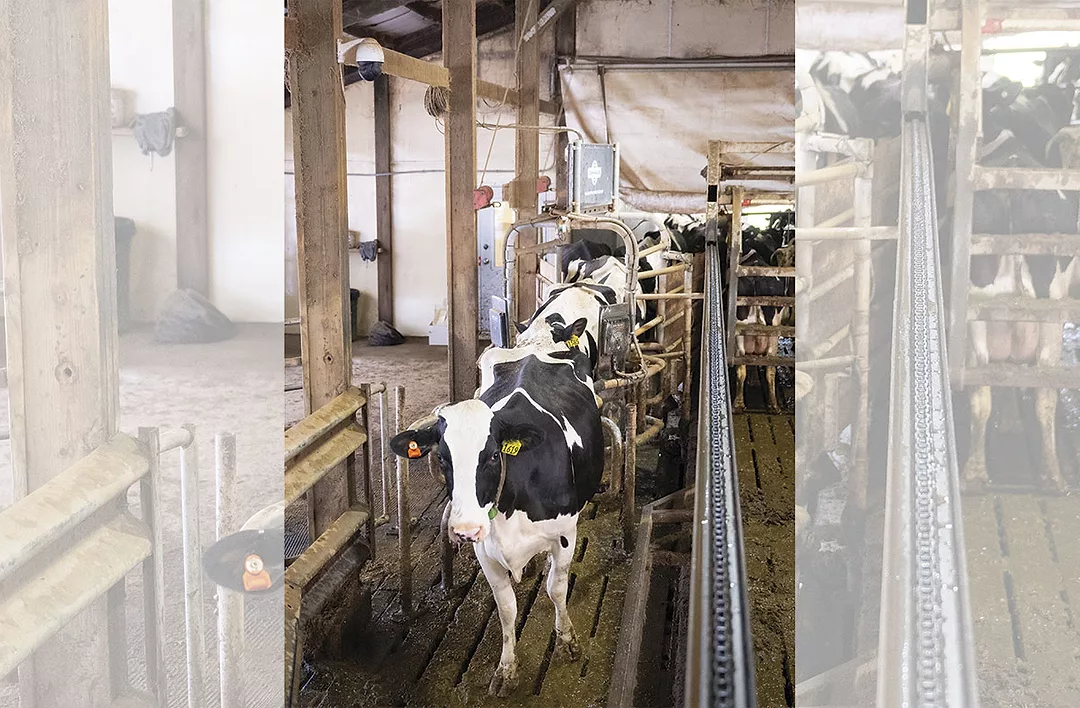
A new back-of-the-barn innovation sorts cows more quietly and reliably in all dairy environments. The Sort my Cow Sort Gate from CowManager runs on electromagnets and springs instead of compressors and pneumatics, making less noise during operation and working consistently, even during extreme weather.

Jared Krull, VP of sales and service for CowManager, says early adopters of the technology most often comment about how smooth and quiet the sort gate operates.
“For years as an industry, we’ve worked on cow comfort, but I think we maybe forgot that principle with the first sort gates to the market,” Krull says. “Those first gates were primarily a saloon door-style. When they open and close, they slam shut. Cows would be scared of them and not want to enter. Our sort gate is more quiet during operation.”
The sort gate is designed to allow only one cow to enter at a time. Two arms, or “spoons” as the company calls them, guide a cow either straight back to the barn or sort her to the side to a sort pen. The spoons sort cows based on activating electromagnets, holding either the left or right spoon stationary.
For example, if the sort pen is to the right of the chute, the left spoon is magnetized during sorting. A cow to be sorted can push aside the nonmagnetized right spoon to move through the gate. The angle of the swinging spoon and the chute on the right under this scenario guides the cow into the sort pen. The magnetized left spoon remains stationary until the cow has exited. Springs then guide the “swinging” spoon on the right quietly back into neutral position.
Conversely, in the above setup, cows returning back to the barn push aside the left spoon while the right remains magnetized. The arrangement of sorting can be flip-flopped based on whether the sort pen is located to the right or left of the gate. Regardless, sorting happens within a second of the cow entering the sort portal.
“The first time I saw the gate in action, I thought, ‘I wonder how strong these magnets are?’” Krull recalls. “I grabbed on the magnetized spoon as hard as I could, and while I could shake the whole sorting portal, I couldn’t move that spoon when the magnet was turned on. They are pretty strong.”
This new gate currently only allows for two-way sorting. If a dairy wanted to sort more than two ways, additional sort gates would need to be stacked behind the first sort gate.
“When we first saw the design, I thought, ‘OK, it works off of springs, gravity and magnets. That sounds a little too good to be true,’” says Iowa dairyman Ethan Wise, who was one of the first farms to try the new sort gate. “But once I had it on-farm and saw it working, it’s been great … you don’t have to worry about loss of air or pressure [to run the gate] like you do with competitors’ designs.”
Wise also likes that the gate is quiet during operation. The only noise from the gate is a soft “clink” when a swinging spoon guided by the spring returns to neutral position and touches the other spoon.
Another unique aspect of the new gate is its multiple identification methods that improve the accuracy of sorting.
The unit comes with two RFID readers anchored at the end of each spoon. The readers are positioned to read tags on the left or right ear – no matter whether a cow has her head up or down. However, the gate doesn’t just rely on RFID technology for cow identification. It can also read CowManager’s own sensors which communicate identification data over the air similar to how Wi-Fi transmits data. This method of identification is less susceptible to interference like RFID, Krull says.
“One of the biggest complaints we heard from the field about other sort gates was identification accuracy,” Krull says. “We’re sending two different signals so that way we can eliminate or overcome some of that on-farm RFID interference.”
At 6 feet by 9 feet, the all-stainless-steel gate is suitable for install in greenfield construction or as a retrofit solution in most barn layouts.
“We’re able to get our sort gate in some tight spaces,” Krull says. “It is delivered fully assembled. We can just basically slide them into place in between milkings.”
The cost of the sort gate is often less than the cost of any retrofit or pen construction costs, Krull says. A lifetime service plan is also included in the purchase price.
“A lot of our industry’s really good cow people are aging. We want to make their job as comfortable as we can so we can keep them around longer,” Krull says. “If we can save those people 10,000 steps or more per day by sorting cows to one place, so that caring for cows becomes easier, that’s going to save the dairy maybe even more money than just the reduced amount of time cows spend in lockups.”