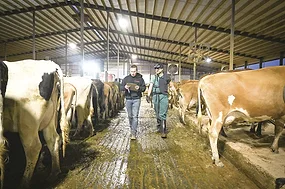
Semiautomated milking technology captured the attention of dairy producers awarding this year’s Nexus Innovation Awards. The new technology from GEA improves upon and brings the fully automated teat preparation common in box-style milking robots to parallel parlors. The company calls it DairyProX and claims it will help farms milk more cows, faster and more consistently with less labor than is currently required.

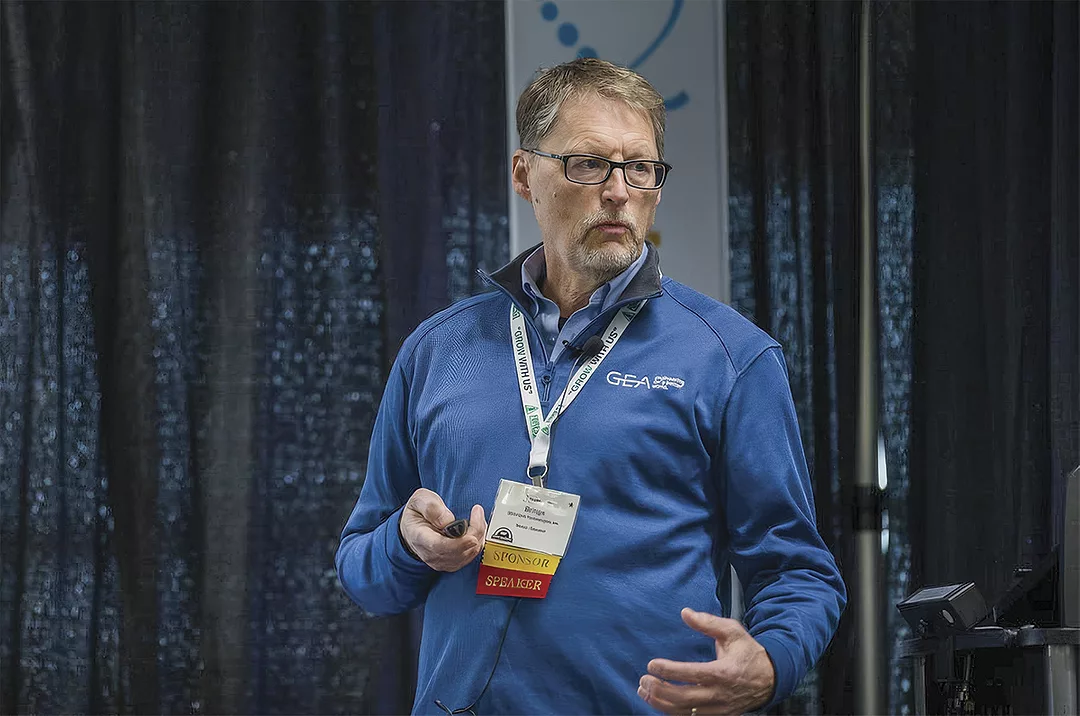
“Almost every customer I work with is milking more cows today than they were five years ago,” says James Bringe, milking equipment sales specialist for GEA Farm Technologies. “Five years from now, they’ll likely be milking even more cows. If they can do that using their existing facility, getting more productivity out of it, that’s a big win.”
The semiautomated milking technology trademarked as “in-liner everything” cleans, pre-dips, stimulates, forestrips and analyzes fore milk for traces of blood or discoloration before milking begins. Then after milking, it automatically applies post-dip before detaching. Then the detacher lowers the unit near the ground where it backflushes to prepare for the next milking. The technology changes a milker’s routine from a multistep process with sequenced timing to just one action – attach the milking unit.
“Training milkers with this system becomes very simple,” Bringe says. “It's a totally different, but simpler, way to manage what goes on in the milking parlor. And attracting talent to work in your parlor will become easy.”
During the Nexus stage presentations at the Professional Dairy Producers Business Conference, Bringe showed a side-by-side video of the same parlor with split milking procedures. One side of the parlor was milking cows utilizing the new technology, and the other was milking conventional prep with humans doing strip, pre-dip and post-dip. The technology-aided side finished well before the other side.
GEA reports parlor turns on some pilot and early adopter farms using the technology have increased from five to seven turns per hour.
“We want employees to attach the unit, go down the line, turn around and do it again. It's hard to screw up the prep process when it's taken completely out of the hands of the operator,” Bringe says. “What we're trying to do is get the consistency and the advantages of robotic milking systems into a conventional parlor to get real productivity gains.”
The technology has been designed to give dairy producers control of the automated steps the unit performs. A dairy owner can decide how much air and water to use to clean dirty teats prior to pre-dip application.
An average unit uses 1 gallon of water per cow to clean teats on a 3X-milking dairy. The unit, on average, applies 20 milliliters of pre-dip to teats per milking and 16 milliliters of post-dip per milking. The sanitization solutions that can be used in-liner also include a range of options – from chlorhexidine to iodine-based products. Only the thickest of winter-formulated teat dips may be too thick to be used in the liner.
“Our intention is to have multiple levels of settings to choose from in this system,” Bringe says. “Let's say you've got a very clean barn, you might be using less pre-dip and water for cleaning. If you are a farm that struggles with bedding management and udder cleanliness, you might use a little more water and product.”
The system has been designed to work with any milking equipment brand. Immediately, the system is available for installation in parallel parlors with automatic detachment and access to subway equipment. Subway equipment access provides a dry, serviceable environment for the new technology’s control systems.
“This type of technology brings the efficiency level of parallel parlors up close to where rotary parlors are,” Bringe says. “That's a huge advantage for people with parallels. They can use their existing infrastructure rather than build a new rotary. People will still build new rotaries, but it repurposes what is already in the market.”
Bringe says it's common to see the return on investment for DairyProX pencil out for most farms between three and five years.
“The bottom line on this technology is it means milking cows faster, using fewer people to get it done, getting more efficiency in the parlor so that ultimately the parlor can turn more times per hour,” Bringe says.
The Nexus Innovation Awards are a collaboration between Progressive Dairy and Professional Dairy Producers (PDP). Winners are announced annually at PDP’s Business Conference. A panel of dairy farmers chooses the award winners. The award is given based on excelling in three criteria: the audacity of the product’s innovation, its ability to ingeniously tackle pressing challenges within the dairy sector and the value it brings to dairy operations.