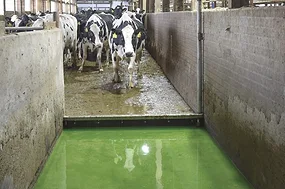
An automated footbath that could already fill, clean out and refill on its own now has a new capability – computer vision. Hoofcount’s footbath counts cow passes through the bath, dumps solution after a designated number of cows have used it, sprays out the bath and refills the bath with solution automatically.

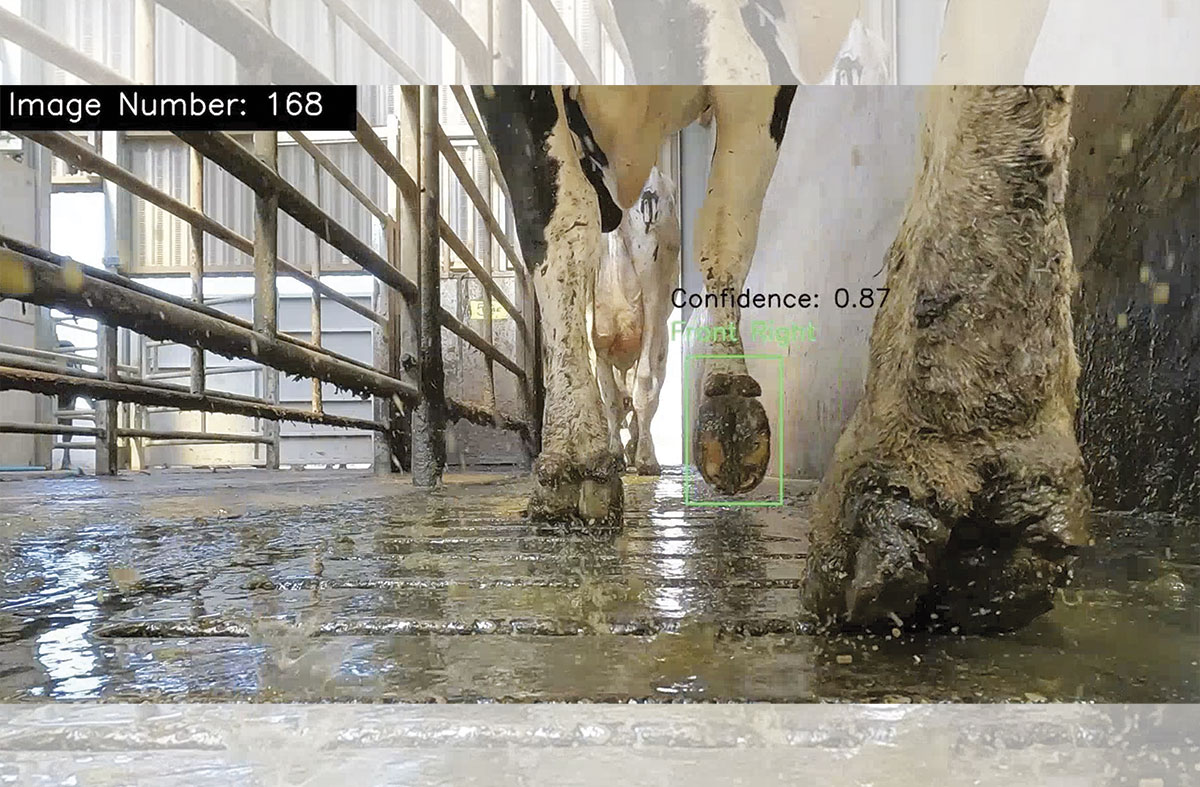
Now the footbath also has a camera called Pedivue mounted on the end of the bath to document the underside of cow hooves as they step through the bath. The new camera enables a next-level ability to detect for early onset of hoof diseases such as digital dermatitis (DD).
“When it comes to hoof health, there hasn’t been a lot of technology out there to detect lameness until now,” says Austin Brozak, owner of Quadra Step Hoof Care in Wisconsin. Brozak is a licensed distributor for Hoofcount’s automated footbath. Since starting his hoof care business 13 years ago, he has taken a full-circle approach to hoof care and emphasizes the importance of prevention, detection and treatment. He offers a suite of hoof care solutions, including concrete grooving, hoof trimming, footbaths and chemical treatments.
With computer vision now available on an already popular footbath, Brozak believes it will help him and his clients better detect and treat faster for DD or heel warts. DD is caused by a bacteria that attacks the soft tissue of a hoof just above the heels. As the bacterial infection progresses, it causes pain and scarring of the tissue.
“I don’t know how many times I’ve walked through a pen of cows and wished I could just tip the cow over and look at the bottom of her feet instead of having to try and judge what’s going on with her,” Brozak says. “With this system’s computer vision, you get pretty much as good of a view of the hoof as having her leg up in the hoof-trimming chute.”
Hoof trimmers rate the severity of DD on a 5-point scale. A hoof that is clean with no lesions or scarring would be graded an M0. A new infection that is just starting would be categorized an M1. M1-, M2- and M3-rated infections will cause a cow pain. An M4 is a dormant chronic lesion with lots of scar tissue.
“I can walk through a pen of cows and pick out the chronic M4s or M5s just by how a cow walks,” Brozak says. “But the M1s which are new infections that have just broke the skin, you can’t see those without lifting up the cow’s foot. Those are the ones where we have the chance to treat them immediately, kill the bacteria before it goes farther into the tissue and creates a chronic condition.”
The computer vision will enable producers to spot new M1 DD infections automatically and begin treating them sooner with extra footbath treatments or sorting off for treatment in the hoof trimming chute. And since the automated footbath already makes filling, cleaning and refilling hands-off, early intervention involves simply the click of a button to add another footbath day to the schedule or tweak the solution of footbath chemicals in use.
Courtesy screen capture.
“This helps producers stay ahead of lameness, reduce intensive treatment costs, improve cow comfort and ultimately protect herd performance,” Brozak says.
The computer vision starts working when a cow enters the footbath. The cow is identified with RFID. Because the cow steps through the bath first and the camera catches her while she exits the bath, the bottom of her hooves are relatively clean, giving the camera a clear picture of the condition of her hooves.
The camera takes dozens of frames per second of video, affording the computer vision multiple images to choose from and find the one with the clearest view of the bottom of each hoof. These images are analyzed using an artificial intelligence (AI) model and scored for DD presence. The status of each hoof and the most recent image of the bottom of the hoof is stored in a Hoofcount’s cloud-based hoof health dashboard. An annual subscription is required for the cloud-based data storage. At present, the Pedivue system is not linked to any other dairy management software; however, all the information collected is on the dashboard and a trim list of cows that need attention can be created.
Also, when Brozak inputs data from trim day, the camera will be synced with that information. He’s excited that the system can detect if wraps or blocks that he’s placed for treatment stay on too long. If that’s the case, the system can send out an alert notifying staff that they are past due for removal.
“When we wrap a cow, within three hours that bandage is wet and we have created a damp, warm, anaerobic environment, which is exactly what dermatitis thrives in,” Brozak explains. “So it’s very important to get those wraps off in a timely manner. Also, if you leave a hoof block on for more than six weeks, it’s going to cause bruising and hemorrhaging, and you run the risk of the cow going lame underneath of that block.”
To date, the system’s AI has been trained to look for just DD, but Brozak says detection of other hoof conditions are also possible in the future. And because the camera sits just 4 inches off the floor and has good view of the underside of every cow, it may be able to be trained to check feet, legs or even the udder for other deviations from normal.
“Lameness detection has always been a challenge in dairy herds, but we now have proactive, data-driven solutions to identify issues before they impact productivity by integrating real-time imaging, AI-driven analysis and automated alerts,” Brozak says.