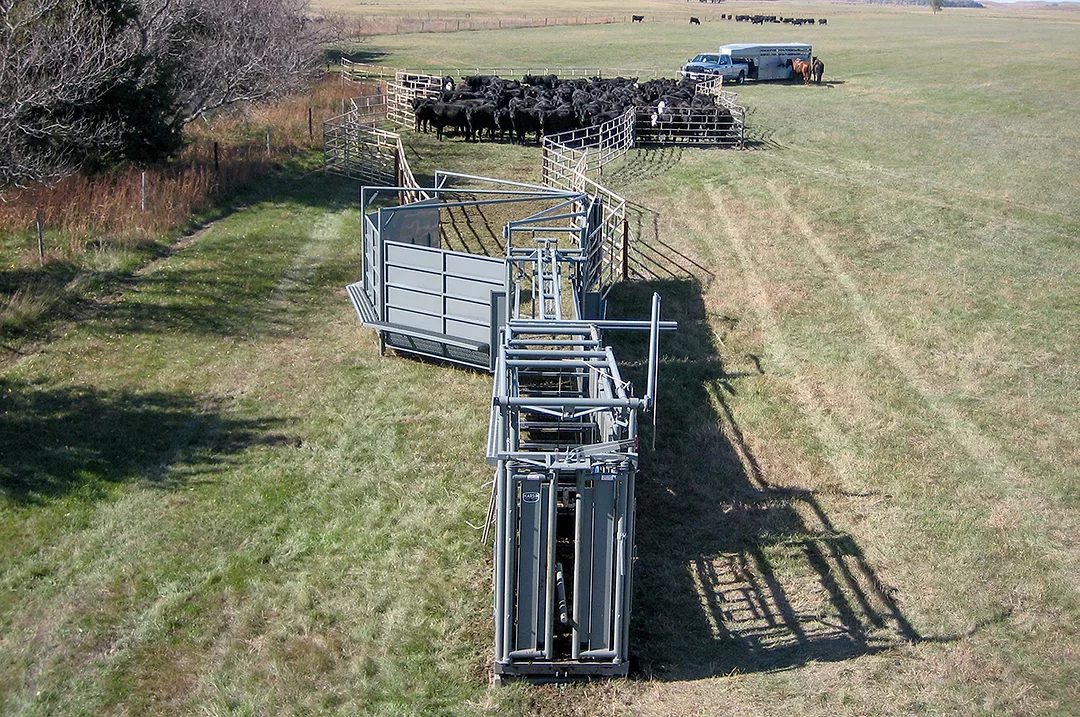
It could easily be said that handling facilities are at the core of beef production operations. When they’re of inferior design and quality, efficiency and profitability become nonexistent. Squeeze chutes, alleys, tubs or Bud boxes may be decades old or brand-new, but all remain the greatest defense against chaos and bring their level of safety and order to the handling process.

Tips and recommendations
“When we consider specific designs, qualities and features of these critical pieces of equipment, most of it boils down to what the operation is predominantly doing,” says Kip Lukasiewicz, consulting veterinarian and cattle handling expert. “Are they processing, preg checking, backgrounding, running mature bulls and cows, or simply dealing with a minimal herd?”
For those building new facilities from scratch or completing major upgrades, Lukasiewicz recommends any squeeze chute be recessed in concrete, creating a zero-floor entry and exit to limit jumping and injury risks.
He proposes straight, non-tapered adjustable alleys to prevent animal confusion. Grooved concrete floors should be avoided; rather, rubber matting provides sufficient traction. Drains for easy cleaning and maintaining biosecurity are also vital.
“Avoid the old-style raised catwalks along alleys and tubs, as they are a major fall risk,” he stresses. “Handlers should be at the animal’s eye level, so keep alley sides open for better visibility and less jumping.”
Lukasiewicz favors using Bud boxes or Bud tubs in conjunction with a well-designed gathering pen over the old-style sweep gate tubs.
“The goal is we don’t want to, and shouldn’t have to, sweep any cattle,” he explains. “We can exploit natural flow with much less stress. Consider how the alleys match up. Where do they come in? Can we take advantage of the ‘return where I came from’ approach? We can get cattle to go wherever; the decision is whether we drive them or let them flow naturally.”
If producers need facility location advice, Lukasiewicz begins with an initial call to understand the requirements. Using Google Earth imagery helps him assess a property’s flow and landscape before making a site visit for hands-on evaluation.
“The goal is to create a layout to encourage natural movement and reduce congestion,” he says. “Biosecurity is also crucial; facilities must be placed to minimize disease risks, like avoiding placing shipping areas in high-traffic spots to prevent potential contamination.”
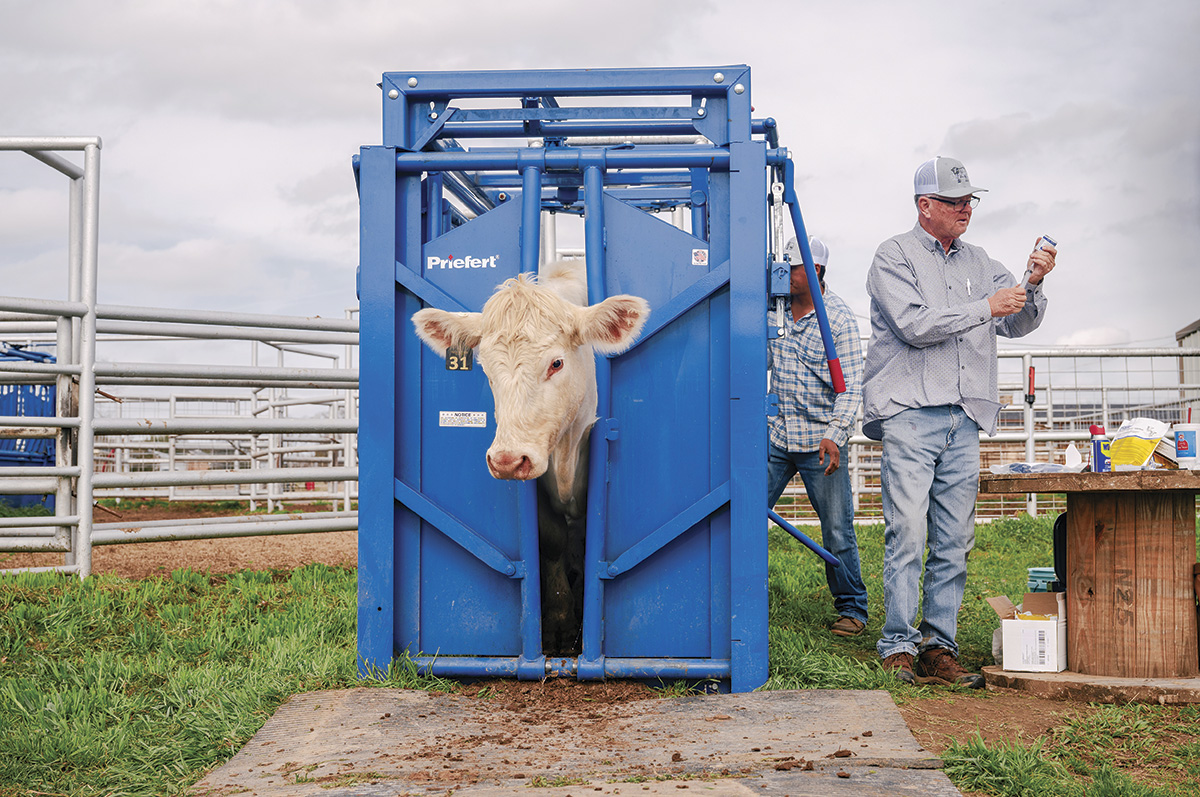
Cody Duncan of Priefert says cattle handling equipment should offer tailored solutions to individual operations. Image courtesy of Priefert Livestock Equipment.
Convenience and practicality
“We as a company are all in on the tried and true, but we’re always looking at ways to improve our squeeze chutes, alleys, tubs, floors, sight lines, tailgates and headgates,” says Pearson Livestock Equipment CEO Brice Sawin. “We’re constantly asking ourselves, ‘How do we make the user experience more convenient?’”
Sawin explains that chutes must be simple, heavy-duty and designed for longevity. Multiple models address safety, reduce stress for both workers and animals, and afford ease of use.
“We understand one chute doesn’t suit every operation, so we build simple and basic for farms with only a few cattle and add all the bells and whistles for the larger outfits,” Sawin says.
Features like quiet, rubberized slam latches and various flooring options help keep the environment calm for both handlers and animals. As portable systems gained popularity, Pearson introduced a 12-volt battery add-on for all their chutes, lowering the physical demands of the squeeze function during long working days.
Sawin believes the industry has also improved alleys and tubs for safety and flow by lowering catwalks, while rail-sided alleys reduce shadows and encourage cattle to move forward naturally. A flex option still offers alley curves, and alleys and tubs are adjustable to accommodate a range of sizes and weights.
“Tub angles are changeable, making them an extension of the alley, to upgrade flow and reduce bottlenecks,” Sawin says. “Sweep gated tubs remain standard as they’re extremely safe, especially for inexperienced handlers.”
Safety and versatility
“More than ever, producers are asking for handler and animal safety in squeeze chutes, alleys and tubs,” says Cody Duncan, key account manager with Priefert Livestock Equipment. “This is especially true because of the astronomical value of cattle today. One cow getting hurt in subpar equipment pretty much pays for a new squeeze chute, so it makes sense to have something well designed.”
Ease of use and versatility top Priefert’s customers’ wish lists.
“They want to make a single purchase of a versatile system that performs as advertised,” Duncan says.
The company’s original manual chutes have remained valuable and popular, but they’re continually seeking improvement. “I’m not saying don’t fix it if it’s not broke, but upgrades can be made,” Duncan says. “Our new chute is stronger, longer and taller, because of producer requests and beef size demands.”
The alley line has also received enhancements.
“We treat our equipment like a Lego set, where operators can build and create anything they want with our guidance,” Duncan says.
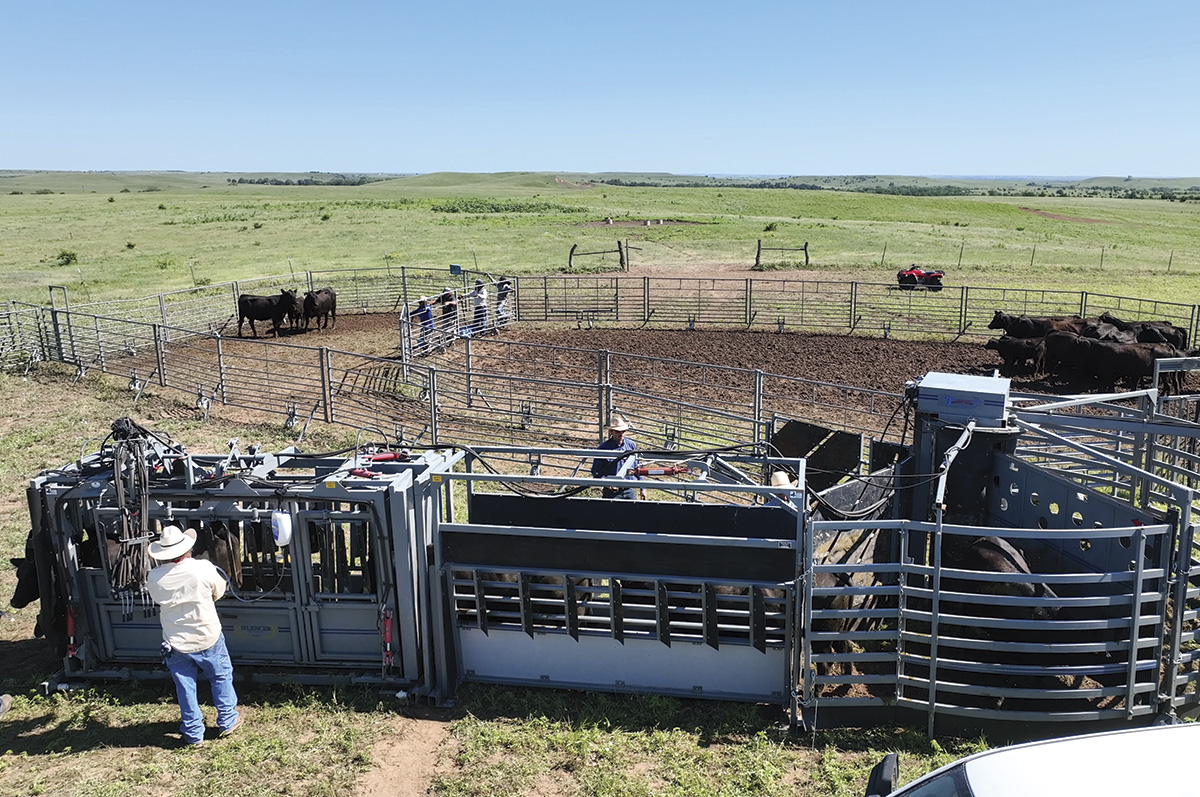
When discussing installation of new equipment, producers should try to ensure facilities will match up well with both the particular people and cattle on their operation. Image courtesy of Moly Manufacturing.
Duncan explains that today’s providers must be highly consultative. “Ask more questions to extract exactly what operations need,” he says. “They might not know this answer, so they call us. Listen more than talk to understand the details, which will dictate versatility requirements.”
To keep pace with technology, staff trained in computer-aided design (CAD) technology use Google Maps to create custom layouts, ensuring all-around safety.
“Ultimately, any handling equipment should present tailored solutions, whether for single-purpose operations or complex facilities, always prioritizing safety and efficiency,” says Duncan.
Such versatility is key for any equipment manufacturer or consultant to develop a fruitful relationship with cattle producers.
“Our customers are looking for quality, consistency, and ease of operation,” says Lacey Mollhagen, vice president of Moly Manufacturing. “They need products that are not only going to work for their operation, but equipment that is also going to fit their cattle.”
That commitment to versatility and customization from equipment manufacturers of necessity breeds innovation.
“We’re always innovating and coming up with new options and new products for our customers,” says Mollhagen. “We’re following not just what the producer is asking for, but also what the industry is calling for.”
Zero in on the supporting features
Lukasiewicz shares insights on secondary equipment, recommending recessed weigh scales be placed before or beneath the squeeze, as gravity-hanging chutes with today’s heavier cattle add tension and harm concrete. For lighting, he suggests white walls and ceilings, fluorescent or LED bulbs, and tall ceilings with at least 16-foot doorways to minimize shadows.
“Cattle aren’t typically scared of their shadows, but they’re leery of different lighting patterns, so they’ll flow in much nicer with uniform lighting,” he says.
Additionally, Lukasiewicz stresses the importance of continual training to maximize efficiency and solidify animal and handler safety.
“We ask the right questions to understand the needs of each individual producer’s operation,” says Mollhagen. “Our products are built to order to match the exact needs of our customers – because there is no one-size-fits-all model. … We are not a cookie cutter.”
“When building new or updated older handling facilities, I believe in dreaming big from the start without limitations,” Lukasiewicz says. “We can always cut from there, but a handling area is a lifetime creation. We want to do our best to get it right the first time.”