Building a safety culture is not about creating complex systems or adding unnecessary work; it is about taking consistent, practical steps that fit into everyday farm operations. It starts with strong management and leadership. When farm owners and managers prioritize safety, it sends a clear message that workers' well-being matters. Beyond preventing injuries, a positive safety culture can also improve worker satisfaction, increase productivity, strengthen relationships and boost employee retention, making it easier to attract and keep skilled workers.

Dairy farming presents unique safety challenges due to the combination of long working hours, unpredictable animal behavior, heavy machinery and changing weather conditions.
Creating a culture of safety is vital in addressing these challenges and must be the foundation of any farm safety program. A true safety culture shapes how people think, act and make decisions every day. It encourages proactive hazard identification and management, reduces injuries and near misses, and ensures that everyone returns home safely at the end of the day.
By following the six steps outlined in this road map, farm leaders can gradually build a strong and effective safety culture.
Step 1: Create your safety policy
A safety policy is the foundation of your farm’s safety program. It defines your operation’s values, expectations and acceptable behaviors, as well as the consequences for not following safety practices. This policy should not be a document that sits on a shelf. Instead, it should be a living agreement that is reviewed regularly and signed by both owners and employees. It should clearly communicate that safety is a shared responsibility.
Key actions:
- Develop a written safety policy tailored to your farm.
- Involve employees in the creation of the policy.
- Review and update the policy regularly.
Step 2: Build trust and encourage participation
A strong safety culture is based on trust. Workers need to feel comfortable speaking about hazards, suggesting improvements and reporting close calls without fear of blame or punishment. This concept is often referred to as psychological safety. When employees feel heard and respected, they are more likely to engage in safe practices and contribute to problem-solving.
How to build trust:
- Involve workers in developing and reviewing safety policies.
- Encourage open communication and feedback.
- Treat reported incidents and near misses as learning opportunities, not reasons for punishment.
Step 3: Analyze risks with job safety analysis
Job safety analysis (JSA) is a practical tool used to identify and reduce risks in everyday tasks. It involves breaking down a job into individual steps, identifying potential hazards at each step and determining how to control those hazards.
When workers participate in creating JSAs, they take greater ownership of safety practices and are more likely to follow them. This process not only improves safety but also engages employees in meaningful discussions about their work.
Steps in the JSA process:
- Select high-risk jobs: Choose tasks with known accident histories, whether on your farm or other dairy farms.
- Break the job into six to 10 specific steps.
- Identify hazards for each step.
- Develop solutions for each step: Identify specific actions to eliminate or control the hazards.
Step 4: Approach hazards using the hierarchy of controls
When hazards are identified, engage your team and use the hierarchy of controls to determine how to address them and to prioritize the most effective ways to develop solutions and stop injuries before they happen. Think of the hierarchy like a ladder (Figure 1). The higher you are on the ladder, the better the protection.
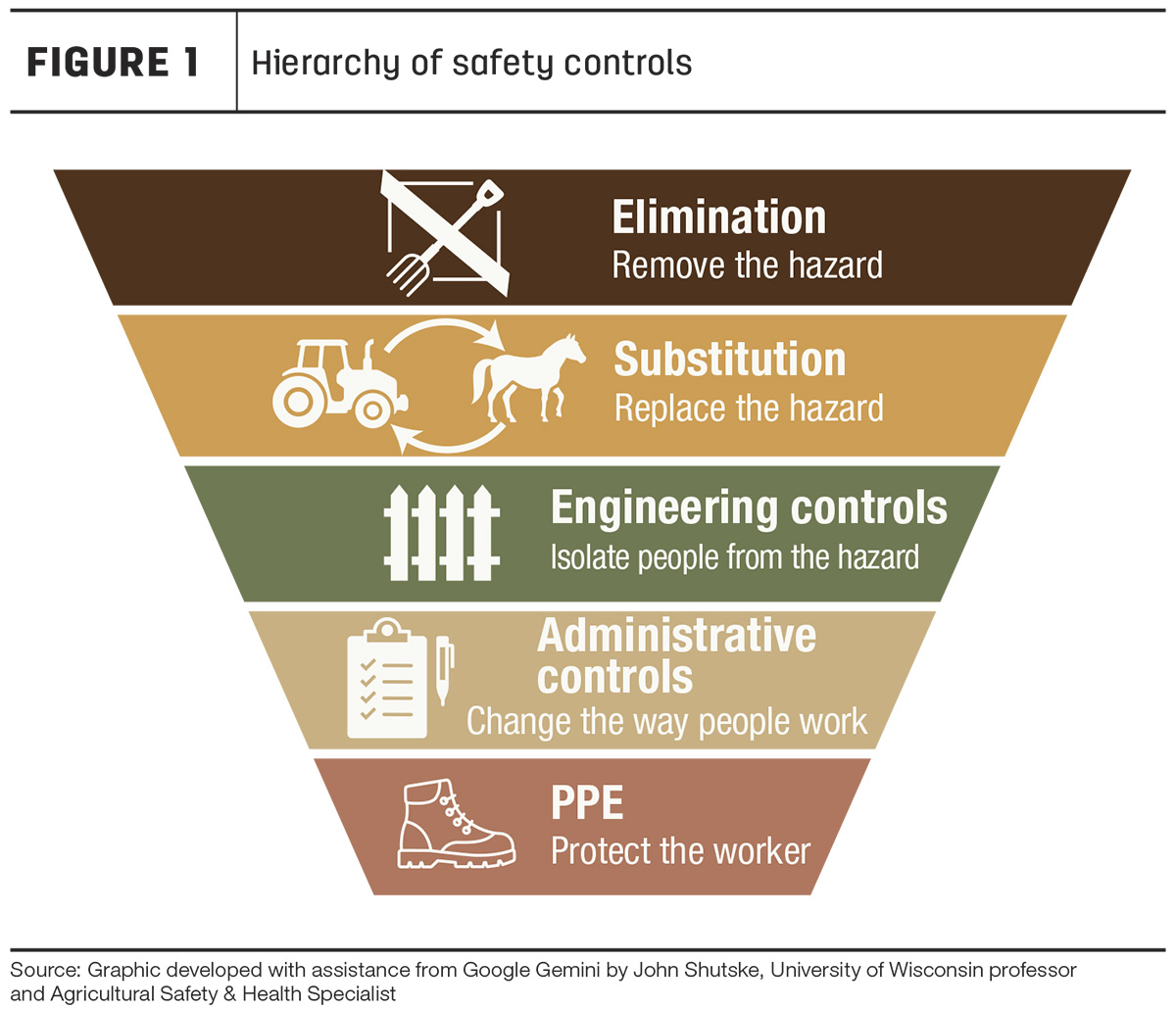
On the top of the ladder are the most effective solutions, the gold standard. They remove the danger or keep it away from you automatically. To stay safe, you don’t have to remember to do something every single time. Even if you are tired or distracted, the protection you’ve created is still there working for you.
High-level controls actions:
- Elimination: Remove aggressive animals from the herd to prevent future injuries to handlers or other cattle.
- Substitution: Replace an old, malfunctioning tractor with a new one.
- Engineering controls: Use headlocks, chutes and gates that restrain animals safely and reduce the need for close human contact.
On the bottom of the ladder, low-level controls are less effective but still vitally important. We should think of them as a last line of defense. They only work if a person does everything perfectly. If you forget your safety glasses or if a co-worker doesn't read a warning sign, nothing will stop an injury. These methods don't fix the hazard; they just try to reduce the damage if something goes wrong.
Low-level controls actions:
- Administrative controls: Limit the number of people in pens to reduce confusion and stress for the animals.
- Personal protective equipment (PPE): Wear gloves, masks, proper footwear and safety glasses.
Whenever possible, try to fix the problem at the top of the list (like fixing a broken machine) rather than relying on the lower controls (like wearing a hard hat while working under a broken machine). However, in some cases, lower-level controls such as using PPE in the milking parlor offer the best protection. For example, wearing safety glasses can help prevent eye injuries caused by teat disinfectant spills.
Step 5: Communicate regularly
Promoting consistent communication is essential for maintaining a strong safety culture. Implement these three methods, or a combination of them, when certain approaches are not practical in your operation.
- Weekly tailgate safety talks. Keep them short and informal (10-15 minutes). Focus on seasonal risks or recent close calls. When weekly in-person meetings are not feasible, use alternative communication methods, such as weekly safety emails or key safety notes in the break room.
- Provide effective safety training. The most successful training sessions involve two-way communication. Encouraging employees to share their knowledge and experiences fosters respect, improves compliance and reduces risk. Encourage group discussion and foster the commitment of your team by asking them to sign a safety pledge after the training sessions.
- Include safety as a required topic in your monthly or quarterly employee meetings. Use this time to recognize and reward team members who follow safety procedures correctly.
Step 6: Monitor progress and track incidents
Track, document and share key safety indicators to maintain a safe and accountable work environment. Consistent tracking fosters a culture of transparency and continuous improvement. Share the results of the following key performance safety indicators monthly:
- Close calls: events that could have caused harm but did not
- Workplace incidents: work-related events causing injury, damage or disruption
- Workers’ compensation claims: requests for benefits for employees’ work-related injuries or illnesses
The benefits of a strong safety culture
Creating a culture of safety is an ongoing process, not a one-time effort. It requires leadership, communication and commitment from everyone involved in the operation. By focusing on prevention, encouraging participation and continuously improving safety practices, farms can significantly reduce risks and create a healthier, more productive workplace.
This investment delivers real, measurable benefits for your farm operation:
- Achieve safety excellence in your operation, where fewer injuries and equipment repairs translate into meaningful savings across your expense lines.
- Increase productivity and employee engagement.
- Attract skilled workers who value a safe farm environment.
The University of Wisconsin website has ready-to-use resources to help prioritize farm safety, including videos, policy templates, job safety analysis tools and key performance indicator tracking logs.