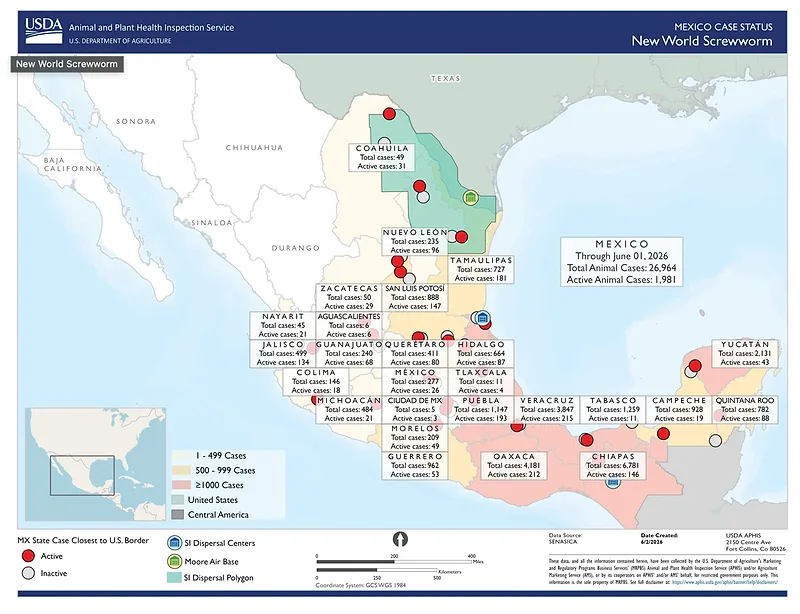
USDA’s Animal and Plant Health Inspection Service (APHIS) officials confirmed Wednesday night the arrival of New World screwworm in a 3-week-old calf in Zavala County of southern Texas, making it the first confirmed case to arrive across the Mexico border.

Cooper david
Managing Editor / Progressive Cattle

New World screwworm (NWS) can be a fatal pest that affects livestock, pets, wildlife and in some cases, humans and birds. Infection comes when larvae find an open wound and go into the flesh of the animal.

The USDA confirmed in a statement the affected calf had larvae in its umbilical area, which is the anatomical spot where cattle industry experts fear cow-calf herds in the U.S. are most vulnerable to NWS exposure.

“All models showed New World screwworm entering the country in 2025; however, thanks to the hard work across the entire Trump administration and our industry, state and local partners, we were able to buy time for this moment,” said Dudley Hoskins, undersecretary for marketing and regulatory programs at USDA-APHIS. “Protecting our livestock industry is a national security issue of the utmost importance, and USDA is wasting no time in taking action. USDA invested heavily in the tools needed to eliminate NWS ever since cases started increasing in Central America and Mexico. The United States has defeated this pest before, and we will do it again.”

The USDA said it is working with Texas officials to “contain and eradicate” the screwworm based on strategies outlined in previous statements. The U.S. is delivering 4 million sterile flies per week using various facilities and releasing them aerially in the region.

Advertisement

Other steps include: an incident command team with Texas Animal Health Commission to deploy response personnel in the area; an established 20-kilometer infested zone around the detection and implementing quarantines, movement controls and surveillance; increased traps for NWS flies along the border and dispersal area; new surveillance and management strategies for wildlife; and conducting targeted outreach in the local area.

The USDA added that the National Veterinary Stockpile will be used to assist in providing treatments, equipment and logistics for vet support.

Producers in regions seeing the proximity of NWS are asked to contact a veterinarian immediately if they see suspicious wounds, maggots or infestations in your animals or herd, or to contact government agents at USDA.

“USDA will continue to work with state departments of agriculture, animal health officials, industry and producers to mitigate economic impacts of restrictions as much as possible, including negotiating with our trading partners to regionalize any trade restrictions on live animals, limiting them to defined geographic areas.

“The U.S. food supply is safe. Screwworms do not infest meat, fruits, vegetables or other food sources. USDA’s Food Safety and Inspection Service (FSIS) ensures that the nation’s commercial supply of meat, poultry and egg products is safe and properly labeled. Under the Federal Meat Inspection Act (FMIA), FSIS inspection personnel must inspect all eligible animal species unless they are exempt or covered by a state inspection program.”

Colin Woodall, the CEO of National Cattlemen’s Beef Association (NCBA), issued a statement assuring that the organization and state partners are “doing everything possible to protect the interests of American cattle producers.”

“We appreciate USDA and other agencies for working rapidly to bolster critical resources that protect producers, including building a domestic sterile fly facility, increasing fly surveillance and expediting the availability of necessary drugs and treatments for cattle. We defeated this harmful pest before in the 1960s by investing heavily in sterile fly dispersal, and NCBA will continue using every tool in the toolbox to ensure screwworm is eradicated in the U.S. once again.”

The USDA has kept the border closed to live Mexican cattle imports for just over a year to prevent movement of possibly infected cattle. The closed ports in Texas, New Mexico and Arizona have taken a toll on the U.S. cattle and beef supply for the past year as a result of the closure.

On April 27, the U.S. Food and Drug Administration issued an emergency use authorization (EUA) for Negasunt Powder (coumaphos, propoxur and sulfanilamide topical powder) for the prevention and treatment of NWS infestation.

“Based on the scientific evidence available, it is reasonable to believe that Negasunt Powder may be effective for the prevention and treatment of NWS myiasis in cattle, swine, goats, sheep, horses, donkeys, domestic hybrid equids (e.g., mules) and captive wild, exotic and zoo mammals, and that the known and potential benefits of the product outweigh its known and potential risks,” the agency said in a statement.

To learn more and follow updates from USDA, go to the website.