I remember the day our son said he didn’t want to ride horses.

We couldn’t blame him because he is allergic to them, and his allergies weren’t getting any better. Yet it wasn’t just the allergies that made him want to stop. He enjoyed other activities more. The type of ranch work he liked – and still likes – is carpentry.
He got excited to build hay feeders and fix barn doors. He could crank out a mineral feeder with an old tire and a pallet in no time. Need a creative idea for a building? He’d come up with one. He once fixed a roof with minimal supplies.
When we absolutely needed help moving cows, he’d join us. He’d prefer to ride his motorbike over a horse – and it was better for his allergies. A win-win!
Except …
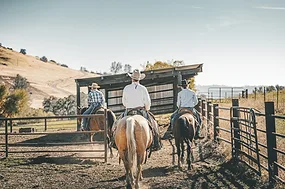
There was an image. And it pervades many minds. “Real cowboys” do work horseback. Ranchers do things a certain way.
When you’re new to an area and you desire to befriend local ranchers, you want them to respect you as you respect them. What we did was best for our family, and we wouldn’t change that, but it didn’t fit the mold, and we wondered what it looked like from the outside. Some of the things we tried were unconventional.
Still, we kept doing what worked for us, and it worked quite well. It didn’t make sense to force our son to fit a cowboy image when he had severe allergies and was obviously gifted in other areas. In fact, several of our family members don’t fit a true mold of what people expect a cowboy to look like, but who’s to say what a rancher should do or not do, look like or not look like? Obviously, there are things a cowboy needs to know how to do, but there are multiple ways to accomplish that.
As we gathered information about our kids and which child liked to do what chores, we realized it was easier for us, and for our kids, to operate in the gifts and talents God gave them, rather than trying to get them to all fit a certain mold. I understand that many families have kids that do like the same things, and they all like to ride, rope, etc. Wonderful! That just wasn’t what our family looked like, and trying to make that happen only frustrated our kids.
Our middle daughter liked to ride and rode well, barely needing a word of instruction. But cows? Not her favorite. She did have a steer for 4-H a few times, but then she focused her attention on sports and photography. She took some great photos as she was growing up, some from the top of the truck cab. She’d climb up, take some snapshots and slide down.
Our oldest daughter liked it all. She loved every animal and knew so much about each species. If she didn’t know something, she was quick to look it up. She has one more year of veterinary school left before she’s a doctor of veterinary medicine (DVM).
Of course, each of the kids had to learn to do jobs and chores they didn’t like. Life is full of things we do because they need to get done. They moved irrigation lines, dug up weeds (and learned to identify noxious weeds), mucked stalls and more. However, if we could balance the necessary chores with things that filled up their proverbial cups, it made for a better day. They might still be working, but doing work within their scopes of interest brought joy to them and to us. It was fun to see them get excited about an action photo they took, or convince us that the cat was pregnant (she was) or build a trough that worked better for graining the steers.
Looking back, how did we find out that our kids loved these things? Mostly observation: What did they talk about the most? What made them smile? What did they ask if they could help with? What did they complain about? These were clues into how each of them was wired. And they were all so different!
Also, mistakes are great teachers. The things that frustrated us or our kids beyond reason could be indicators that there is a different way to do something or that there might be a person who wants to do that job that could do it without frustration.
The goal is to look for gifts and talents and foster them. Even extended family members and employees appreciate this so that everyone feels successful in their daily work. Yes, we do need to do things outside of our comfort zone. But we also need to feel successful in areas that we enjoy and have an interest in; this helps us want to leave our comfort zone. Our kids are no different. They need our encouragement and to feel seen. If a kid would rather build than ride a horse, well, there’s plenty of building to do on a ranch!