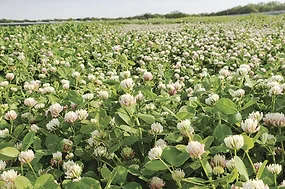
August is a month that rewards practical thinking. By late summer, forage stands across Illinois are telling the story of the season – days of heat, drought, uneven growth and pest pressure that arrived early in some regions and late in others.
Producers are making decisions that directly influence forage quality heading into fall, and they’re looking for information that helps them respond quickly and confidently. That’s exactly the role the Illinois Forage Institute, hosted by the Illinois Forage and Grassland Council (IFGC), continues to fill.
As IFGC Secretary-Treasurer Keely Wilcoxen explains, “The institute provides growers with peer-to-peer strategies for improving forage systems, coupled with research-based information from our university and extension experts and emerging products from the ag industry. We bring them together in one place to help growers find solutions to better operations that improve profitability and build soil health.”
That blend of producer experience and research-grounded guidance is what makes the institute valuable – especially in a year when forage inventories are tight and weather patterns remain unpredictable.
The institute returned in 2026 after several years of the Forage Expo format. According to Wilcoxen, “The institute returned in 2026 following several years of the Forage Expo, which focused more intentionally on practical hay growing, cutting and storage demonstration. Last year, the Forage Expo was held in northwest Illinois.”
The shift back to the institute brought renewed emphasis on education, discussion and producer-to-producer learning – the kind of environment where growers can compare notes, challenge assumptions and walk away with ideas they can use immediately. Held on June 26, this year’s event reflected that purpose.
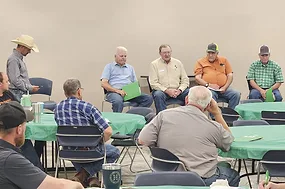
Attending the Illinois Forage Institute feels less like going to a conference and more like stepping into the Illinois forage livestock sector. The day brings together farmers, landowners, educators and industry partners – a cross section of people who care about forage systems and the livestock they support.
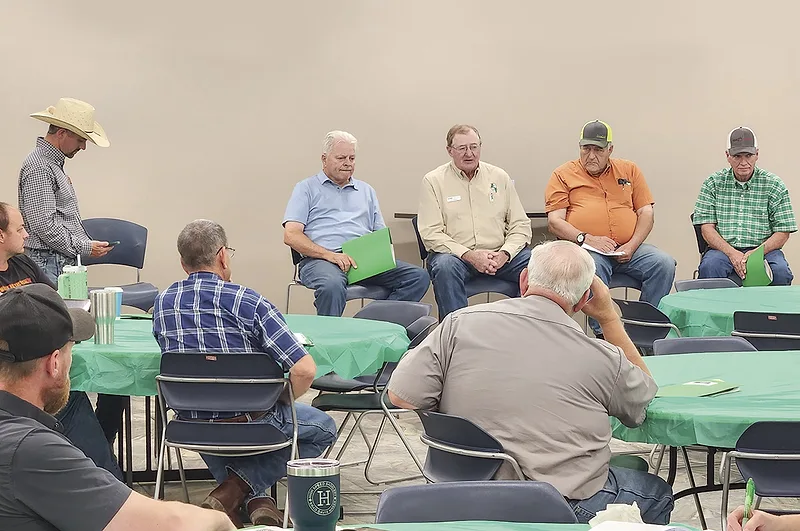
This year’s institute featured informational sessions led by 13 presenters, covering a spectrum of forage and grazing management. The day started with a panel of four hay producers whose combined business experience exceeds 200 years, setting a tone of practical, lived expertise.
From there, the schedule moved through topics producers are actively dealing with:
- Can you make money grazing? The Toland Experiment
- Soil testing micronutrients
- Hay sampling
- Maximizing forage production through species selection and management (see page X)
- How to achieve the perfect graze
- Multispecies grazing
- Black vulture nuisance permits
- Virtual grazing
- How I graze in corn and soybean country
- Using hay to improve pastures
- How to start a regenerative grazing system
Each session reinforces the same principle: Better forage leads to better livestock, better land and increased profitability.
What sets the institute apart is the quality of conversation. With a focused group of farmers, graziers, educators and industry partners, discussions are direct and grounded in experience. Producers compare notes, share what’s working and talk about what isn’t – the kind of exchange that doesn’t happen in online meetings or quick farm visits.
For those of us working in forage communications, attending the institute offers a clear window into what producers are thinking about right now:
- Stretching forage supplies
- Improving grazing profitability
- Integrating livestock into row crop rotations
- Managing forage quality under volatile weather
- Navigating wildlife pressures
These insights shape the information producers need most as they move through late summer.
Illinois agriculture is diverse, and the institute reflects that diversity while reinforcing a simple truth: Forage is foundational. When producers gather to learn from one another, the entire forage livestock sector grows stronger.