Camel milk, a popular nutritional staple in the Middle East, offers consumers a variety of health benefits, including people with conditions such as diabetes and those with certain allergies. Camel milk is available at many markets across the country but is much more easily found online in both liquid and powdered versions.
The high prices of camel milk may make operating a camel dairy seem like a great way to make money. However, the business has challenges beyond those experienced by cattle dairy owners.
Humpback Dairy
Sam Hostetler of Humpback Dairy in Miller, Missouri, established one of the two largest camel dairies in the U.S. in a roundabout way.
“Twelve years ago, I was contacted by a doctor to see if I would consider milking camels,” he says. “I said, ‘Milking a camel? I didn't know they milked camels in this country.’ Then she said, ‘They don't, but I need milk for a patient. I worked with a doctor in the Middle East for a while and I need milk.’ To which I replied, ‘Well, I've been known to do some crazy things. One more won't hurt me.’”
Hostetler, who has bought and sold animals for 40 years, including camels, decided he would buy a couple of camels for milking.
“The first year, we milked one camel,” he says. “We set up an old milk pump and bucket and we just milked the camel. We bottled by hand, and we shipped the milk. Ignorance was bliss. But it didn't last too long. After a while, demand started increasing, and I started selling all I had as fast as it would come. Then we increased our production, and we milked a few more camels.”
After being informed that he would have to comply with regulations about camel milk, Hostetler made the necessary changes to his business.
“I found that I can't ship it over state lines raw, but I can sell it face-to-face in Missouri to anybody,” he says. “We sell it around Missouri or people can drive here. We’ve got people who will drive hundreds of miles to come get raw milk and that's legal, but I do not ship any raw milk across state lines or sell to stores for resale raw.”
Humpback Dairy does, however, ship its pasteurized camel milk across the country. About 90% of the milk is sold frozen, enabling it to be easily transported.
Humpback Dairy camels are fed a mixture with oats, sunflower seeds and grain.
“We feed them a 16 percent ration while they are in the barn, and then we feed alfalfa hay,” Hostetler says. “We keep brome and alfalfa hay on the hay floor, and we feed them accordingly.”
Hostetler recalls the early days of Humpback Dairy.
“When we started, we'd buy one box of maybe 250 pint bottles,” he says. “We'd buy ice packs at Walmart, dry ice at the grocery store and the cheapest shipping boxes we could find at Walmart. Now, we buy the shipping boxes and cardboard by the semi load, and we buy bottles by the semi load on pallets. Our accommodation turned from a Mickey Mouse deal into kind of a full-fledged business.”
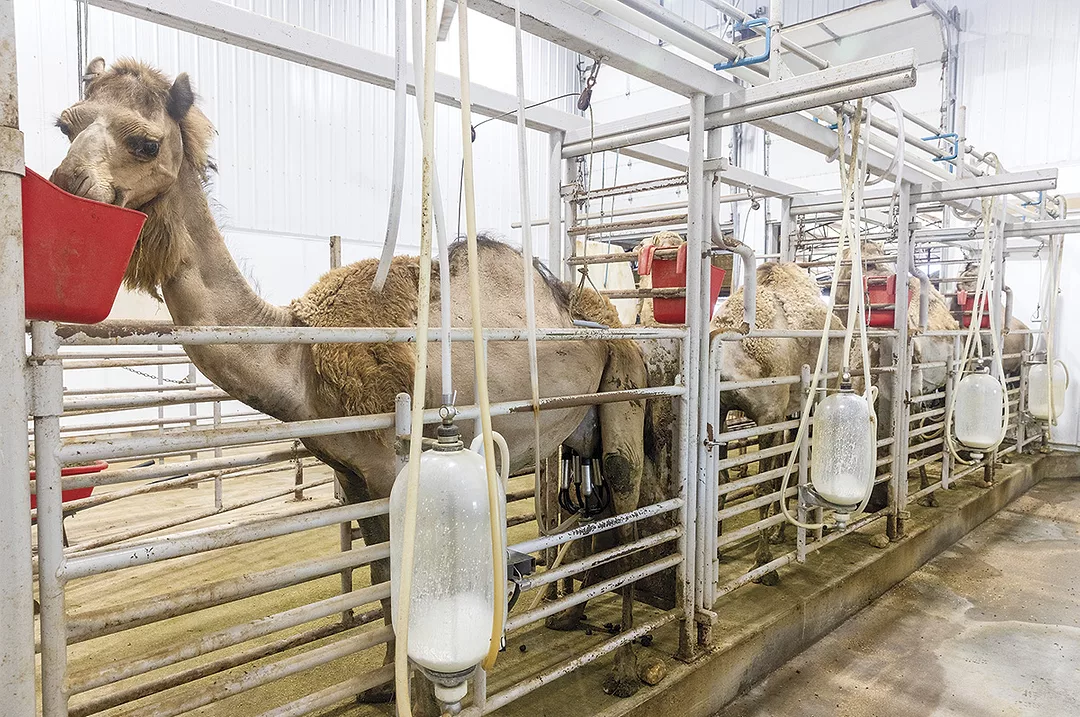
Humpback Dairy has a new modern-day facility, the first in the U.S. where camel milk goes into a pipeline, straight to the tank and the bottling plant, according to Hostetler.
The company, which is now owned by Hostetler and his son, has about 200 camels, which are referred to using cattle terms.
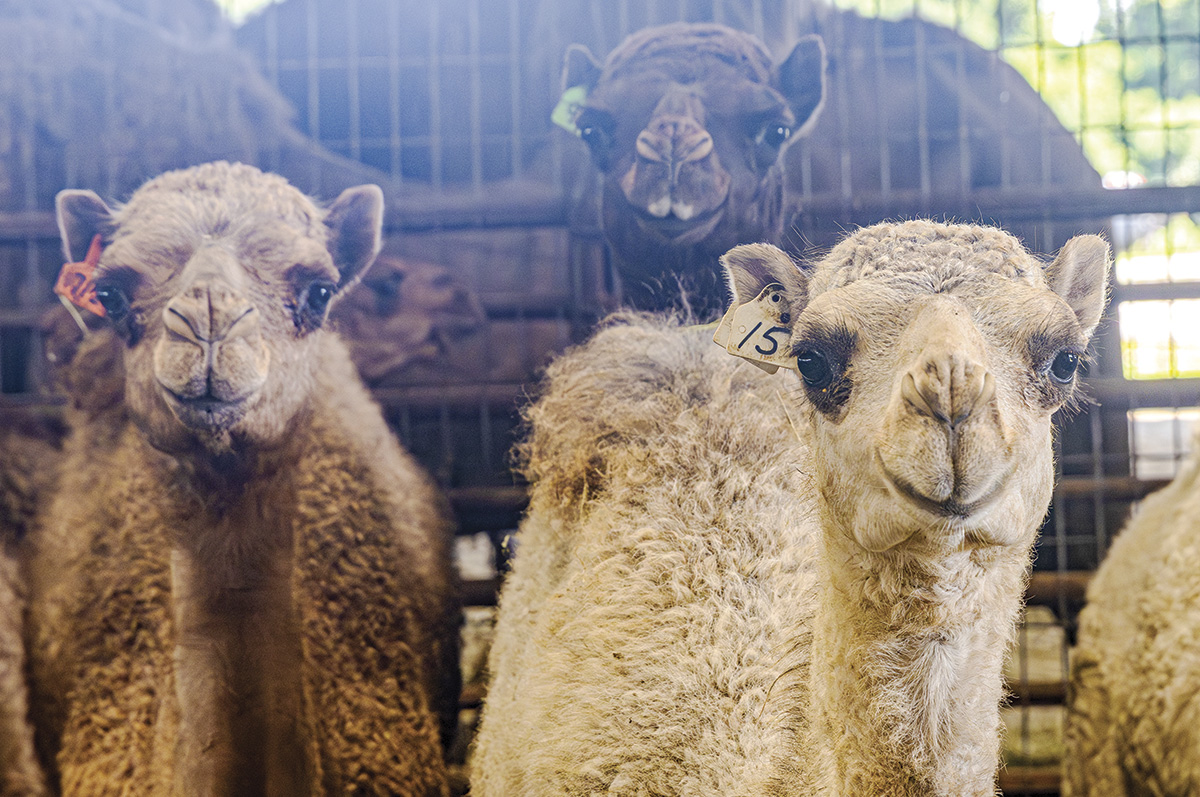
Young camels at Humpback Dairy. Image by Julie Brown.
“We have probably 100 breeding-age cows, the rest are heifers and bulls,” Hostetler says. “We also have several ride camels because I have a contract with a company with Dolly Parton’s Stampede where I ride camels in the nativity scenes 10 weeks a year.
“Camels are high-dollar,” he says. “They cost a lot and calves bring a lot, so for anyone to jump into the camel dairy business, it’s a major investment.”
He says that a prime-age camel will probably sell for between $18,000 and $20,000. A bred cow will go for $10,000 to $12,000, and $8,000 to $10,000 if the animal is not pregnant.
Hostetler doesn’t expect to expand his dairy anytime soon.
“If we need more milk, I would rather our bottling plant license would let us buy Grade A [camel] milk from another dairy,” he says. “We'd probably promote that before we'd expand again because we’ve got the bottling plant, and we do continuous slow pasteurizing.”
Camelot Camel Dairy
Kyle Hendrix, owner of Camelot Camel Dairy in Wray, Colorado, started his camel dairy business in 2012. The dairy now has about 50 camels, with a quarter of them producing milk.
Camelot is the other largest camel dairy in the nation, according to Hendrix.
“We ran a dairy up on the front range, and milk prices and feed prices weren’t good at the time. We ended up getting out, but we still had some pretty good elite Brown Swiss that we showed in Stillwater, Oklahoma. We met a man there who had been raising some camels and so we went out and visited with him. At that time, there was nobody producing camel milk in the United States,” he says, adding that he became a camel milk producer after hearing about a woman who went to Israel to bring the first shipment of camel milk back to the U.S. for her son.
Hendrix offers advice to anyone interested in running a camel dairy.
“You have to maintain a cow-calf relationship at all times,” he says. “If a baby dies at birth or if you wean the baby, you’re done. They dry up. That calf has to come in and help stimulate the mother.
“He’ll go from teat to teat, she’ll drop her milk, and we only have 90 seconds to harvest that milk,” he continues. “And then she’ll go back and feed the baby the rest. We’re milking once a day right now, but we’re going to go to twice a day.”
The management aspect of camels can also be a challenge, according to Hendrix, noting the cow-calf relationship and the way they breed, not calving until age 5 or 6. And there are major mistakes that could cause problems for a camel dairy.
“We bought a lot of camels, and probably a fourth or a half of them weren’t going to work for the dairy,” he says. “They’d raise a calf or wouldn’t raise a calf and wouldn’t milk in the barn or had attitude. We culled pretty hard actually.
“Then on top of it, you go to these sales and everybody wants to sell you a 7- or 8-year-old cow; well, she’s 15 and 20 years old and never had a calf in her life, or won’t raise a calf,” he says. “Stuff like that happens.”
Hendrix says there are only 3,000 to 3,500 camels in the U.S.
Camelot Camel Dairy feeds its camels brome, orchardgrass, alfalfa and millet hay.
“The camels aren’t designed for high-protein diets, but we push a little bit just to keep that milk production up,” Hendrix says.
The dairy works with a distributor.
“They'll sell their own labeled milk and then we also sell our own Camelot milk,” Hendrix says. “It’s pasteurized and then we freeze the milk too, and then we ship it all frozen across the nation.”
Hendrix is among those who consider camel milk a superfood.
“Camel milk is easy to digest, it’s hunger-satisfying, it’s a low-fat, low-protein milk, it’s a perfect dairy alternative if you have a food allergy, and you can take the camel milk safely,” he explains. “It lacks that beta casein. There’s natural insulin in the milk for diabetics. It’s been able to reduce their A1C levels. It’s kind of a unique milk and helps a little bit with everything, actually.”
Additionally, Camelot Camel Dairy offers tours.
“We have a lot of schoolkids, 4-H, FFA, extension officers coming out, a lot of elderly, too, and young kids,” Hendrix says. “They like to interact with the camels. They don’t get to ride them; they just get to pet them.”
He adds that his dairy has dromedary camels, which are single-hump camels and don’t have the attitude that bactrians, which are double-humped, do.
River Jordan Camel Dairy
Luke and Amber Blakeslee rented what used to be a farm in Milford, Indiana. The couple decided to get animals and provide a small farming lifestyle for their children.
“We had two really young ones and wanted them to have some animals out here, and we wanted to do more with our time than mow grass,” says Luke Blakeslee, who co-owns River Jordan Camel Dairy with his wife, Amber. “We were both raised with horses and ponies and goats and chickens, but we slowly started thinking a little bit more outside the box and were thinking of versatile animals that we could have fun with and that also might produce a little bit of income. I guess God directed our path to camels. We went on a camel ride at one point and enjoyed that and discovered there was a camel dairy not far from us, so we spent time over there.”
They soon became steady customers of that farm, the Bender Camel Dairy.
“For a couple years, we were buying milk from them because Amber started making our skin care products, soap and lotion,” Blakeslee says. “First, it was to help our own kids with some skin allergies, and the camel milk from that farm actually helped. Then, the owner gave us a call and told us he was moving out of state and wondered if we wanted to buy some of his camels.”
The couple bought four camels, Jenny, Daisy, Ginger and Journey.
“We started out needing to get our name out there, and we did that by doing a lot of craft shows and farmers markets and different Christmas bazaars,” Blakeslee says. “We did that for two or three years, and it got our name out there.”
When the couple launched their website, it quickly attracted visitors and, more importantly, customers.
“They come back for more and they tell their friends,” Blakeslee says. “A lot of people are introduced to milk soaps through goats’ milk or sheep’s milk, and when people see camels’ milk, of course, that intrigues them. There's a novelty there.”

River Jordan Camel Dairy doesn’t sell any of its milk but uses it to make soaps and lotions. Image courtesy of River Jordan Camel Dairy.
River Jordan Camel Dairy doesn’t sell any of its milk but uses it to make soaps and lotions. The dairy makes a profit, but not enough for the Blakeslees to make a living.
“With camels, if you're trying to do anything with milk, you need a large herd because the milk supply is not reliable over a long term for each animal,” Blakeslee says.
River Jordan Camel Dairy also offers tours, mainly geared toward bus groups.
“Tour buses coming into northern Indiana are looking for unique places to visit, so we end up on their list,” Blakeslee says. “Those are big charter groups. We've had people from North Dakota, South Dakota, Alabama and a lot of different states. People come up to visit the Amish country around us.”
He describes River Jordan Camel Dairy’s tours as hands-on.
“They see some of the tools we use,” Blakeslee says. “We don't do the milking while they're there, but we show them where that takes place, and we describe all the processes. We show some videos and then they hang with the camels. There's a lot of fascinating aspects of how camels are created, and we talk about all those different things, and they get to feel the hump of the camel and its foot and its nose. And then they browse our store and they can buy our soap and our lotion.”