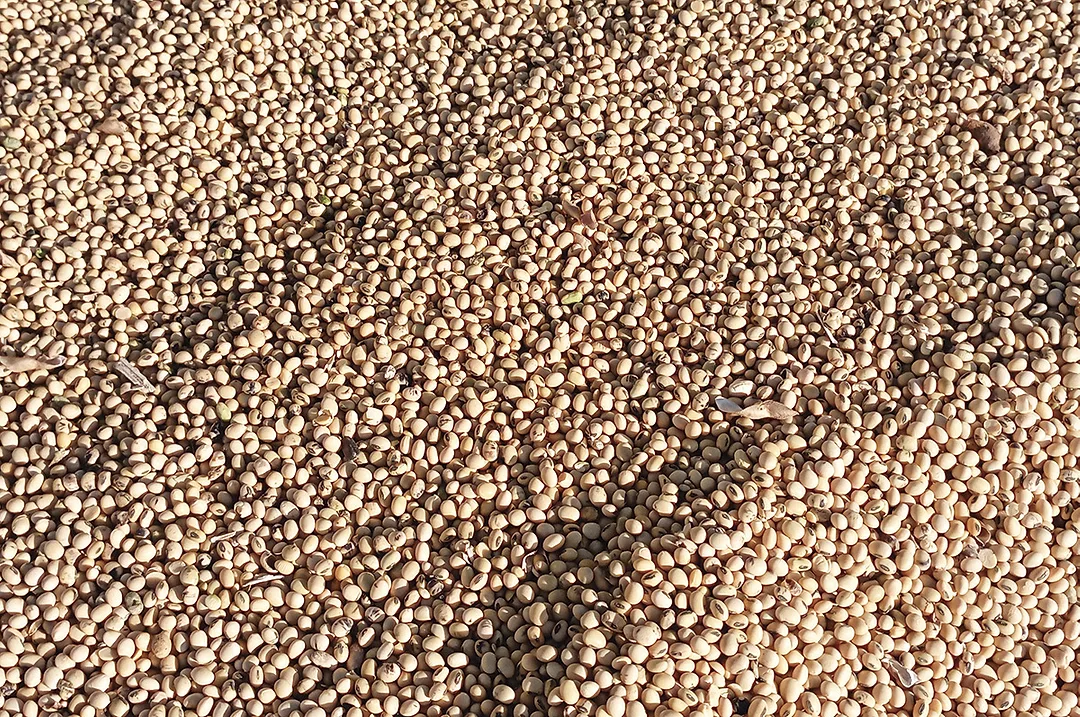
In recent years, dairy producers and nutritionists have shown a renewed interest in utilizing roasted soybeans in dairy diets. This is due to the availability and practical application of using high-oleic soybeans rather than conventional soybeans.

In the past, feeding high levels of roasted conventional soybeans was commonly associated with milkfat depression, but high-oleic soybeans do not carry this same high risk. That’s because high-oleic soybeans contain approximately 70% or greater oleic acid compared to only 2% oleic acid in traditional commodity soybeans. Oleic acid is less likely to contribute to milkfat depression than typical fatty acids found in conventional soybeans. Moreover, increased milk volume and milkfat can be observed in herds feeding roasted high-oleic soybeans. In addition to their desirable fatty acid profile, roasted high-oleic soybeans also are a great source of rumen-undegradable protein (RUP) and can significantly increase the energy density of a lactating ration due to their high fat content.
This makes the feed particularly interesting for those using automated milking systems. Because the feed table allows automated milking system farms to target feed based on stage of lactation, these soybeans can be utilized in both the partial mixed ration (PMR) and as a feed in the robot. Specifically, feeding high-oleic soybeans at varying levels in the robot from fresh cows through peak production can aid in improving energy balance, body condition and persistency through peak lactation.
Roasting first
Roasting of the high-oleic soybeans can be done on-farm or through an outside vendor. Each farm will need to determine how to best accomplish this and, while it’s important to consider, it is outside the scope of this article. However, no matter where the roasting is done, it is important for farms to do periodic evaluations on the quality of the roast.
Under-roasting and over-roasting are both inefficient means of utilizing this feedstuff. Both scenarios will affect the quality and availability of the RUP content. Under-roasted soybeans are also problematic due to urease activity, which can make it risky to feed urea in conjunction with poorly roasted soybeans. A simple lab test – referred to as the Protein Dispersibility Index (PDI) – can be used to monitor the quality of the roast. This report together with urease activity will tell you whether optimal heating of the soybeans occurred. It is wise to test soybeans on a quarterly basis, anytime a new crop of soybeans is fed, when seasonal fluctuations occur and/or when speeding up or slowing down the roasting output is necessary.
Consistency is key
The PDI test is also a great tool to help achieve consistency when feeding high-oleic soybeans in an automated milking system. Cows fed through the robot can detect changes in roasting quality due to the palatability (including taste and smell) of the resulting product. Abrupt changes in the soybeans can be associated with lowered milking frequency, lowered refusals, increased rest feed and/or more feed accumulated in the feed bowls that must be cleaned out.
Additionally, it is best practice to screen the soybeans coming out of the bin to exclude any foreign material from the feed and to minimize its dustiness. These factors will also negatively affect palatability in the robot.
When feeding high-oleic roasted soybeans, some grinding is necessary to yield the full scope of an energy-corrected milk (ECM) response. In a robot setting, splitting the soybeans between the robot feed and PMR is likely necessary to feed levels greater than 8% of dry matter inclusion. Because the soybeans will be fed in both places, particle size becomes an important detail. If ground too coarse, it's common to see passage of undigested soybeans through the manure, and milk yield responses can be lower. However, if ground too fine, flowability and palatability through the robot will become more of a challenge.
Field experience indicates that a particle size of 1,000 to 1,500 microns with good particle uniformity feeds well through the automated milking system. Another way to look at this is to make sure that the soybeans are at least quartered. This, of course, likely also depends on the other feed products used in conjunction with the soybeans.
Feeding through the robot and PMR
It is likely that, when incorporating high-oleic soybeans into a robot feed table, they will displace something else. For example, replacing some of the total robot pellet with roasted high-oleic soybeans is a common strategy to make room for the soybeans inside a diet and save purchased feed costs. However, when replacing something like a pellet, we must keep in mind that cows cannot eat finer-ground materials as fast. The combinations and total allotments in the feed table need to reflect this change in eating speed. This is also where a slightly higher micron size can help ensure that cows can consume product fast enough to push higher levels of soybeans inside the robot. A good option is to set up the roasted high-oleic soybeans as a second feedstuff in the robot and target it toward cows on the front end of their lactation curves.
Optimal feeding rates can vary between forced-flow and free-flow systems. Specifically in free-flow systems, identifying the optimum levels of roasted soybeans to feed in the PMR and robot is important. We know it is critical to balance rations that motivate cows to get up and eat frequent meals throughout the day. This quick return to eating also drives movement to the robot for milking. Many factors go into free-flow movement, but having your nutritionist find a balance point that best combines starch, fat and fiber is important. I have observed that, depending on the other pieces of the ration puzzle, fat can be a limiting factor to good cow movement through a free-flow system. Because soybeans allow us to safely feed higher overall fat levels in lactating rations, they have the potential to reduce cow movement in free-flow traffic situations if rations are not balanced correctly.
As roasted high-oleic soybeans gain more attention and adoption in the industry, consider how they may find a place on your farm. With an automated milking system, the producer has a unique opportunity to embrace the technology in their system. By finding an ideal combination of PMR and robot concentrate feeding, you may find great opportunity for purchased feed cost savings, higher feed efficiency and improved ECM, all while maximizing the management of your automated milking system.