Large and small contributions build the beef industry’s success. Some of these contributors are more well-known than others, but each adds their own unique strengths.

Here are three often unacknowledged participants who go above and beyond.
Rendering the undesired
“For decades, rendering has been known as the invisible industry,” says Donn Johnson, vice president of U.S. operations for Sanimax. “People don’t want to think about what happens to what they don’t eat or what takes place beyond the butcher, but the reality is we have a green, environmentally friendly story to tell.”
Sanimax specializes in reclaiming and transforming agri-food waste into useful animal feeds and desirable consumer products. Part of its focus is collecting bones, offal, blood and other unconsumed organic materials from large and small processing and food packaging plants throughout North America. This waste is made into livestock feed and pet food, plus consumer products people need and use daily. Over 2 million tons of organic materials are collected by the company annually.
When the byproducts arrive at one of Sanimax’s plants, it’s ground down to a uniform size, cooked and heated to a level that eliminates bacteria and other harmful elements. During the cooking process, the moisture is evaporated, and the remaining material is separated into protein and fat.
The protein is continually milled and dehydrated, resulting in ground meal for feed sectors, poultry and pet food, while the tallow (fat) is used in renewable fuels, fertilizers and cosmetics. Sanimax’s goal is to convert 100% of the byproducts gathered into useful goods.
Rendering can be used in animal health situations by safely neutralizing infected animals. The process kills pathogens through high-temperature cooking. The finished products are all extensively regulated and tested with strict quality controls for safety.
“Rendering adds an unseen and unthought-of value as it supports both sides of the industry,” says Johnson. The byproducts become feed additives for livestock grown and finished to become food for consumers.
“Rendering has been used for centuries and is the original recycling method,” Johnson says. “People won’t stop eating, so rendering will always be present and needed. The North American Renderers Association cites that if the rendering industry didn’t exist, landfills across the U.S. would be filled in only four years.”
Spreading the low-stress handling word
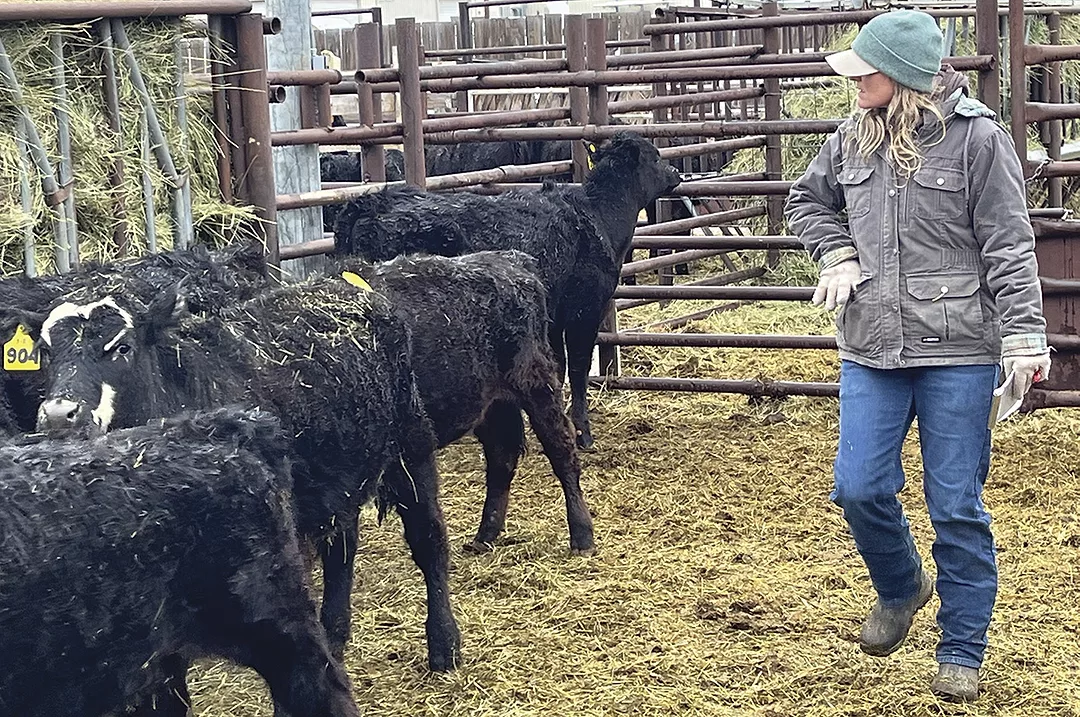
“You could say what I do is a little on the fringe side, as I still get some side-eye looks,” laughs Dawn Hnatow, owner of Cattle Up Stockmanship. “It’s a slow progression for people to understand.”
Hnatow explains the cattle industry primarily addresses livestock stress by using external solutions such as stress tubs and medicated feed. Her approach views stress as an emotional and psychological entity.
Cattle Up Stockmanship provides ranch consulting services, classroom workshops and field demonstrations for producers, feedlots and packing plants. Training variations include working from horseback, on foot, four-wheelers and even helicopters. While cattle are her focus, Hnatow also teaches techniques for handling bison, sheep, goats, horses and even deer and poultry.
Proud to follow in the legendary Bud Williams’ footsteps, her philosophy is to step back and consider what drives the animal.
“I work to understand basic instincts and what makes good or bad behavior,” she says. “Then I use this knowledge to my advantage by establishing clear and concise communication.”
Hnatow believes low-stress handling techniques benefit animals and handlers as they support health and production while reducing conflict.
“There’s no struggle or force used, it doesn’t need many people, and the animals are much more compliant,” she says. “It’s a front-loading investment. I spend a lot of early time with new cattle getting them to feel comfortable, so I don’t have to pay for it later. It’s a bad day to find out I can’t handle my stock on shipping day.”
Hnatow has noticed a gradual movement by the public to be more observant of animal rights. She believes consumers hold the purchasing power to drive changes, whether the cattle industry wants them to or not.
“It doesn’t cost anything to be better at stockmanship,” Hnatow says. “If we take the time to learn a few things, our cattle will actually give us the benefit of the doubt and try harder to do what we ask.”
Protecting the livestock sector
Todd Inglee is the seventh brand commissioner in the Colorado Board of Stock Inspection’s history. He oversees 10 districts with 10 supervisors and 63 brand inspectors across Colorado. Together, they protect the livestock industry from loss and theft by completing ownership and brand inspections. They help facilitate commerce, license cattle markets, certify feedlots and alternative livestock facilities, plus act as the state’s eyes and ears during emergencies such as fires and floods.
Colorado law requires a brand inspection for ownership changes, transfers over 75 miles from a home site and out-of-state transport.
“About 80 percent of what we do is behind-the-scenes prevention work,” Inglee says. “The other 20 percent is investigations, working with local law enforcement and tracking down thieves. The regulatory part of our role isn’t sexy, but when we keep our heads down, we accomplish a lot.”
Last year, Colorado’s 63 inspectors covered 104,000 square miles of property and drove 1.29 million miles to check over 4.2 million cattle and horses.
One year into his role as brand commissioner, Inglee’s expectations of the law being black and white have been tested.
“It’s fascinating how many different ways a law can and needs to be interpreted to fit circumstances,” he says. “It’s seldom the same issue twice. We take the information, apply it to the law and then make a judgment call.”
Inglee admits no new tools have been discovered for permanent ownership identification, but he sees promise in new technologies helping staff do things better, less expensively and more efficiently.
“Our people have a lot of responsibility as they carry a badge, do vehicle stops, write citations and even make arrests, all done quietly without fanfare,” Inglee says. “They’re well known and trusted within their communities. Each has a common core to be justice-oriented, uphold the law and do what’s right for livestock producers. The exceptional people are what I love about my job.”