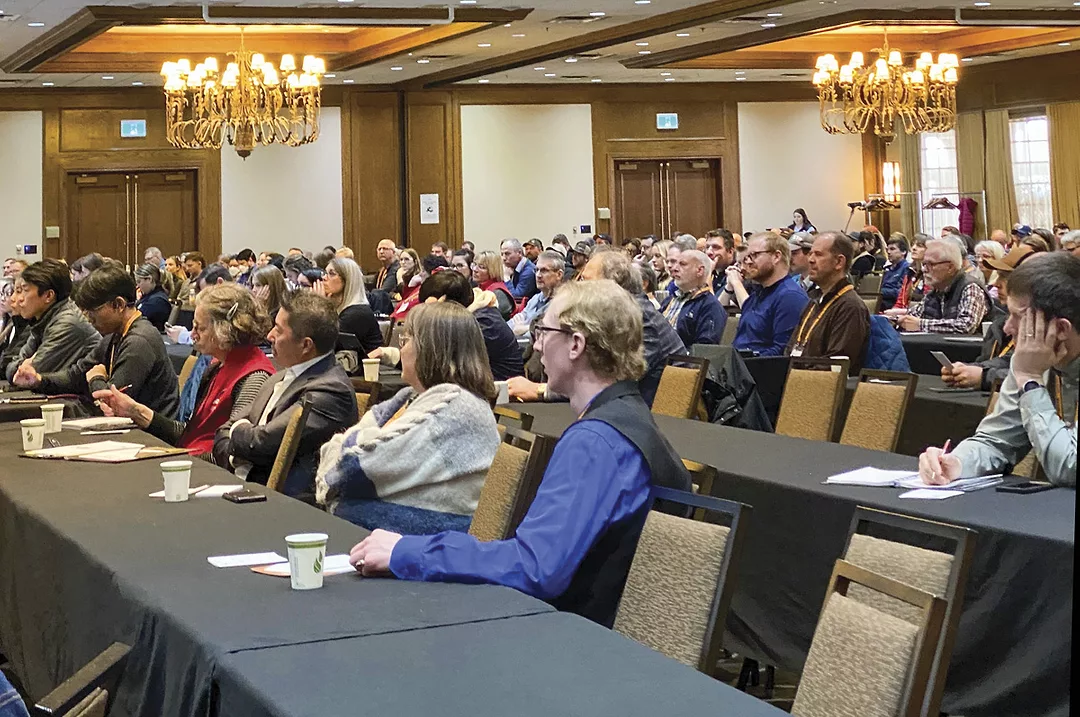
A dry and cool Red Deer, Alberta, welcomed the dairy industry March 5-7 for the Western Canadian Dairy Seminar. Students, producers and industry professionals gathered for the three-day conference and settled in to learn about topics relating to this year’s theme, “Excellence in efficiency.” With a buzzing trade show and well-attended conference sessions, attendees had plenty of opportunity to engage with researchers, experts and dairy producers.

Miriam Sweetnam, chair of the WCDS advisory committee, welcomed guests to the conference Wednesday morning with a reflection on the evolution of the event.
“It’s been 42 years since the inception of the Western Canadian Dairy Seminar,” Sweetnam said. “The first conference had 77 people registered to attend.” At the end of the 2025 conference, registrant numbers neared 900.
Efficiency
Steve Eicker of Valley Ag Software opened the first fireside session with a bold statement: “The longevity of a cow has nothing to do with the longevity of a herd.” Eicker fielded questions from emcee Dianne Finstad and an engaged audience, all intrigued by his thoughts on heifer growth, longevity and culling.
Eicker emphasized the importance of growing heifers to mature size before calving. In his opinion, undergrown first-calf heifers leave money and milk on the table. Pushing growth once heifers are bred can maximize investments in youngstock.
“A mature size at calving can equal an extra 1,000 kilograms of milk,” Eicker said. He also said that culling has nothing to do with the overall longevity of a herd, but replacement numbers do. “We shouldn’t focus on how much it costs to raise heifers, but how much it costs to replace her.”
Eicker shared his thoughts on utilizing beef-on-dairy in herds, urging producers not to buy beef semen if replacement numbers are already lacking. However, he encouraged producers to take advantage of current beef prices and emphasized the importance of sending healthy underproducing cows to slaughter – rather than old lame cows – which will put more money in producers' pockets.
“In summary, I’d encourage you to take advantage of beef prices, grow heifers to mature size before calving and don’t be afraid to sell ‘healthy’ cull cows,” Eicker said.
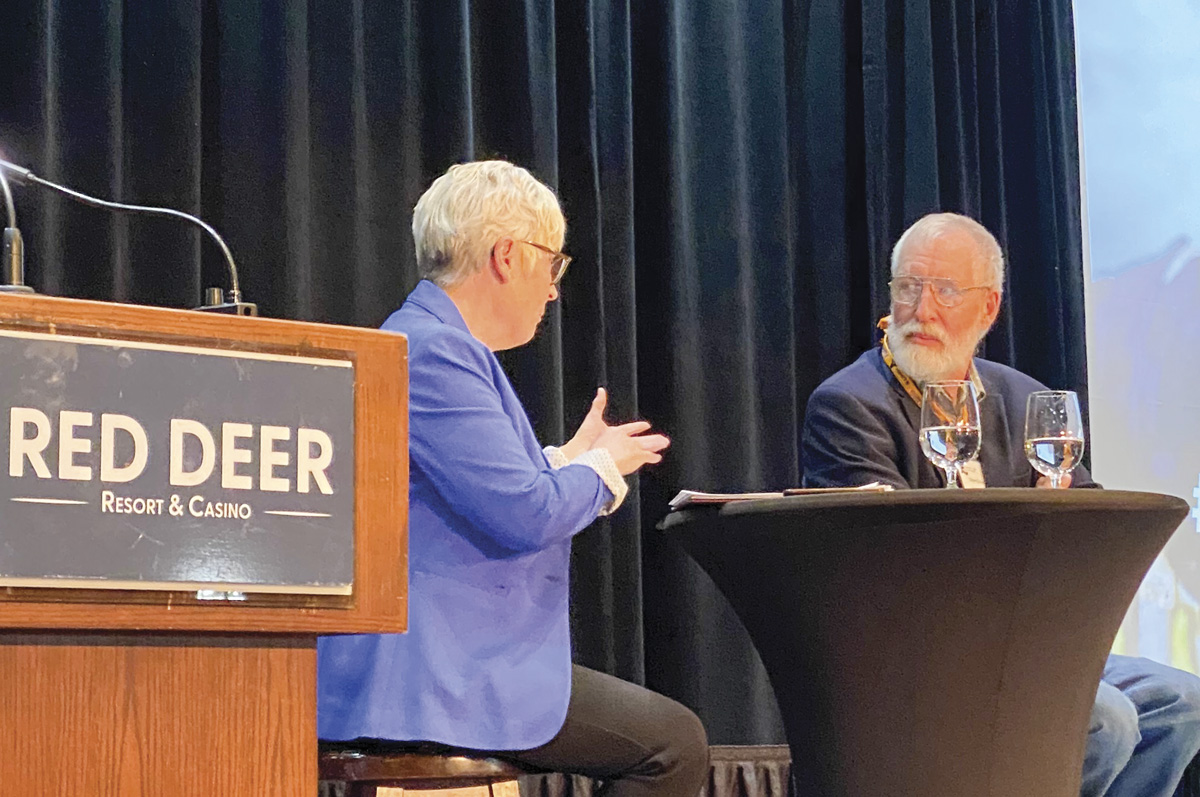
Diane Finstad and Steve Eicker opened the conference with a fireside chat about efficiency. Image by Matti McBride.
Mike von Massow from the University of Guelph spoke to the consumer side of the dairy industry, discussing the results of several recent surveys. Overall, the general public is starting to view animal agriculture in a better light, but still has no idea what producers do.
“The issue with our industry isn’t lack of trust; it’s lack of knowledge,” von Massow said. He emphasized that labeling and words the dairy industry uses matters to consumers, largely because many have different definitions of certain terms. He gave an example using the word "sustainability," which can mean one thing to a dairy farmer and something completely different to a mother shopping for her family.
“Conversations are going to happen whether we as an industry are at the table or not,” von Massow concluded.
Dan Wong, president of the Western Dairy Council, gave an overview of the current status of milk processors in western Canada. He noted that processors view the supply chain completely opposite from dairy producers, looking at what’s selling to make management decisions rather than what products are available. Looking ahead, Wong is optimistic about the future of milk processing in western Canada.
Succession planning
Day two of the conference brought the highly anticipated virtual farm tours, this year focused on succession planning rather than technology or innovation.
“It’s something everyone deals with, so we wanted to share some different ways it’s been done,” said Tietsia Huyzer, WCDS committee member.
This session began with a presentation from consultant Annessa Good-Hassard, who works with many farming families across Canada to navigate uncharted waters when it comes to succession planning. Good-Hassard broke down key points of contention, confusion and frustration on family farms. She noted that dairy farms often present more of a challenge when it comes to splitting assets because “you can’t split a dairy barn in half.” Good-Hassard encouraged attendees to have conversations like these proactively instead of reactively.
Following Good-Hassard’s remarks, attendees watched virtual farm tours of Lone Pine Jerseys in Didsbury, Alberta, and El Shaddai Dairy Farm of Leduc County.
Lone Pine Jerseys is owned and operated by the Adrian and Vreni Haeni family and is currently discussing what the transition between the senior generation to the junior generation might be. With an impressive herd of Jersey cows and an on-farm processing facility, the Haenis' four sons can be involved in many avenues.
“It’s overwhelming when you start out,” Adrian Haeni said. “But it’s also a privilege to have children who are interested in taking over.”
What if children aren’t interested in taking over the operation? Geoff Volkman of El Shaddai Dairy Farm was facing this reality when Dieter Gagelman was introduced to him. Gagelman was looking for a way to dairy farm and Volkman was interested in discussing a transition. After a lot of hard work and tough conversations, the pair reached a compromise that allowed Gagelman to slowly take over as Volkman stepped back.
“Trust the younger generation and step back a bit,” Volkman said. “Don’t let things fester if something is bothering you – be an adult and admit when you are wrong.”
Other presentations during the conference included discussions on reproduction and fertility, hoof health, herd health, nutrition and more. The Western Canadian Dairy Seminar will be back in Red Deer March 3-6, 2026.