A single low-fertility bull can wreak havoc on breeding success, leading to fewer calves and major financial losses. But how can producers know which bulls are underperforming before it’s too late? That is where time-dependent semen analysis changes the game. Fertility markers can now reveal hidden weaknesses before impacting the herd, helping ranchers act confidently.




The cost of low-fertility bulls
Not all bulls perform equally over every season. While some maintain high-quality semen production for years, others suffer from poor motility, semen abnormalities or a gradual decline in reproductive potential. The problem? These issues are often invisible to the naked eye and can go undetected until pregnancy rates plummet – costing cattle producers valuable breeding seasons and profits.
Semen motility – the ability of sperm to move effectively – is a key fertility indicator. Poor motility means sperm have difficulty achieving effective pregnancy. Even bulls that start with high-motility sperm can experience a rapid decline due to age, injury, illness, environmental stress or simply due to mishandling. Identifying these bulls early is crucial for herd productivity.
A game changer: Time-dependent semen analysis
Traditional semen tests offer only a one-time snapshot of motility, but fertility isn’t static. A bull that looks good on one test may still have rapidly declining semen quality after thawing, making his sperm ineffective for fertilization.
With new fertility markers, time-dependent semen analysis can track progressive motility over time under low-oxygen conditions, as experienced in the cow’s reproductive tract. This gives producers a real-world understanding of how well a bull’s semen will perform.
The results speak for themselves:
- Bulls with lower fertility experience a significant drop in motility within just 15 minutes, even after passing a complete traditional veterinary assessment (Figure 1).
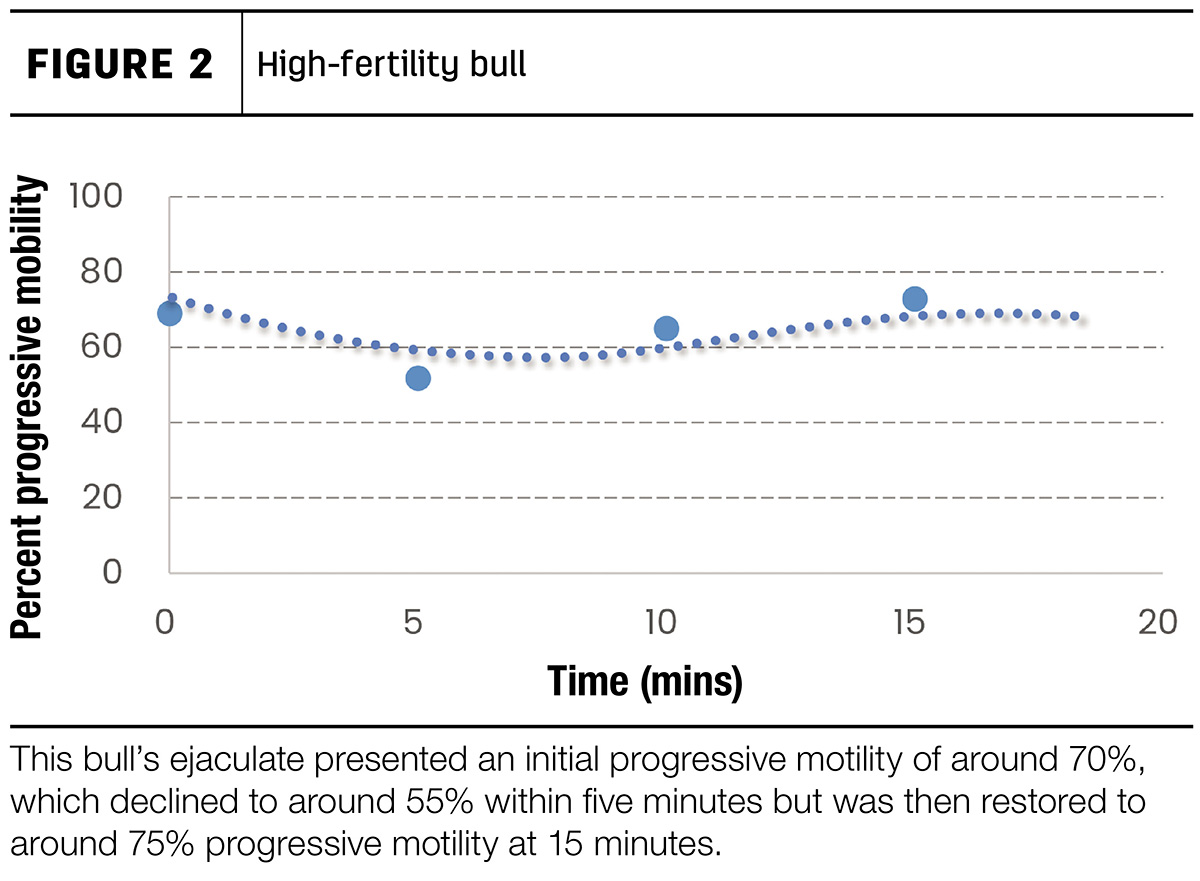
- In contrast, highly fertile bulls maintain motility for extended periods, demonstrating their viability for successful breeding (Figure 2).

Act before conception drops
Knowing when to remove an underperforming bull is a difficult decision, but waiting too long can be costly. The key is tracking semen motility over time, prior to the breeding season. The results speak for themselves when beef cattle producers utilize crucial fertility markers, such as Sustained Motility Lifetime (SML) to help identify bulls whose semen deteriorates too quickly.
Research shows semen quality declines can be linked to health issues, injuries (such as lameness) or even mishandling – even those health events that are not always detected clinically. By testing semen regularly, producers can act before conception rates drop.
Take control of your herd’s fertility
Low-fertility bulls pose a major risk to herd productivity. With modern tools, producers can identify problems early and make data-driven breeding decisions. By incorporating time-dependent semen analysis into bull evaluations, producers can select bulls that maintain high motility and maximize conception rates, prevent financial losses by culling underperforming bulls before breeding failures occur and improve herd genetics, productivity and profitability.