


In recent years, dairy crossbreeding has been a topic of conversation because it presents the opportunity to create a cow in one generation that is more efficient, makes fewer trips to the hospital pen, and possesses better fertility. While the benefits of dairy crossbreeding can positively impact your herd, it does take the management of a focused genetic plan to incorporate, which can turn some away.

There are several options to customize a crossbreeding program, but it is key to understand that breeding crossbred F1 sires to crossbred dams to simplify a breeding program can cause more damage than good. To understand why, let’s start with how an F1 is created. F1 stands for first filial generation, or the first generation after an original parent group. In crossbreeding, F1 represents the first group of offspring that results from two purebred parents of different breeds.
Some are promoting breeding crossbred F1 sires to crossbred dams to simplify breeding programs. We don’t suggest that strategy because, in most cases, it won’t yield the results one expects to receive. Many think breeding an F1 sire to an F1 dam will result in another animal that looks like the original F1 generation. The reality is that there likely won’t be a 50-50 split of purebred genes when it comes to the genome.
Three reasons not to breed F1 sires to F1 dams
1. A considerable range of phenotypic variation in the resulting progeny
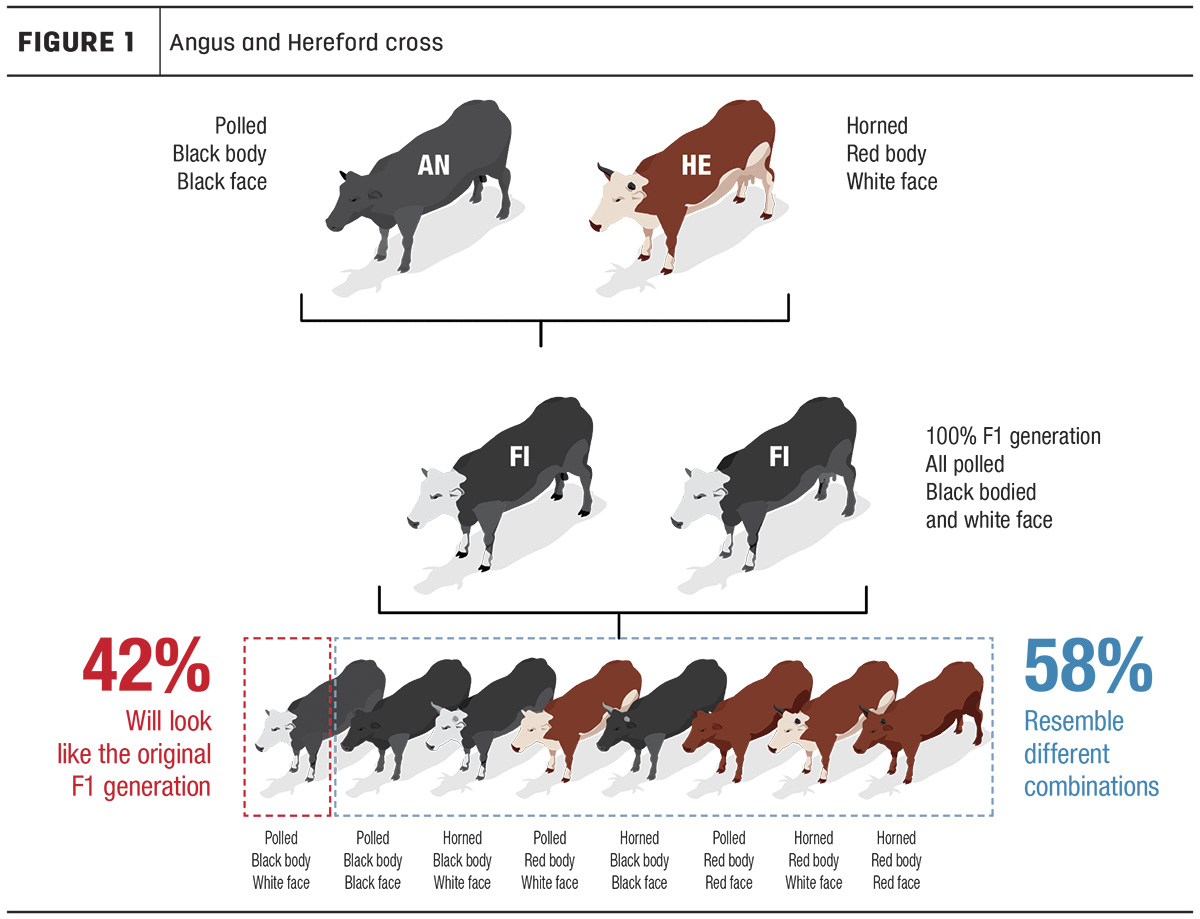
F1 animals are extremely uniform, receiving exactly 50% of their genetics from their sire and dam. Regardless of what some believe, breeding an F1 sire to an F1 dam will not subsequently create another uniform F1 animal. For example, traits like Stature, Udder Depth, Milk Production, and Fat and Protein will have extreme variation when compared to breeding with purebred parents.
Inconsistency occurs because of how genes are passed to the next generation, since the sperm or egg cell only contains one parent allele for each gene pair. When a parent is an F1, they can pass on Holstein or Jersey genes for each gene pair because 50% of their genes are Holstein, and the other 50% are Jersey.
Finally, genes are transmitted independently of each other, meaning an F1 sire could transmit only Holstein genes, only Jersey genes or a combination of both. To visually validate this point, let’s consider the Angus and Hereford cross (Figure 1). This cross clearly demonstrates the drastic variations one might see in polled, face color and body color when crossing an Angus Hereford F1 sire and Angus Hereford F1 dam.
2. Lack of selection intensity in crossbred sires
There is a lack of selection intensity when it comes to crossbred genetics as compared to purebred sires, which is largely due to the absence of a validated genetic evaluation to accurately represent the F1 sires. These sires are not evaluated on an F1 base. In fact, most are compared genetically to a Jersey base.
Today, a small number of F1 sires are created, and nearly all enter studs. It is key to understand that within genetic companies’ mating strategies, F1 sires are not created using the stud’s highest genetic merit purebred sires. Those purebreds are most likely being used to create the next generation of purebreds. This means many of the F1 sires are created using the bottom portion of the top end of purebred sires. While many of those purebreds are still good sires, it drastically reduces the selection intensity within the F1 population. This lack of selection intensity adds to the variation in genetic quality seen among F1 sires.
3. Unreliability of crossbred genotypes
Today, there is no great way to genomically evaluate crossbred animals because we haven’t identified the appropriate method. While we can genotype crossbred cattle, they are not able to use the same evaluation method as purebreds. The reason behind this has to do with appropriately determining the effects of a gene. This works effectively for purebred animals, but unfortunately not for crossbreds.
Currently, when crossbred animals receive a genotype, they are compared against each breed that is represented in their DNA. The results are compiled as a weighted average based on the percentage of each breed present. Genes from all breeds are included in all comparisons, which is not an accurate way to evaluate cattle because many genetic combinations are breed-specific and not found regularly in other breeds.
Three benefits of dairy crossbreeding
Although we don’t suggest using an F1 sire, we cannot overlook the benefits of a properly managed dairy crossbreeding program. The biggest advantage of the F1 cross is the 100% boost in performance achieved through hybrid vigor, specifically in terms of health, survival and fertility. Mating an F1 sire to an F1 dam will give you surprisingly less hybrid vigor than one would think. While creating an F1 will give 100% hybrid vigor, mating an F1 sire to an F1 dam will only give you 50%, which is the same as a two-way cross or breeding an F1 dam back to a Holstein sire.
Another advantage is reducing the fear of inbreeding by using populations completely unrelated to each other. Inbreeding can hinder traits like those related to survival considerably. Crossbreeding provides the opposite effect for those same traits.
The three most common benefits of dairy crossbreeding are breed complementarity, heterosis or hybrid vigor, and the ability to improve a herd faster. Breed complementarity allows one to take advantage of the superior traits within various breeds. Heterosis or hybrid vigor is the “free benefit” of crossbreeding that enhances performance, particularly fertility and health traits. Improve your herd faster through significant breed differences and a larger genetic pool.
Dairy crossbreeding recommendation
We understand the value dairy crossbreeding brings to a dairy producer, so here’s how we recommend taking advantage of an F1 female. We suggest implementing what we call a "Terminal F1 Crossing." This strategy uses a portion of a herd as a purebred nucleus herd. From this “nucleus herd,” producers create both replacement purebreds and F1 crosses by using sexed semen and embryo technology.
The F1 females are then bred to terminal beef genetics to create a superior beef cross calf. Mating the F1s to beef genetics removes the worry of phenotypic variation, the lack of selection and unreliability of crossbred evaluation by producing an offspring destined for the beef supply chain. Nowadays, male sexed beef semen could also be leveraged in this breeding decision.
This method results in a herd that is partially purebred and partially F1 crossbreds and allows producers to respond to market demands, maximize heterosis and use tools not available to fully crossbred herds, such as genomics. However, there is an increase in management complexity, and the purebred half of the herd will lack heterosis.
Dairy crossbreeding can yield more benefits if implemented and managed correctly. Are you ready to reap the benefits?



