Genetic advances in the cattle industry have resulted in animals with rapid growth rates and increased production efficiencies, requiring critical minerals and vitamins. As cow-calf producers strive to become more efficient through extended grazing programs such as fall/winter swath and bale grazing, the industry standard of providing free-choice mineral and vitamin supplements to herds often results in sporadic consumption by individual animals. In most cases, this is insufficient to compensate for the decreased mineral and vitamin availability in winter pasture, crop residue and stored feed.

Typically, a portion of your herd will eat twice the minerals and vitamins they require, another portion may not attend the mineral and vitamin feeder at all, and the rest of the herd will fall somewhere in the middle. On average, the herd’s consumption looks accurate because the herd is going through the right number of bags of minerals and vitamins per week. However, the distribution across the herd is often not even and does not meet a portion of your herd’s mineral and vitamin requirements.
Drought has also been shown to reduce mineral and vitamin content in forages, and the increasing frequency of drought events due to climate change is likely to lead to greater mineral and vitamin deficiencies in beef herds. Subclinical deficiencies, including poor immune function and reduced reproductive performance, are becoming more common, underscoring the need for a refined supplementation program strategy that could include an oral, individual animal, targeted supplementation.
There is a common perception among some cattle producers that beef cattle can sense when their diets are deficient in certain minerals and vitamins, and they will eat free-choice minerals and vitamins to replenish those deficiencies. We call this “nutritional wisdom,” but trust me: Cows just aren’t that smart! Cattle are much like me at a buffet; they eat what tastes good and appeals to them, not necessarily the “broccoli” needed from a nutritional perspective.
That being said, the one component that can either encourage or discourage free-choice intake, depending on its level in a free-choice product, is salt. Animals will seek out a certain level of salt in their diet, and intake of minerals and vitamins can be encouraged with the addition of salt. However, the flip side is also true, that you can limit an animal’s free-choice intake of creep feed by increasing the level of salt in the ration. The other factor to be considered is that the animal’s only source of salt is not just from the mineral and vitamin product you are providing them; it is also in your water and feed. The higher the salt content of your water, the less free-choice salt your animals will consume in a mineral and vitamin supplement. Feedstuffs grown on saline soils and some plants such as kochia will accumulate high levels of salt, which will also reduce the free-choice intake of mineral and vitamin supplements offered, which include salt.
Another complicating issue when examining mineral and vitamin supplementation and its availability to the animal is confounding factors such as mineral antagonism. The animal may be consuming the right amount of minerals and vitamins, but they are not able to utilize it to its full potential. For example, copper is one of the most common nutrient deficiencies in grazing cattle, and its utilization by the animal after it has been consumed in a mineral and vitamin supplement can be affected by antagonistic minerals such as sulphates and molybdenum that are found in an animal’s feed and water, thereby reducing the available copper to the animal.
So the question is: What is a producer to do? Well, there are a few strategies producers can try depending on their winter feeding program if they are concerned about deficiencies. Force-feeding minerals and vitamins in grain to the herd periodically or providing a total mixed ration that includes minerals and vitamins are options. However, these may be difficult if you practice extensive winter grazing.
Our research team at Lakeland College partnered with Alberta Veterinary Laboratories Ltd. (AVL) on a two-year study starting in 2022 funded by the Natural Sciences and Engineering Research Council of Canada (NSERC) to benchmark neonatal mineral and vitamin deficiencies (vitamin A, vitamin E, selenium and iron) in calves and their dams at calving in Lakeland College’s purebred, commercial and dairy herds as well as local participating producers’ herds. Results indicate that 44% of cows being supplemented minerals and vitamins free-choice before calving were deficient in vitamin A and, to a lesser extent, deficient in vitamin E and selenium at calving. Sixty-seven percent of calves were deficient in vitamin A, 13% in vitamin E, 32% in iron and 94% in selenium at birth. These findings are consistent with a University of Saskatchewan study in 2017 where 58.3% of calves had below-adequate vitamin A levels and were 2.8 times more likely to die, and calves deficient in vitamin E (12.9%) were 3.2 times more likely to be treated for scours.
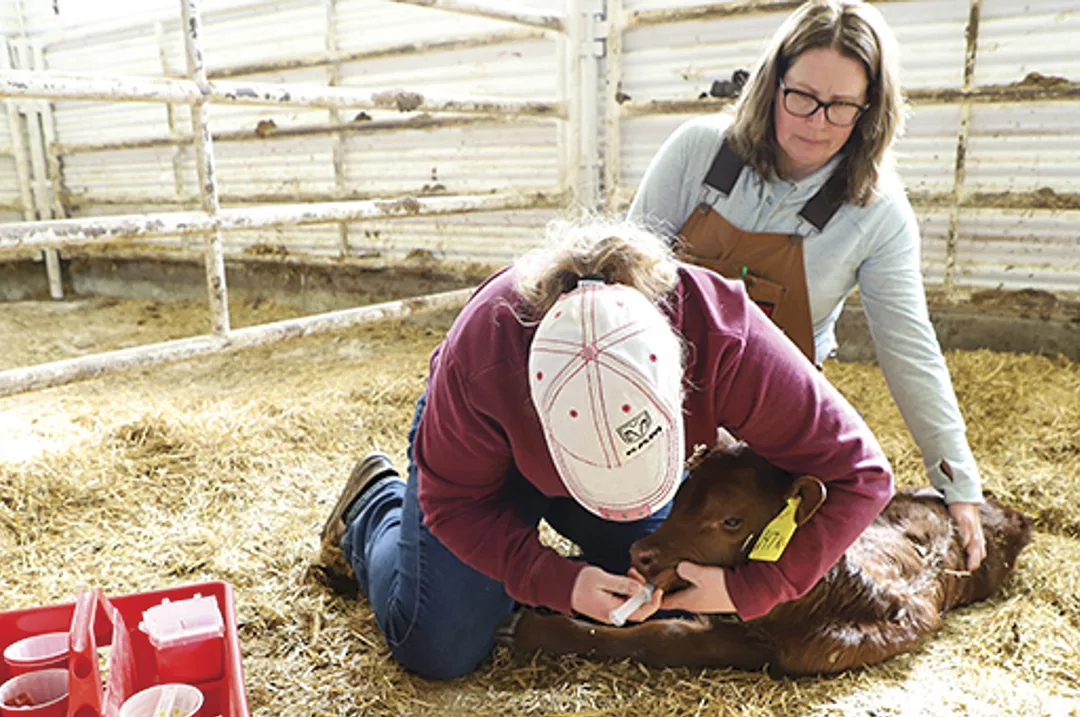
Half of the calves making up the treatment group in the Lakeland study received an oral neonatal supplement containing selenium and vitamins A, D, E and B12 approximately 24 hours after birth when the calves had nursed and mothered up, and while producers were catching the calves to do other management procedures such as tagging and castrating. The control group of the calves received an oral saline placebo. Blood samples were collected from both groups and analyzed for mineral and vitamin levels three days after treatment. We didn’t see a significant increase in the mineral and vitamin levels in the serum between the two groups; however, serum samples are not as accurate a measure as liver biopsies for some minerals and vitamins, which may be why we didn’t see a significant difference. In a similar study where serum samples were collected one day post-treatment, there was a rise in mineral and vitamin levels in the calves.
In further research, we would like to evaluate improving the mineral and vitamin status of all animals in the herd by taking a systems approach. One way would be to boost the mineral and vitamin levels with an oral drench or injection; several adult formulations are available in the marketplace. The intention is not to make more work for producers; rather, they could “top up” each animal’s levels by providing a supplement when the cattle are handled in the chute. At the time of handling, animals are often stressed and may also be getting a vaccination. Some research suggests that this is an optimal time to boost their minerals and vitamins, which may set the animals’ immune system up for a more robust response to the vaccine administered. Adding individual supplementation is not to replace the free-choice supplement but rather to boost each animal’s mineral and vitamin level at convenient times for the animals and producers.
The first step for producers is to evaluate their herd’s nutritional status through evaluating their production records and consulting with their nutritionist and veterinarian. If mineral and vitamin intervention is required, the team can help you develop a strategy for your management system.