The dairy industry has evolved significantly over the past few decades. Major improvements in lactation performance have been achieved through enhanced nutrition, genetic gains and fine-tuned management practices focused on improving cow comfort.


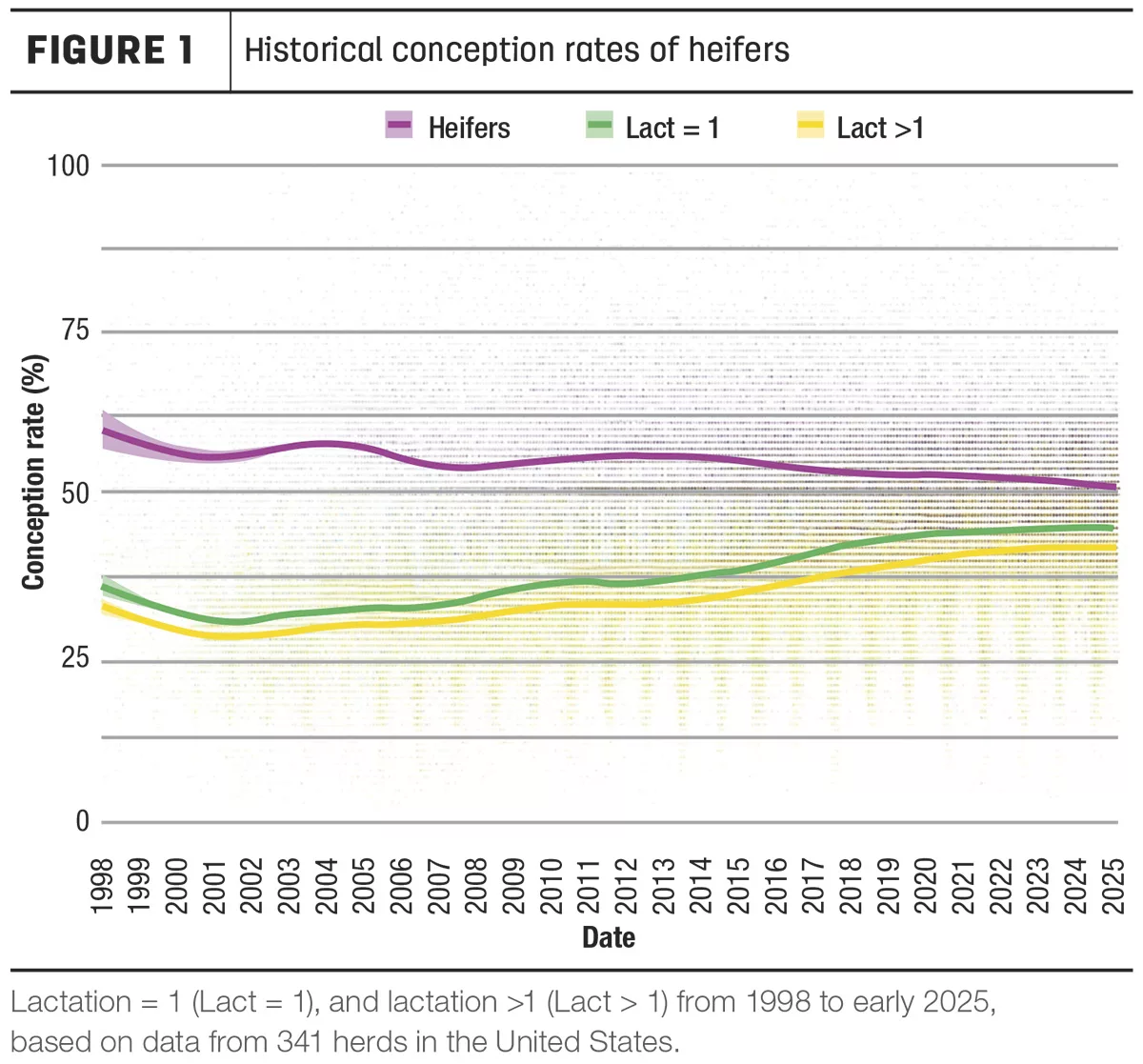
Reproductive performance has also seen steady gains since the early 2000s. Based on data from the mySYNCH database, comprising nearly 350 herds across the U.S., this broad data showed that the average conception rates of first-lactation and second-lactation-plus groups were 30% and 27%, respectively, in 2001. At that time, reproductive success in lactating cows had reached a low point.
The good news is that there was a turning point. Since then, conception rates for lactating cows have consistently improved, driven by a series of advancements across the industry. In 2024, conception rates reached 44% for first lactation and 42% second or greater lactation.
Many of these advancements occurred in the first decade of the 21st century. For example, in 2001, the seventh edition of the NRC (Nutrient Requirements of Dairy Cattle) was released, providing updated nutrient guidelines that enabled more accurate ration formulation. Around 2002-05, kernel processors became more widely adopted in the U.S., which likely improved corn silage digestibility through enhancement of starch utilization and overall energy availability in dairy diets. These advancements are not just nutritionally relevant, as research has indicated that inefficient availability of energy in the diet results in a negative energy balance, long associated with anestrous and infertility. Before 2010, bull selection based on genomics also began to include fertility traits in addition to milk production, contributing to broader genetic enhancement and more rapid improvement of these fertility traits.
Since then, the widespread use of fertility protocols, timed artificial insemination and improved transition cow management have played a role in this reproductive success. The adoption of new on-farm technologies and a growing interest in targeted reproductive strategies have further supported this positive trend in cow fertility.
While reproductive performance in cows has improved, the same cannot be said for heifers. The aforementioned dataset shows that conception rates in heifers have declined since the early 2000s (Figure 1).
Some may argue that this decline in heifer conception could be attributed to increased use of sexed semen or embryo transfer because these biotechnologies are more commonly applied to heifers than cows. However, these tools are also being increasingly used in lactating cows, whose conception rates continue to improve. Moreover, both sexed semen and embryo transfer (ET) have improved in efficiency over the years, making this explanation insufficient on its own.
Looking ahead
Is it time for us to rethink how we manage dairy heifers? While reproductive improvements in cows have come through deliberate attention to detail, such as precise nutritional strategies, reduced lock-up times and strict protocol compliance, heifers often remain on the margins of that attention. In many cases, their care, feeding and reproductive programs are not held to the same standards.
On many dairies, feed may not be pushed up as consistently in heifer pens as it is for lactating cows. Lock-up times may be longer, silage quality is often less closely monitored, and reproductive protocols might be less rigorously followed. These differences, while subtle in daily operations, can accumulate and may affect reproductive outcomes in this group.
Reproductive delays in heifers come at a cost, just like in cows. Even a short setback delaying conception can quietly raise the total cost of raising, with added feed, labor and space that often go unnoticed but still chip away at profitability. Improving heifer fertility requires the same intentionality applied to lactating cows, beginning with clear performance metrics and consistent monitoring.
One foundational aspect of managing heifer fertility is ensuring that breeding and calving align with both the farm’s goals and the animal’s development milestones. Rather than for a specific age, the focus should be on achieving key bodyweights thresholds, which are typically around 55% of mature bodyweight at breeding and 85% by calving. Monitoring weight by age and breed allows for individualized management and early intervention. Herd-specific benchmarks should be tracked monthly to monitor success. Beyond averages, it is important to evaluate the distribution of events. For example, a narrower window for age at conception or age at first breeding indicates program consistency and reduces the risk of both delayed and premature insemination.
Reproductive program compliance is another critical area. Research has shown that protocol timing and execution, including accurate hormone administration and timely insemination, significantly affect pregnancy outcomes. Synchronization programs like PGF2α-based heat detection, G6G or 5-day CIDR protocols can be effective in well-managed heifer groups, but they require the same discipline in administration and follow-up as cow protocols. Heifer grouping and housing can also influence reproductive outcomes. Overstocking or excessive mixing of age groups can increase social stress, suppress estrus expression and reduce feed intake. Keeping heifers in uniform, age-appropriate groups and minimizing regrouping events within 21 days before breeding can help maintain reproductive stability.
Ideally, heifers should be grouped by both size and reproductive stage, such as pre-breeding, breeding and post-breeding to simplify feeding, heat detection and compliance. We all know that overcrowded pens with poorly functioning headlocks challenge protocol compliance in lactating cows; heifers are no different. Ensuring a good work environment along with technician training contributes to good compliance and reproductive success in heifers, just like in cows.
Do you extend the same level of discipline and innovation applied to cows to your heifer program? Has your trend in heifer fertility improved over time? If not, consider revisiting your records to identify where gaps may be occurring and build a plan that emphasizes consistency and measurable progress.
Improving heifer fertility is not only possible, but it’s necessary for building a sustainable, efficient herd.