In early July 2025, drought conditions across U.S. hay and alfalfa-producing acreage remained a key market factor, though regional shifts continued.

Here’s a review of what we do know about hay and forage markets as you continue to look for answers.
U.S. Drought Monitor maps indicate that U.S. drought conditions continue to fluctuate across regions. Significant rainfall eased drought stress in parts of the Great Plains, especially across Nebraska, Minnesota and Montana, while the desert Southwest received strong storms that brought temporary relief but failed to fully resolve long-term drought in areas like south-central Texas.
In early July 2025, the cooler-than-normal pattern from June gave way to warmer and more variable conditions across much of the eastern and central U.S.
As of July 8, approximately 19% of U.S. hay-producing acreage (Figure 1) was considered under drought conditions, consistent with a month earlier. The estimate of alfalfa hay-producing acreage (Figure 2) under drought conditions increased slightly to 31%, up 4% from a month earlier.
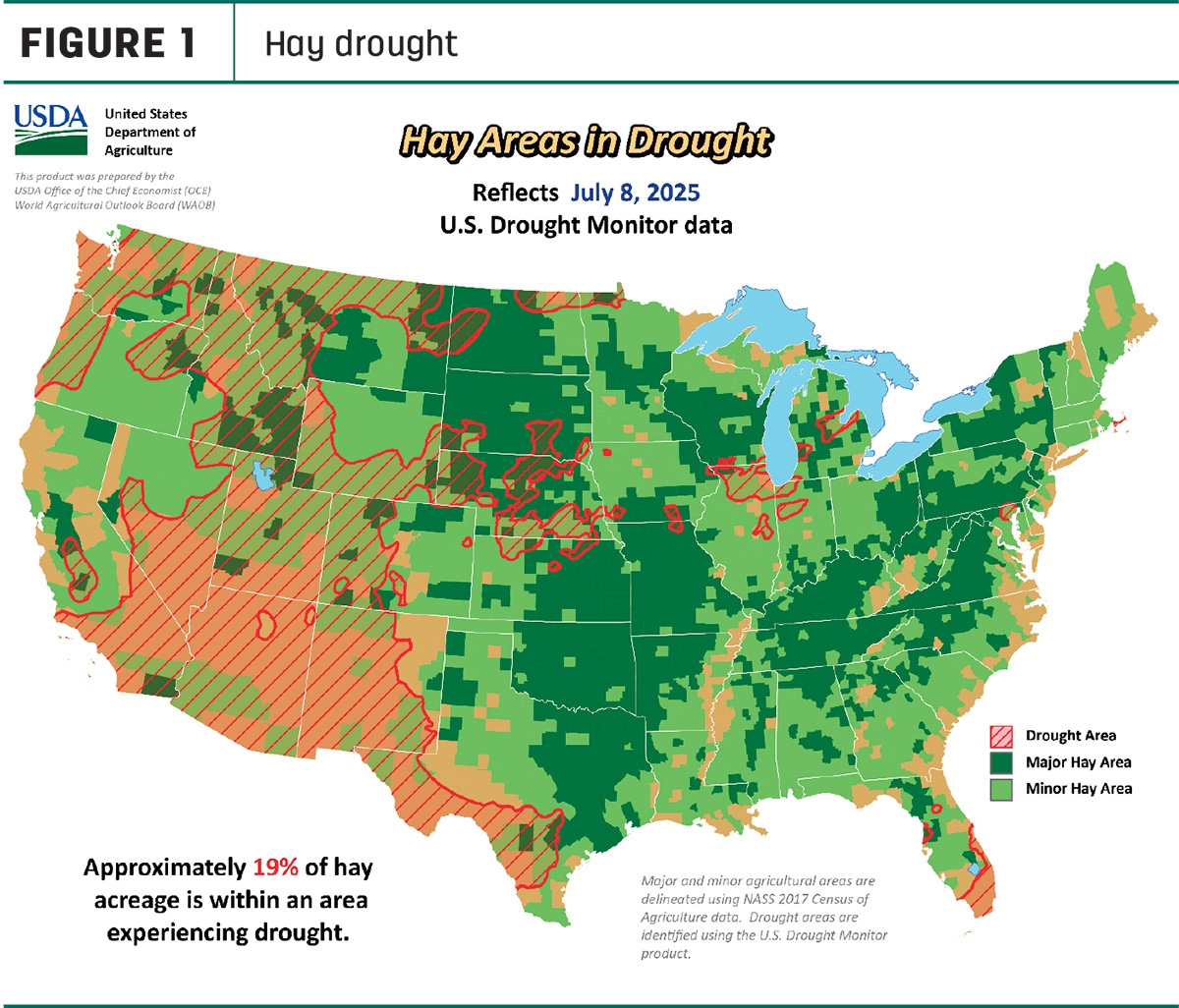
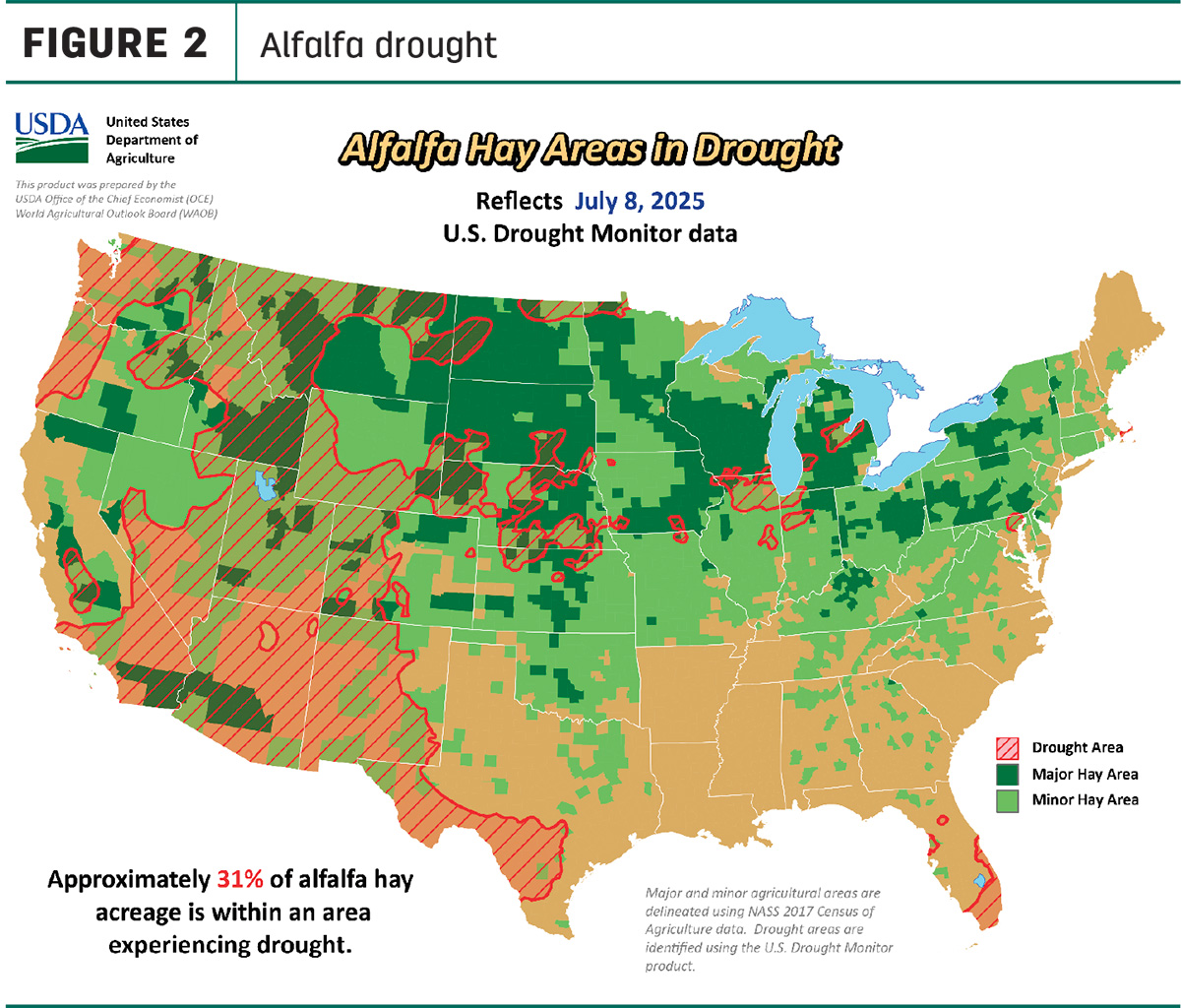
Drought conditions across the U.S. in early July 2025 remained active, with regional improvements offset by expansion in key agricultural zones. While heavy rainfall alleviated drought in portions of the Great Plains, areas such as southern Iowa, northern Illinois and northern Missouri saw worsening drought due to sustained precipitation deficits and increased temperatures.
A snapshot of hay prices
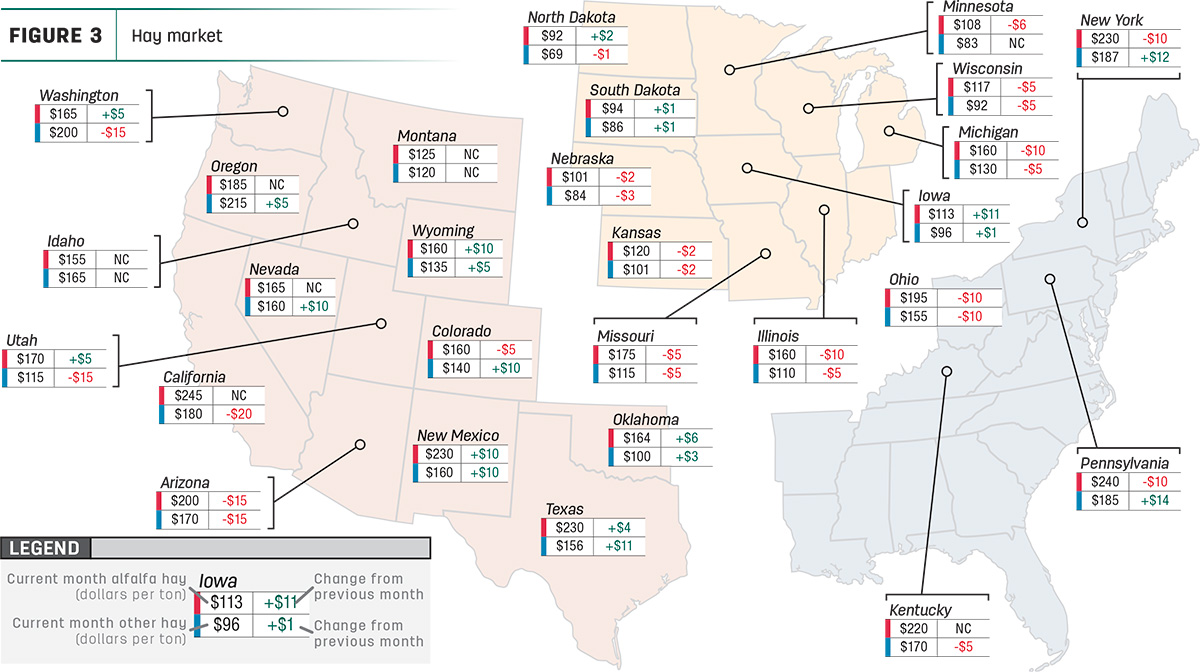
USDA price data for 27 major hay-producing states is mapped in Figure 3, illustrating the most recent monthly average price and one-month change. The lag in USDA price reports and price averaging across several quality grades of hay may not always capture current markets, so check individual market reports elsewhere in Progressive Forage.
Dairy hay
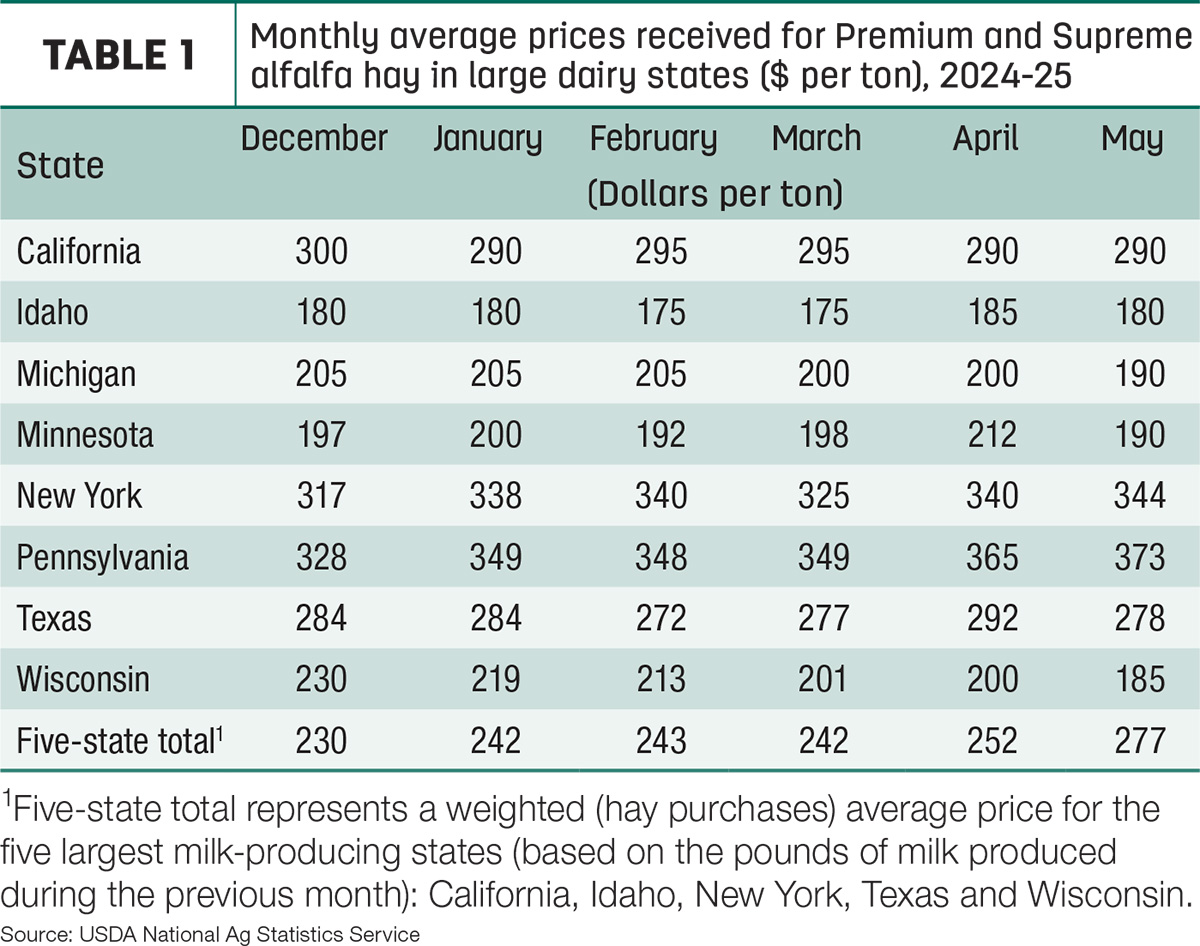
The top milk-producing states reported an average price of $277 per ton for Premium and Supreme alfalfa hay in May 2025, a $25 increase from April 2025 (Table 1). The average price was $1 higher than May 2024.
Alfalfa
The U.S. average price for all alfalfa hay increased $11 in May to $191 per ton. Compared to a month earlier, prices were lower in 12 of 27 major forage states, with the largest declines in Arizona, Illinois, Michigan, New York, Ohio and Pennsylvania. Prices were up in nine states, including Iowa, New Mexico, North Dakota, Oklahoma, South Dakota, Texas, Utah, Washington and Wyoming.
With few exceptions, year-over-year alfalfa hay prices were down substantially, with the U.S. average down $11 compared to May 2024.
Other hay
At $144 per ton, the May 2025 U.S. average price for other hay was up $6 from April. Prices increased in 12 of 27 major hay-producing states, with the largest month-to-month increase in Colorado, Nevada, New Mexico, New York, Pennsylvania, Texas and Utah. Declines were recorded in 12 states: Arizona, California, Illinois, Kansas, Kentucky, Michigan, Missouri, Nebraska, North Dakota, Ohio, Washington and Wisconsin.
Expanding the timeline, the May 2025 U.S. average price for other hay was $10 less than a year earlier.
The gap between average U.S. alfalfa and other hay prices was about $47 per ton in May.
Exports
At deadline, the U.S. saw notable shifts in its hay export market, especially in trade volume and destination dynamics. This snapshot offers valuable insight into the nature of U.S. hay exports and its key global markets.
At 128,303 metric tons (MT), May exports of alfalfa hay decreased. Saudi Arabia was the top buyer, importing 37,662 MT during the month, about 29% of the total. May shipments to Japan also maintained a steady eight-month trend at 28,835 MT, 22% of the total for May.
Exports of other hay also decreased to 74,409 MT in May. As usual, Japan and South Korea led buyers in the other hay category: Japan purchased 44,017 MT during the month, followed by South Korea’s 22,464 MT.
U.S. exports of most categories of alfalfa cubes and meal were mostly lower in May, totaling about 10,129 MT. Japan imported about 68% of the total.
Regional markets
Regional hay sales and USDA Ag Marketing Service market reports have remained steady to moderate, with good demand for high-quality alfalfa and grass hay. Export hay demand continues to be light. Trading is light and cautious buying from overseas markets is the norm.
- Midwest: In Iowa, all grades of hay are selling steady to strong. This week, the quality is more attractive than the previous weeks. Demand is moderate to good with best demand for alfalfa. Trade is active.
In Kansas, the demand was light, trade was moderate and prices were mostly steady. Showers continue to put a damper on hay and wheat harvests and the planting of milo. Many areas have reported that their second cutting of alfalfa will end up being grinding-quality hay due to the delay in getting it put up dry, while others report that alfalfa was put up after bloom stage.
In Illinois, comparable hays in small squares sold from 68 cents lower to 65 cents higher. Comparable hays in large packages sold $10.67 lower. Trade was active with moderate demand, with a small buying crowd.
In Missouri, demand is light to moderate, with most interest coming from equine interest. Most cattle producers are not really in the market currently. The supply of hay is moderate, and demand is light to moderate.
In Nebraska, all reported forages sold steady to a little weak. Demand was light at best. Recent rains across the state have halted demand for old- and new-crop hay and the prices feel like they could slip downward.
In South Dakota, the alfalfa hay market is steady. Light to moderate demand currently. Hay growers have had a difficult time with the second cutting of alfalfa and first cutting of grass, as frequent rains and high humidity levels have made it almost impossible to put up dry hay. More rain is in the forecast for the next few weeks.
- East: In Alabama, hay prices are steady. Trade is moderate with moderate supply and demand.
In Tennessee, no confirmed trades are recorded this month. New-crop hay is in the process of being harvested.
In Pennsylvania, moderate volume and firm pricing are showing.
- Southwest: In California, trade activity and demand were moderate to good. Retail hay demand was good. Dairy hay demand was steady. Export hay demand was light.
In Oklahoma, demand is at a standstill. There are some movements but not enough for a trend for all types of hay. Parts of Oklahoma have been able to start baling hay, but other parts haven't been able to get into their fields. Mature hay is becoming a problem for hay producers.
In Texas, hay prices are mostly steady across all regions with light to moderate demand.
- Northwest: In Montana, hay sold mostly steady to firm on good to very good demand. The strongest demand was seen from northern Montana, as buyers were active in purchasing hay again. New-crop prices continue to establish themselves, and some variation in price was seen this session. Market activity was mostly moderate.
In Utah, demand and movement for new crop has been good and active. New crop has started getting sold across the state with good demand from buyers.
In Idaho, movement has increased due to some contracts being made for new crop. Demand for hay is moderate to slow; most producers say there isn't going to be a lot of Premium and Supreme-quality hay right now, with the first crop getting rained on. Some people are holding onto their hay, waiting for better prices.
In the Washington-Oregon Columbia Basin, all grades of hay are steady. Trade is slow to moderate with moderate demand. Supreme-quality alfalfa and Premium small square timothy remain in good demand.
In Oregon, movement has increased with mostly new-crop sales. The demand for new-crop hay across the state is slow. Producers are saying it has been quiet and are thinking movement will pick up in the next couple of weeks with hay starting to get tested and stored.
In Wyoming, old-crop square bales of alfalfa sold steady. Alfalfa cubes and pellets sold steady. On comparable new-crop sales, alfalfa sold steady on a thin test. Demand was light to instances moderate.
In Colorado, trade activity and demand are light. No market trend is available due to a lack of comparable trades.
Other things we’re seeing
- Dairy: The July milk production forecasts for both 2025 and 2026 are raised from last month based on higher cow inventories and an increased rate of growth in milk output per cow, based on the latest information published in the National Agricultural Statistics Service (NASS) Milk Production report.
- Cattle: The 2026 beef production forecast is raised from last month by 135 million pounds to 25.275 billion pounds. This change is less than 1%, and it reflects increased placements in the second half of 2025 and into 2026. This change reflects further evaluation of the timing of expected marketings, along with slightly heavier weights that more than offset lower expected cow slaughter next year.
- Fuel: National average fuel prices were slightly higher to start July, according to the U.S. Energy Information Administration (EIA). The U.S. retail price for regular-grade gasoline averaged $3.13 per gallon on July 7, down 3.9 cents from the previous week and 36.4 cents less than the same week a year earlier. The average U.S. on-highway price of diesel was $3.74 per gallon, up 1.2 cents from the prior week and 12.6 cents less than early July 2024.
- Trucking: Spot flatbed prices were mostly lower to start July, down in the Southwest, Midwest, Northeast and West, only higher in the South, averaging $2.52 per mile nationally, according to DAT Trendlines. Regionally, average spot prices per mile were: Southeast – $2.72, Midwest – $2.57, South – $2.72, Northeast – $2.36 and West – $2.21.
- Other costs: The USDA’s May prices paid index for commodities and services, interest, taxes and farm wage rates is up 0.4% from April 2025 and 6.4% from May 2024. The index for May, at 169.6, decreased 0.6% from April but increased 0.1% from last May. Compared with last month, prices are lower for self-propelled machinery and tractors but higher for other machinery. For fertilizer, the index for May, at 108.9, is up 1.6% from April and 6.2% from May a year ago. Since April, prices are higher for nitrogen, potash and phosphate and mixed fertilizer.
- Total May feed prices, the index is up 0.4% from April but down 1.9% from last May. Since April, higher prices for hay and forages, feed grains and supplements more than offset lower prices for complete feeds and concentrates.
- Interest rates: USDA Farm Service Agency (FSA) interest rates for farm operating loans (5%) remained the same, and direct ownership loans (5.875%) were higher for July.