Over the last few years, Canadian dairy producers have faced a rapidly evolving economic landscape. Feed costs now as much as ever are one of the critical determinants of profitability. Feed represents the largest operating expense on most dairy farms, often accounting for 45% to 50% or more of total production costs when accounting for all groups on-farm.

Much emphasis has been put on optimizing heifer inventories on dairy farms for profitability in recent years. This is a result of a cost control measure with the feed cost associated with raising heifers, in addition to the increased income potential from generating beef-cross animals. As dairy farms have dialed in their heifer inventories to optimal levels (65% to 80% of the mature herd, dependent on goals), turning a keen eye toward evaluating and managing lactating feed cost is another essential step for maintaining an economically sustainable operation.
If you ask producers across Canada how they evaluate their lactating ration cost, you will get more answers than the number of hours in a dairy farmer's day. Some of the key performance indicators (KPIs) that are commonly calculated by farmers in different regions are summarized in Table 1.
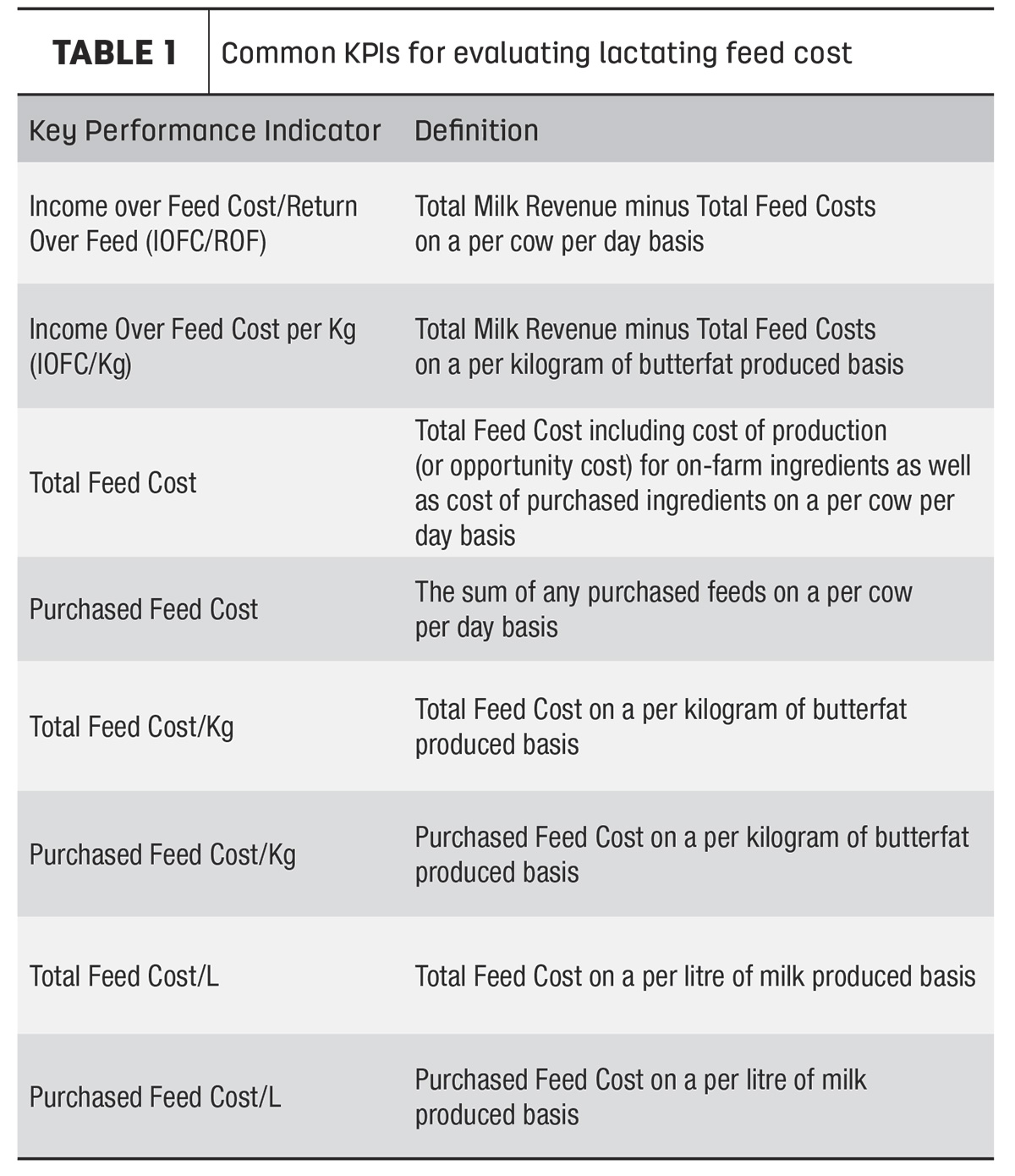
While all these KPIs have their place in evaluating feed cost, monitoring only a few or only one single KPI may not help capitalize on the feed cost opportunity of an operation. Oftentimes, KPIs related to purchased feed costs are weighted most heavily when making ration decisions. While managing purchased feed costs is extremely important, particularly from a cash flow perspective, from a total operation profitability perspective, focusing only on purchased feed cost may result in missing the mark on profit potential. Understanding what the total feed cost of the ration is, including purchased feeds, on-farm grains and on-farm forages, is the best way to optimize costs.
There is much debate on whether on-farm grains or forages should be valued at cost of production or opportunity cost, and that really is dependent on several factors, some of which are listed below:
- Can the true cost of production of on-farm ingredients be accurately calculated?
- What is the difference between the cost of production of an on-farm ingredient and the opportunity cost of selling it as a cash crop?
- Can the land utilized to produce a certain on-farm ingredient be utilized to produce a higher-value cash crop?
- Does the profit of a cash crop on an acre outweigh the profit from making a feedstuff for milk production on that acre?
Ultimately, the way to evaluate the value of on-farm ingredients needs to be carefully assessed through a couple of different lenses to determine the best method for a single operation. For many operations, maximizing forage and reducing purchased feed ingredients may be a good option; for others with lower forage or grain yields and higher costs of crop production, certain purchased ingredients may be better than on-farm forage options to optimize ration costs. Until actual costs of production or opportunity costs of on-farm ingredients are calculated, those questions cannot be answered.
Consider the following scenario outlined in Table 2 as an example of evaluating ration costs. For the exercise, on-farm ingredients (corn silage, haylage and grain corn) were valued on an opportunity cost basis. The scenario assumes the herd milks 150 cows producing 38.5 litres (L) of milk at 4.3% butterfat (BF). Three diets were balanced for similar production levels and accounted for typical nutrient requirements:
- A diet with haylage and corn silage fed roughly 50-50 on a dry matter basis (50-50)
- A diet designed to minimize purchased feed cost (least purchased cost)
- A diet least costed from a total feed cost perspective (least total cost)
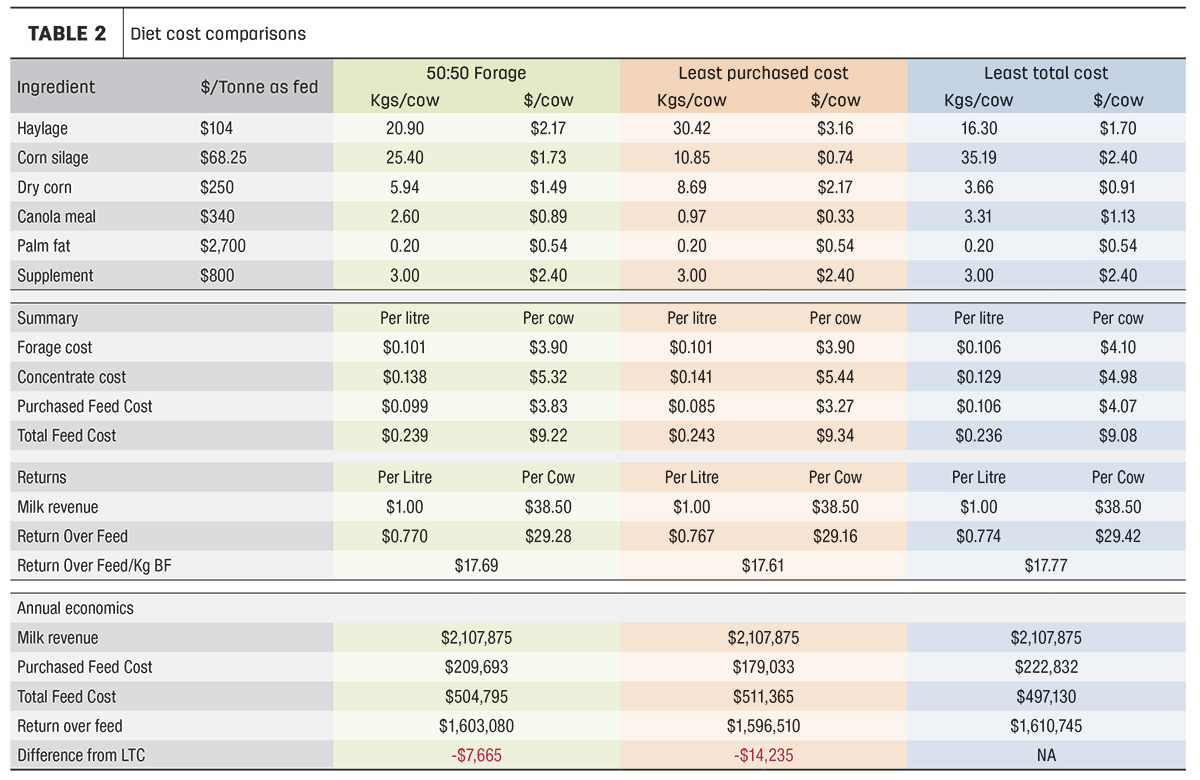
When evaluating the three options, it is interesting to note the differences in ingredient inclusion rates and subsequent consequences on cost between the different diets. The LPC diet minimizes purchased protein by maximizing haylage inclusion in the diet; however, the cost of the total concentrate in the diet ends up being the highest of the three scenarios due to the increased need for starch from grain corn with the lower corn silage inclusion. The annual purchased feed bill on the LPC diet is $43,000 lower than the LTC diet, which can be important from a cash flow perspective, but the return over feed on an annual basis ends up being a little over $14,000 lower with the LPC. The LTC diet does have the highest purchased feed cost, but total feed cost and concentrate cost in the diet is the lowest, as even though more purchased protein is needed with less haylage, that is offset by less grain corn being needed for starch with the higher corn silage inclusion rate. The higher purchased cost is also offset by the total concentrate cost in the LTC diet on an annual basis being $25,000 less than the LPC diet.
If the calculations are taken a step further to factor in the land needed to grow the on-farm ingredients for the scenarios, more insights come to light. Assuming a yield of 22 tonnes per acre of corn silage, 12 tonnes per acre of haylage and 180 bushels per acre of grain corn, as well as an average cash crop profit per acre of $250 excluding land payments, Table 3 outlines the differences.
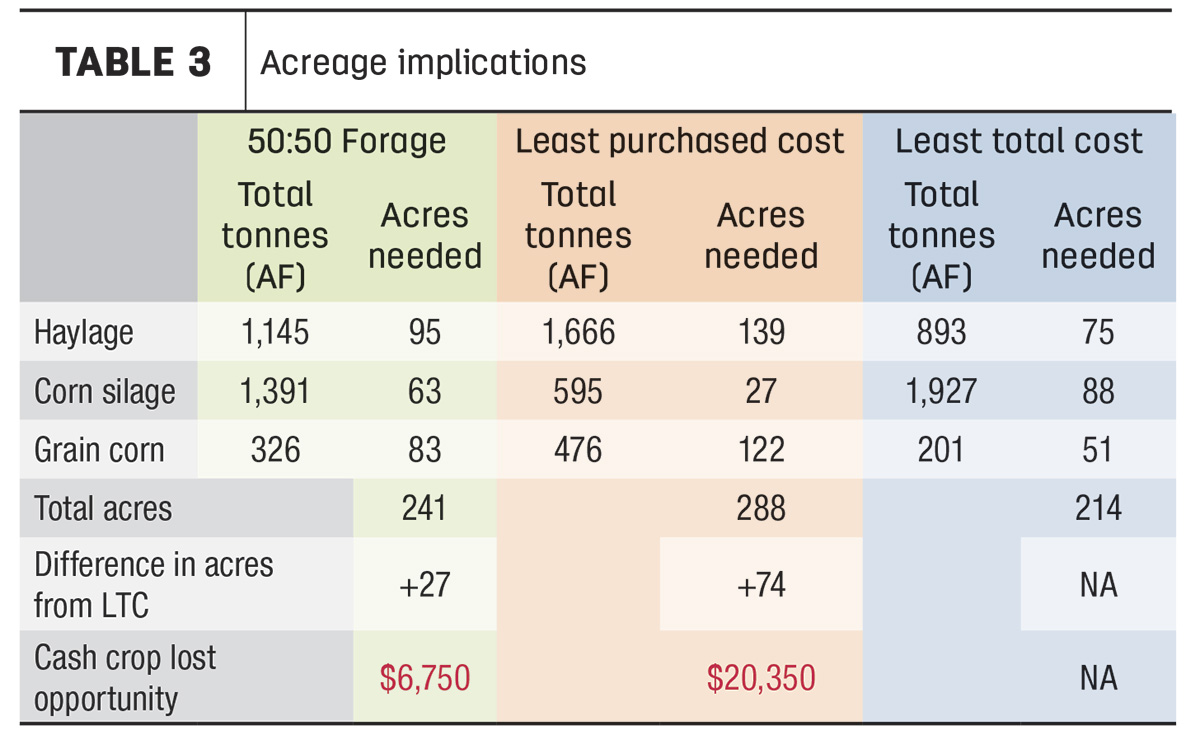
If the cash crop opportunity from less acres needed to grow feed is added in, the differences between the diet scenarios become even more apparent, with the LTC diet ending up a cumulative $34,585 ahead of the LPC diet and $14,415 ahead of the 50-50 diet. Note, these scenarios only take into account the lactating ration. Adding in the differences from other rations on an operation may yield even greater differences.
Dairy producers use different ways to measure feed costs, but focusing on just one method, especially only on purchased feed, can miss the bigger picture. It is important to consider both purchased and homegrown feed to truly understand costs. The scenario comparing three diet strategies outlined that the diet with the lowest total cost, not just the lowest purchased feed, was the most profitable overall, especially when land-use opportunities were factored in. This shows that a full, balanced view of feed costs is key to running a successful dairy farm.
It is important to note that these diet models will differ for every operation. Factors like land value, forage yield, cost of production, opportunity cost of on-farm ingredients and more can vary widely. Working with a team of advisers to properly evaluate costs in the best manner for your operation is a great starting point to ensure your lactating ration strategy drives farm profit.