Editor’s note: This is the third installment of a series summarizing the author’s master's project with the Ontario Veterinary College and the Lang School of Business.

In two previous articles, I encouraged you to think like your farm's chief executive officer (CEO) and to depend on your advisers for support. Let’s say that you meet with your veterinarian and nutritionist and know that milk production, pregnancy rate and income over feed costs (IOFC) are above average. However, after your year-end tax statements are prepared, you meet with your banker and find that your farm is below average. You decide to hold a team meeting with all your advisers but quickly realize they do not speak the same language. Each adviser uses a set of metrics from their area of expertise, but how do they all connect to your profitability? Are we even measuring the right things?
Marginal milk
First, I will share my bias as a veterinarian. In theory, higher production should lead to higher profit. Every cow must eat to survive, even if she is not milking. This cost remains constant across different production levels (about $3 per cow in fixed costs). Milk also requires a certain amount of energy to produce, but the feed cost is less than the milk revenue (17 cents per kilogram versus 90 cents plus per kilogram). Each cow still incurs the $3 fixed feed cost, but this gets diluted over more kilograms in higher-producing cows. This is the concept of marginal milk and explains why most dairy resources focus on production. This is a fundamental theory in the international dairy industry and is implicit in any magazine articles you read from the United States.
What about supply management?
Many Canadian producers aim to increase production, which suggests they believe that marginal milk is more profitable. But how does this align with supply management? If you can’t purchase more quota, you will need to sell extra cows as production rises. Your expenses should decrease with fewer cows, but your revenue will stay the same if you fill 100 kilograms of quota with 50 cows or 200 cows.
Financial adviser language
In previous articles, I recommended reporting income over feed costs (IOFC) on a per-kilogram quota basis instead of per cow. This provides a clearer picture of your results with supply management. We surveyed members of the Canadian Association of Farm Advisors for our study on their key financial metrics. They supported reporting on a per-kilogram basis rather than per cow and introduced another financial metric to consider. Twenty accountants and lenders shared that earnings before interest, taxes, depreciation and amortization (EBITDA) per kilogram of quota is their main measure of dairy farm financial success.
So what exactly is EBITDA? Most of us think of profit as what remains after deducting expenses from revenue. If your profit is small, you need to either increase revenue (which can be difficult with supply management) or cut expenses to earn more. When reviewing expenses, advisers often break them into subcategories to provide more detail. A simple way to categorize these is as short-term and long-term expenses. Short-term (or variable) expenses include feed, veterinary and breeding, bedding, labour and fuel. Long-term (or fixed) expenses, or capital costs, encompass items like barns and tractors (interest and depreciation). EBITDA is calculated by subtracting short-term costs from revenue and indicates how much money is left to cover your longer-term expenses.
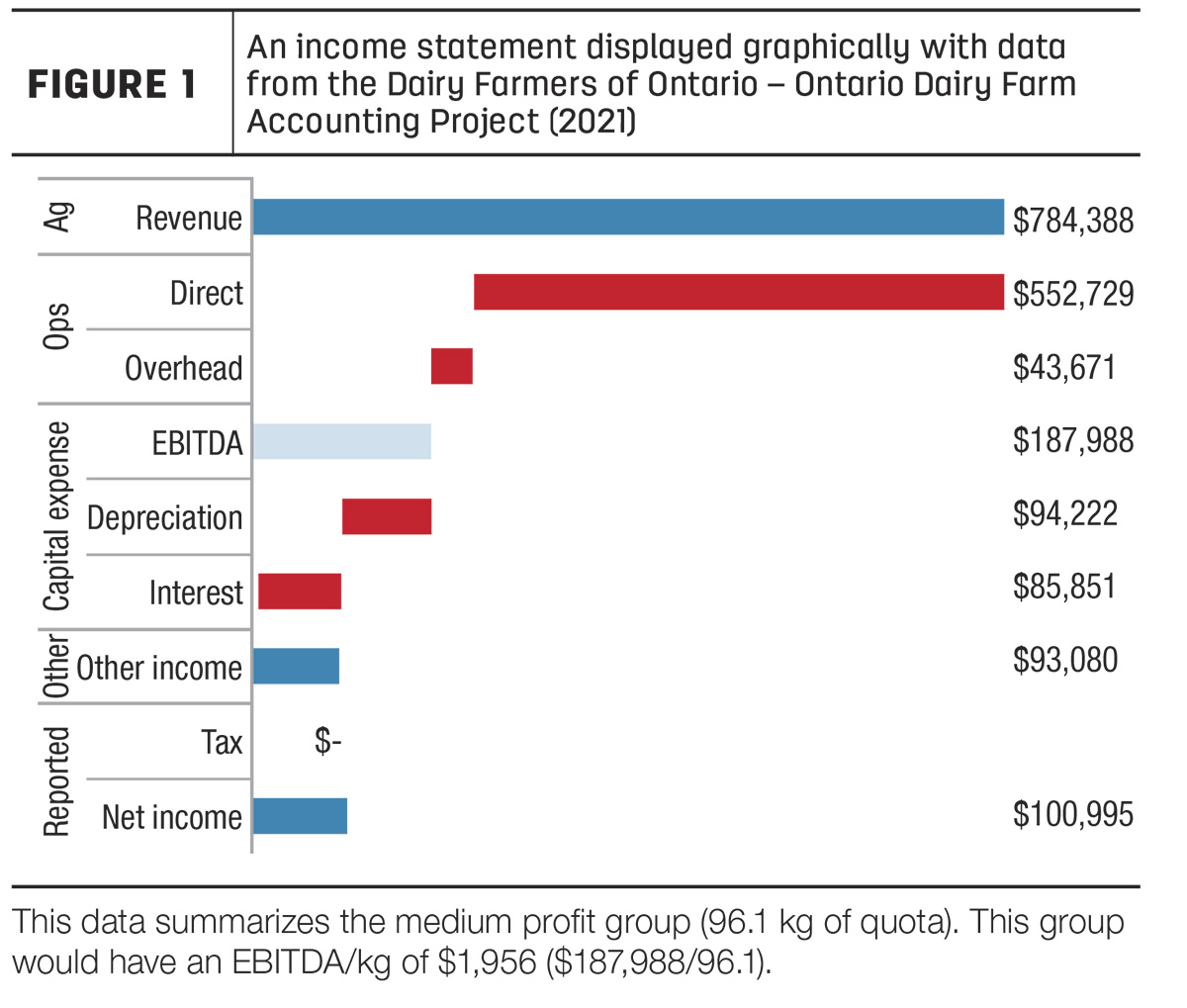
In Figure 1, revenue ($784,388) minus operating expenses ($552,729 and $43,671) leaves $187,988 in EBITDA. Divided by 96.1 kilograms of quota, the EBIDTA per kilogram for this farm was $1,956. This is similar to your operating expense ratio (OER), which expresses short-term expenses as a percentage of revenue. In summary, EBITDA and OER show how efficiently you convert feed and labour into milk.
The Profit Link project
Our group was interested in how production per cow related to profit, so in 2022 we enrolled 60 farms from across Canada in a study to better understand how production metrics interact with EBITDA per kilogram. Participants had to be 1) located in Canada, 2) English-speaking, 3) enrolled in DHI milk recording or used DairyComp 305 for data collection and 4) receive 90% of their revenue from dairy sales (milk and cattle). They gave us access to their annual accounting statements for 2017-21 and permission to contact their nutritionists for forage quality data.
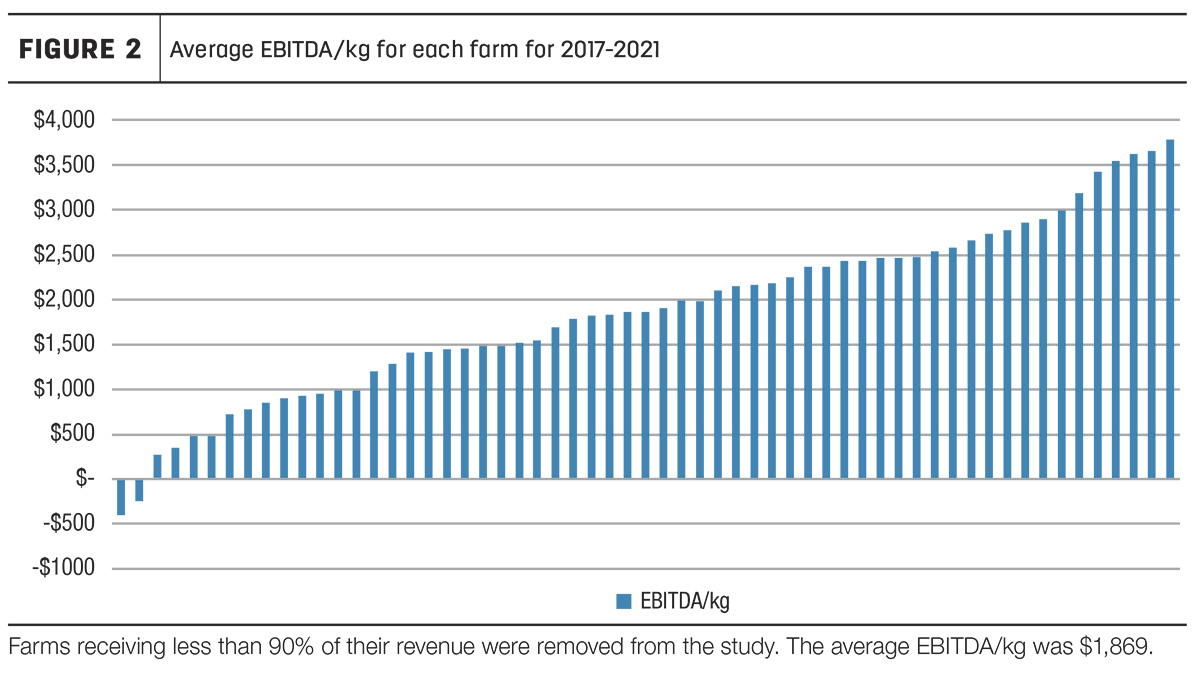
Participating herds were located in Ontario (53), Nova Scotia (3), Manitoba (2), Quebec (1) and British Columbia (1). Thirty-one accounting offices provided us with the available financial data, which was reformatted into a standardized format. Figure 2 shows the ranges of EBITDA per kilogram for the participating farms (each line represents the farm’s average EBITDA over five years).
Milk production and EBITDA per kilogram
One of my classmates served in the military. After a mission, they would discuss what went well and what didn’t. They were encouraged to start with the bottom line up front. Our bottom line is that milk production was not associated with EBITDA per kilogram.
Figure 3 needs some explanation. The top box shows that milk revenue remains unchanged as milk per cow increases. This makes sense because you are paid the same for each kilogram of butterfat (with some variation based on components), regardless of individual cow production. The middle box shows the operating (or variable) expenses per kilogram. We would have expected these to decrease as milk per cow increases (since fewer cows would be needed to meet the same quota), yet it was essentially flat. The bottom box represents the EBITDA per kilogram (revenue minus operating expenses), which remained flat as milk per cow increased (the curve in the line was not statistically significant).

Does this mean the concept of marginal milk is wrong? No, but the way we apply the theory is flawed.
Let’s switch species for a moment. If you are raising chickens for meat, the genetics of an average chicken are very similar to those of other chickens. All feed is purchased, with little variation. Barns are comparable between farms, and if you have a disease outbreak, you can start a new batch in six weeks or less. The theory of how chickens convert feed into growth aligns closely with real life.
In dairy, consider your best cow. Her genetics may differ significantly from your herd’s average. She might have had an easier transition and be near peak milk production. Now think about your herd’s average. Genetics, days in milk and transition all influence how your cows convert feed into milk, which can break the marginal milk equation. Additionally, your barn setup, forage quality and labour needs may differ from those of other farms, further affecting your costs to produce milk.
Here’s an example: A farm produces 34 kilograms of milk per cow at 4.2% butterfat and tells their nutritionist they want 38 kilograms, without wanting to change their management practices. The feed adviser adjusts the ration and successfully increases milk output. However, the feed costs must also rise to push the cows beyond the milk-to-feed ratio dictated by their days in milk, genetics and other factors. The producer gets higher milk yield but also higher feed costs, which may offset any increase in profitability.
Metrics related to efficiency
Our research journey was focused on helping you and your advisers get on the same page. Assuming the marginal milk-to-feed theory is correct, we aimed to identify what might be causing your farm to produce inefficient milk. Think of it this way: if you drive your truck with the brakes on, what does that do to your fuel efficiency?
We analyzed 22 metrics from various areas of farm management compared to EBITDA per kilogram. This included variables from genetics, forage quality, reproduction, transition health, longevity, replacement management, herd size and labour management. We identified four key factors associated with efficiency. Average days in first milk (DIM), average days dry, labour requirements and purchased feed as a percent of revenue were significantly associated with EBITDA per kilogram.
Days in milk
Herds with lower average DIM tend to have higher EBITDA per kilogram, which makes practical sense. If you feed a one-group total mixed ration (TMR) to your herd, which cows are more efficient at converting feed into milk – a cow at 100 DIM or one at 200 DIM? Similarly, herds with lower average DIM have greater financial efficiency. Days in milk is affected by factors like reproduction, transition and herd turnover; therefore, we recommend consulting with your veterinarian on ways to improve your herd’s average DIM.
Days dry
Dry cows do not generate daily revenue but incur daily expenses. Longer dry periods increase your overall costs, and cows with extended dry periods often face transition issues and produce less milk in the subsequent lactation. Conversely, short dry periods can also negatively impact future production. Most research agrees that dry periods of 40 to 70 days are optimal. We compared the percentage of cows dry during that period on each farm and found an association with higher EBITDA per kilogram.
Labour
Producers have various options for drawing income from their farms. Some take wages, some take dividends, and others do not pay themselves at all. Additionally, some farms employ unpaid labour, such as relatives. We considered these factors and found that farms with lower labour requirements tend to have higher EBITDA per kilogram. This is an area that many advisers may overlook; however, labour efficiency should be evaluated by the team.
Purchased feed as a percentage of revenue
Some farms had higher costs for purchased feed relative to each dollar of milk revenue, which reduced their EBITDA per kilogram. While it might be tempting to blame feed advisers or mills for overcharging, that explanation is likely too simple. Forages constitute 60% to 80% of most diets, and nutritionists rely on purchased feeds to balance the diet for peak production. If, for any reason, the forages are less digestible, the need for purchased feed will increase. We tried to incorporate forage quality metrics into our study, but we couldn't gather enough data from feed advisers to include this in the analysis. We recommend producers calculate their purchased feed cost percentage and work with their feed adviser to investigate opportunities for efficiency.
Conclusions
Dairy farming is complex, as are the factors that influence efficiency and profitability. In this series, we have emphasized the importance of viewing your farm as a business, collaborating with your advisers as a team and communicating with a common language. This installment recommends that dairy advisers and producers use EBITDA per kilogram as a shared measure of efficiency. Teams should focus on leading biological and operational metrics that impact the farm’s ability to produce milk efficiently. Ask your lender to help you calculate your EBITDA per kilogram. If you are dissatisfied with how your number compares to the national average, organize a meeting with your advisers to brainstorm ways to improve your financial efficiency.
Author's note: I would like to thank Drs. David Kelton and Todd Duffield from the Ontario Veterinary College, Dr. Louise Hayes from the Lang School of Business, and Dr. Michael Overton from Zoetis for their expertise and encouragement in overseeing these projects.