The applied research team at Lakeland College has investigated the use of genomics with phenotypes to better predict the success and longevity of replacement beef heifers in the cow herd, especially past their second calving. The objective of this project was to identify which variables are associated with greater reproductive performance (higher number of pregnancies) so replacement heifer selection can be done at an earlier age or stage in the production cycle.
Background
Fertility is the number one trait linked to profitability for cow-calf herds. It’s also of low heritability and sometimes difficult to assess, depending on your record-keeping system. Typically, it includes age at first calving, pregnancy rate, calving interval and longevity or stayability. Unlike the feedlot sector that relies on highly heritable growth traits, cow-calf operations need to focus on fertility first, then growth and carcass traits.
It is also well established that reproductive success in the first calving season is highly linked with a cow’s lifetime reproductive efficiency. So, in addition to good nutrition and health protocols, using commercial replacement heifer selection strategies that include evaluating conformation, body condition, weight, age and adherence to breeding seasons of less than 45 days make the most sense.
Until, however, there is a drought. During drought conditions, cattle are exposed to reduced nutrition, poor water quality and heat stress, which can lead to delays in reproductive development, estrus and maturity – especially for suckling heifer calves during the critical 4-to-9-months-old growth period. Since heifers that grow faster tend to reach puberty at a younger age, drought-induced growth impairment can negatively affect reproductive efficiency. Drought also means you might need to cull harder and at higher rates like 25% to 50% compared to the usual 15% to 20%.
The study
After selecting the heifers from reputable heifer development herds for conformation, age, weight and crossbred breed types, rumen boluses were inserted, and DNA was collected and analyzed. The heifers needed to be 55% to 65% of their mature bodyweight at breeding.
Heifers were palpated internally using ultrasound to assess reproductive tracts for any abnormalities, then scored for maturity on a scale of 1 to 5. This scan identified immature or abnormal ovaries and uterus as well as found freemartins. Scores of 1 are likely too immature to conceive in the first cycle, while scores of 2 and 3 will mature enough to be bred, with scores of 4 or 5 being mature and likely to successfully conceive in the first cycle. About 2% of the heifers were freemartins.
This scan should be done no more than 60 days (and preferably 35 to 50 days) before breeding or bull turnout dates.
Just because a heifer is born single doesn’t mean she will be reproductively sound. A single-born heifer can be a freemartin. The likely explanation is that the heifer had a bull calf sibling in utero that died and was reabsorbed, so was never known.
Breed composition and predicted growth, maternal and feed efficiency traits were gathered through DNA. Generally, hybrid vigour is an indicator of longevity and efficiency. Increased hybrid vigour is known to improve weaning weights, disease susceptibility and hardiness of the offspring.

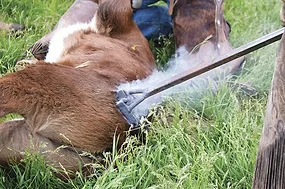
Using ultrasound technology to obtain a reproductive tract score on your heifers can help prevent pouring resources into females that will not be productive long term. Image courtesy of Lakeland College.
Results
The investigation of new technologies and processes for improving decision-making regarding reproductive selection and efficiency evaluations of beef heifers has uncovered numerous benefits and issues. Key results include:
- The research found strong correlations between heifers who ended up open and their reproductive tract score being low. These are reproductively unsound females using valuable pasture resources for breeding.
- Females with body condition scores greater than 2.75, teat scores that were neither too large nor too small, and those that shed more hair earlier in the spring and summer tended to be the heifers that got pregnant early or in the first two cycles in both of their calvings.
- Based on remote-sensing rumen bolus technology implemented in this project (providing daily water intake frequency, internal temperature and activity indicators to alert for cycling), the flightier heifers (based on a chute exit score) did not settle after processing and had elevated temperatures and reduced water and/or feed intake for a longer time period compared to the more docile heifers, resulting in poorer gains.
- Hip height was also significant, with a negative correlation to these fertility measures. Heifers that were too tall were less fertile than the moderate-framed ones for the breeding programs in the herds studied. Uterine horn diameter was significant and negatively correlated to our fertility and calving outcomes. However, that may be because those taller, larger-framed heifers with more continental breed influence had proportionately larger reproductive tracts. This reinforces the notion of selecting for the more moderate breeding females and not for the extreme small or large heifers. Clearly, visual appraisal and specific conformation assessments of heifers are good measures to select replacement breeding heifers.
- A breed influence was evident, as these more fertile, early-calving heifers tended to have more British breed influence and less continental breed, with approximately 65% British/maternal and 35% continental/terminal breed composition.
- This finding complicates the interpretation of the genomic results. Generally, research literature supports increased retained heterozygosity or more hybrid vigour (reported as the percent of gRH), as it may indicate females with improved fitness traits (feed efficiency and longevity). Conclusions from prior research have been made that more hybrid vigour results in females staying in the herd longer and thus producing more calves and income. To simplify this conclusion, we assume a three-way cross is near ideal. However, our study shows that the ideal breed types in that three-way cross, or those breeds contributing to that increased hybrid vigour, are not only location- and management-dependent but most likely need to be in higher proportions (2/3) from the maternal breed types, and less (1/3) from the terminal breed types.
- There is merit in the genomic tools with breed composition having value when sorting animals into mating groups for next year’s breeding season if ranchers wish to optimize hybrid vigour in the offspring. Such a tool allows for optimum bull breed selection to complement crossbred heifers. Selecting heifers based only on coat colour is not accurate enough to optimize the hybrid vigour and fertility outcomes.
- Return on investment calculations can show positive and worthwhile outcomes under certain scenarios when utilizing these various technologies, including reproductive tract scoring to sort females into breeding groups and genomic indexes for genetic assessment management. Obviously, assumptions specific to a ranch may influence the results and small herds may not see the benefits, but these technologies have promise for ranch adoption if more value can be demonstrated over longer periods of time.
Why it’s important
The financial risk of developing replacement heifers (currently ranging in cost from $2,500 to $4,500 per head) that don’t perform is reduced when they are evaluated beyond their external conformation and coat colour. Identifying subfertile and poorer genetic heifers early provides the opportunity to move them into a later breeding program to allow them to mature, or cull and market them at an optimal time and reduce the overall cost of the replacement heifer program on the ranch.