In reviewing large commercial datasets, experts are seeing certain patterns beginning to emerge – particularly as it relates to a cow’s ability to stay in the herd. These trends are important to be aware of to identify challenges as well as opportunities.

Let’s explore a few key trends identified from a subset of terminal (Figure 1) and maternal and terminal (Figure 2) index data representing more than 8,200 commercial heifers across the U.S. These trends highlight how genetic selection, especially when guided by genomic insights, can help producers make more informed decisions while avoiding the unintended consequences of single-trait selection.
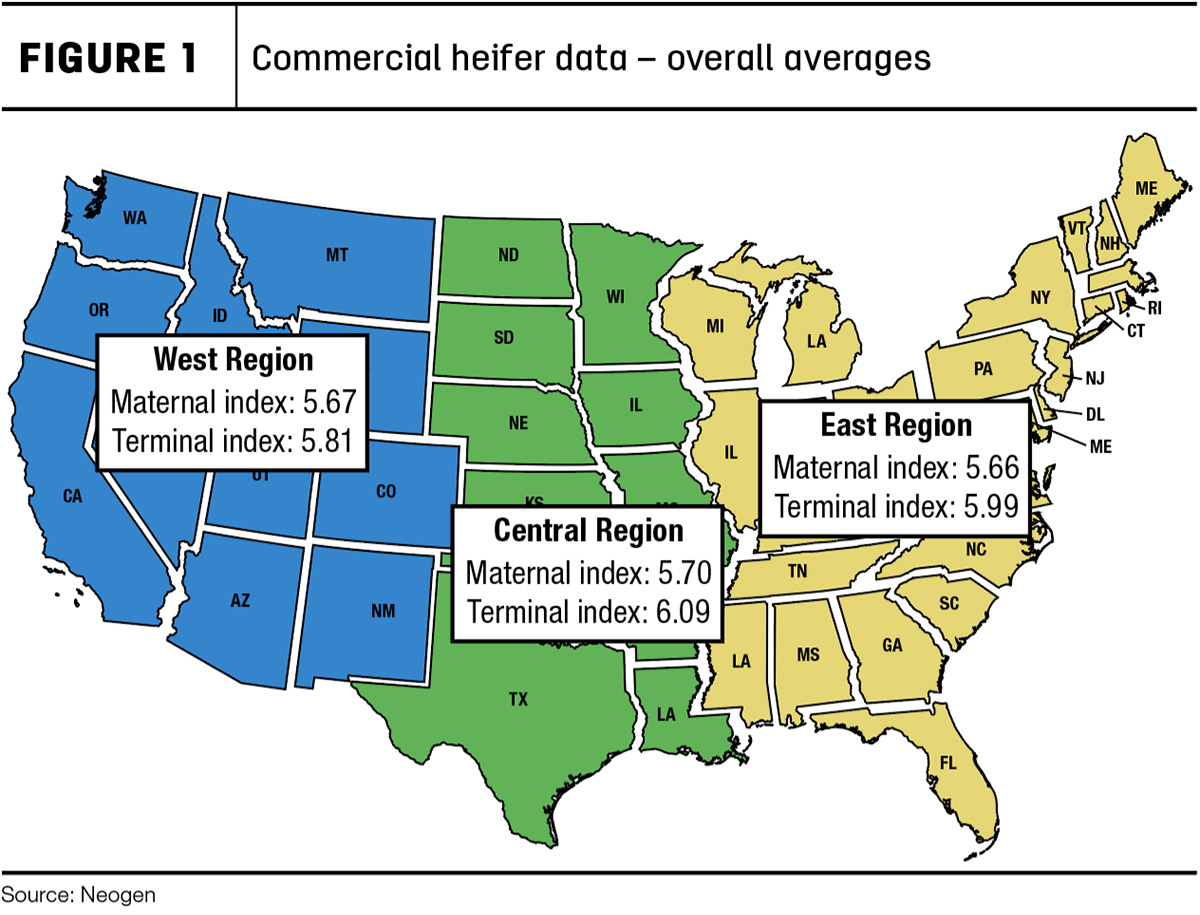
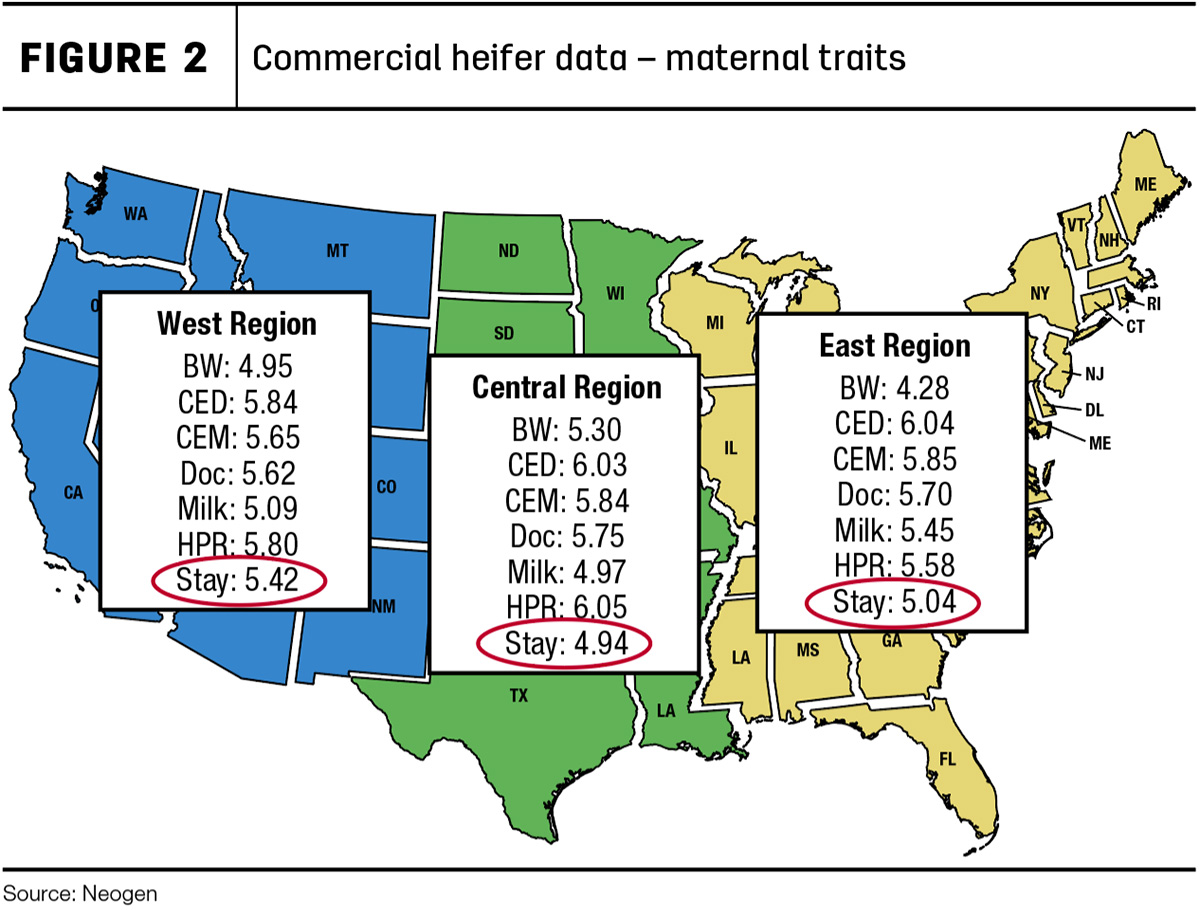
“The dataset covers averages from three different regions across the U.S. – West, Central and East regions,” says Sydney Tuckwiller, key account manager with Neogen. “Overall, terminal index scores continue to be higher than the maternal index scores.”
Why does it matter that terminal index scores are higher than maternal index scores?
“A major consequence of selecting for terminal traits includes decreasing Stayability,” says Paige Pratt, a beef genomics specialist with Neogen. “When you select for the terminal index, cows don’t stay. Selection for an increase of hot carcass weight while selecting for decreased fat thickness, results in cows with larger mature cow size that have less body condition. It is obviously an unfavorable combination in the replacement heifers produced.”
Stayability is the length of time an animal stays in the herd, measured by consecutive calvings, overall soundness and the ability of the cow to recover and rebreed. Heritability for Stayability is between 0.18 and 0.47. Traits negatively correlated to Stayability include hot carcass weight, weaning weight, yearling weight, average daily gain and marbling.
“Heritability for Stayability is higher when evaluating younger females – particularly around 2 years of age – because fewer environmental factors have accumulated to dilute genetic differences,” explains Tuckwiller. “As these females age, environmental variation increases and heritability declines, meaning we lose the ability to effectively select based on genetics alone. This underscores the importance of making early, data-driven replacement decisions rather than waiting until phenotypic differences become less genetically informative.”
3 trends in our cow herds nationwide
Trend 1: Overselection for Calving Ease Direct (CED)
“Something our industry is really great at across the three regions is selection for Calving Ease Direct; however, one thing that is a detriment to our cow herd is that by only selecting for calving ease, we are selecting for noodle-shaped calves instead of basketball-shaped calves,” Pratt says. “By breeding generation after generation of noodle-shaped calves, we are seeing a decrease in the Calving Ease Maternal (CEM), so the heifers produced in subsequent generations will have more dystocia issues due to overselection of CED without equal pressure on CEM. It is imperative that producers only utilize high-calving-ease bulls on heifers and don’t shift the heifer bulls to the cow herd when they are too big to breed heifers or have daughters that have been kept.”
Trend 2: Average cow age is decreasing
When selecting replacement heifers based on phenotype alone, we tend to keep the bigger, prettier females.
“We need tools to look under the hood and know more about cow longevity when selecting the females we are keeping,” Pratt says. “In addition to the utilization of genomic testing replacement heifers, a producer also needs to place emphasis on a dam’s calving interval and weaning weight ratio when purchasing bulls for their operation.”
Trend 3: Increased cow size
Another trending factor is that the calves are becoming too growthy for their available feed resources and environment.
“Yearling weight is positively correlated with mature cow size,” says Pratt. “And because of that, I have developed more custom indexes with a negative emphasis on yearling weight and a positive emphasis on average daily gain, with the end goal of finding replacements that offer growth but won’t increase the mature cow size.”
The opportunity before us
In short, raising productive and profitable herds of cattle can be a balancing act.
“As a producer myself, I think it is key to learn from these trends and findings,” Pratt says. “Maternal index scores are heavily influenced by Stayability, one of the two lowest genomic scores of all 17 traits shown in the nationwide comparison. When Stayability declines, the profitability of our herds will decline. This means there is still work to be done, and through genomic selection strategies – rather than single-trait selection – there are a number of opportunities available for producers.”
In 2023, the Kansas Farm Management Association (KFMA) calculated annual cow costs at $1,323.27 for a midprofit operation. Given that a bred heifer is worth $3,500 and salvage value of a cow is worth $2,000, the break-even calf price (given 100% of the calf crop makes it to weaning) for a 500-pound calf is described in Figure 3.
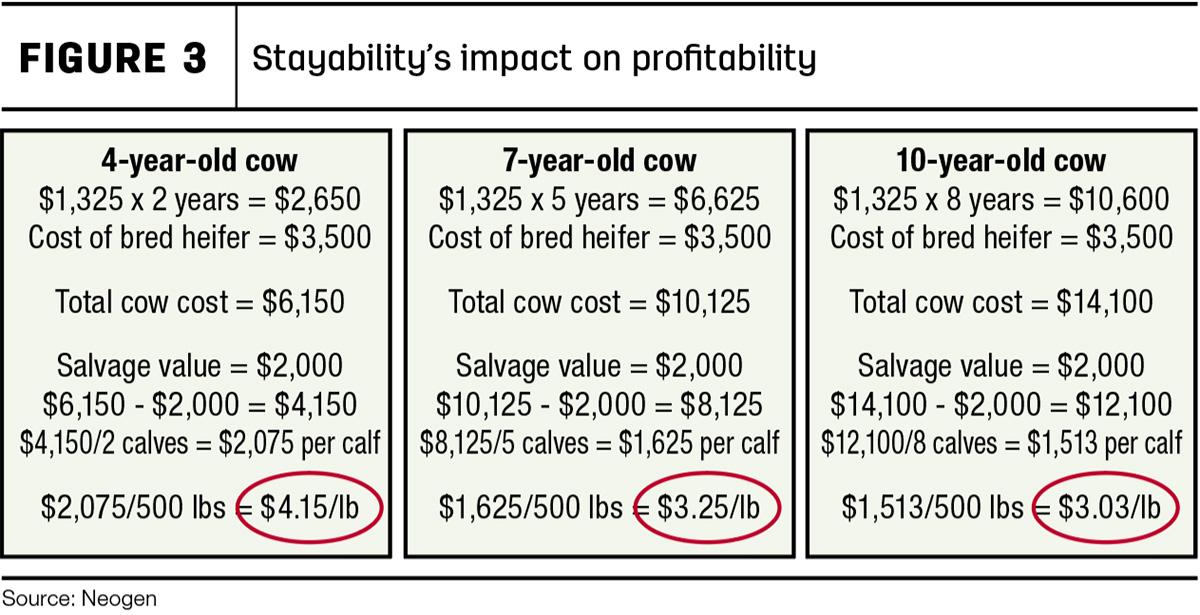
Even though Stayability is important, it is also important to note that single-trait selecting for Stayability may negatively impact growth and carcass traits, so using a multitrait custom index can enable producers to increase Stayability without sacrificing other traits of importance.
“You can design your own custom index by assigning weights to each trait,” says Tuckwiller. “This will allow you to rank the females and develop keep/cull lists more easily. [Genetic experts] can also work with you to ensure that what you are selecting for doesn’t have unintended consequences.”
Consider these trends, thoughts and the value of building a custom genomic index to turn these trending challenges into opportunities.
“Stayability is the fountain of youth we are all looking for, but we need to find the females that can improve multiple traits at one time to maximize overall profit in every cow herd,” Pratt concludes.