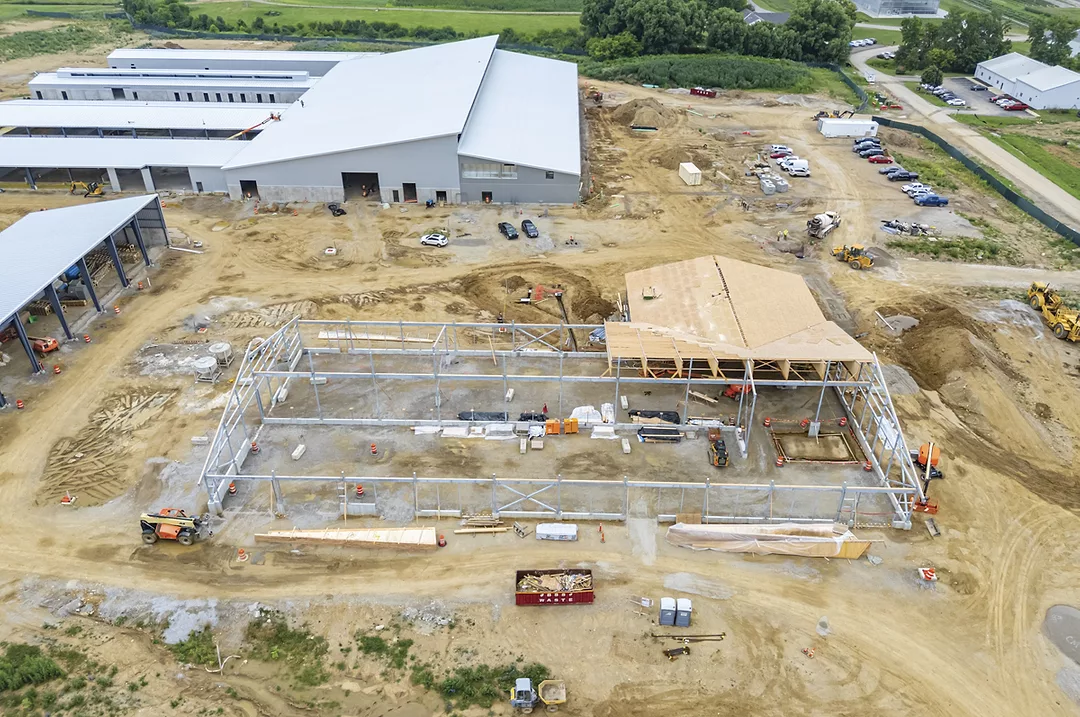
A modern dairy building with automated systems and a viewing corridor will soon replace the aging dairy facilities built in 1972 at Waterman Dairy at Ohio State University in Columbus. Initial conversations about renovating the facilities began in 2019 while working on the master strategic plan for the college.

“After much discussion and cost analysis, it was determined that it would be more cost-effective to tear down the outdated structure instead of renovating the building,” says Graham Cochran, associate dean of operations in the College of Food, Agricultural and Environmental Sciences (CFAES) at Ohio State.
Maurice Eastridge, professor and senior associate chair in the Ohio State Department of Animal Sciences, adds, “With the importance of the dairy industry to Ohio’s economy, and the large student base with interest in dairy cattle, it became obvious that we needed modern, state-of-the-art facilities to use for teaching in preparing the new generation of students for working in the industry.”
At the new facility, the herd will be comprised of three groups, including 60 lactating cows (16 cows can be in a research group), approximately 15 dry cows and springers, and approximately 16 calves. Previously, the dairy herd consisted of 110 registered Jerseys.
“This modern, fully autonomous dairy will not only revolutionize how we teach and study dairy farming, but it will also serve as a model for sustainable and technologically advanced agriculture,” Eastridge says. “With this state-of-the-art technology, the opportunities for research and learning will be vast. Students and faculty will want to come here because it’s the future of agriculture. Even at this early stage, it is having a positive impact on student recruitment, as the incoming class and future students will have full access to this facility during their academic program.”
Some of the technology used will be two Lely Astronaut A5 milking robots, the Lely Vector automated feeding system and two Lely Discovery manure vacuums. The barn is naturally ventilated and the fans, curtains and misters will be automatically managed through thermostat controls.
This new facility will replace the older double-eight herringbone milking parlor, 100-cow freestall barn and 60-cow tiestall barn.
Dairy farm manager John Lemmermen says the main reason they opted for two milking robots instead of one for the smaller herd size is to provide time for more learning opportunities for dairy students as well as agricultural engineering students.
“The best thing about this is that the students working at the dairy won’t be spending all their time in the parlor milking cows,” Lemmermen says. “They will have more time to get out in the barn and actually interact with the cows more and will be able to do more of the health checks. Students will also help out a lot with the tours.”
Additionally, student employees at the dairy will be responsible for bedding, refilling the feed kitchen, fetching cows twice a day, health checks and feeding calves – among other tasks.
Instead of raising calves in outside hutches like in the old facility, new calf housing will be built in the main dairy barn with individual pens for pre-weaned calves. Weaned calves will then move into group housing until they are moved to the CFAES Wooster heifer development facility at 6 months old. Springers return to Waterman Dairy 60 days prior to calving.
At the new dairy facility, all animals will be in the same barn, and all groups will have access to pasture, except the calves. The research pen’s access to pasture will depend on the research. Dry cows will be housed in freestalls and moved to the maternity pen when signs of calving occur.
Previously, cows used in research projects were housed in tiestalls. Now, the research area will include 16 stalls in the freestall area with a feeding system that allows for the measurement of individual cow intakes – dry matter intake, the amount of time they spend eating and other data. Additionally, another area within the new barn will be available to house up to four cows for metabolism research.
“We were really restricted in the old facility, and it was very labor-intensive for conducting research,” Eastridge says. “We did a lot of hand mixing, delivery and weighbacks of feed. All this will be automatic in the sense of weighing, so it will be a tremendous asset. Then those animals will be going to the robot to be milked, and we will have all the data from the robot for these research cows.”
Currently, all milk from CFAES Wooster and Waterman Dairy is shipped to Prairie Farms. The new dairy facilities will have space for potential future milk processing that could complement CFAES efforts from the dairy pilot plant on the Columbus campus.
Foundations, steel and roofing were completed over the summer. The walls and ceilings in the offices, milk room, lab spaces and all internal work on the dairy barn will be finished by the scheduled completion date in December 2025.
Showcasing modern dairy farming to the public
Tours have been a mainstay for decades and will be open to a variety of groups, ranging from K-12 students, college students, industry groups, international visitors and the public. The primary focus will be to teach youth about modern agriculture and increase awareness among youth and teachers about the vast array of careers in the dairy industry. Discussions are currently underway to design and build custom displays.
Public viewing areas will provide a transparent look into modern dairy production, making the process more accessible to those who know nothing about the dairy industry. The farm’s biosecurity plan will also limit where visitors can go to protect animals and people.
“Aside from the students, the other key part of these K-12 tours is the education for the teachers, because then they can tell the story beyond that specific visit with other students. They can also integrate the information within other curriculum throughout the year,” Eastridge says.
Plus, not being tied to a milking schedule will allow more visitors to see how cows are milked firsthand.
“Most of our tour groups in the old facility never got to see a cow being milked because we milk at 4 in the morning and 4 in the afternoon, and it’s not conducive to people getting out of Columbus without dealing with rush-hour traffic,” Lemmermen says. “That’s one of the big things we are excited about. That will be great not only for the little kids but also college classes and everyone else that visits us.”
Funding
The $6.2-million price tag for the dairy portion of the project is funded through CFAES and through gifts from alumni and partners. Fundraising is led by their advancement team and has focused on alumni, stakeholders and industry partners. Several spaces in the dairy have already been named through generous donations.
The new dairy is part of an overall strategy for the Waterman Agricultural and Natural Resources Lab, which is a 261-acre learning lab on the Columbus campus at Ohio State. Aside from the dairy, the Multispecies Animal Learning Complex (MALC) will include classroom space, offices, labs, a locker room, a large arena and separate barns for swine, poultry, equine and ruminants, each built with biosecurity in mind.
“Come and see us,” Eastridge says.