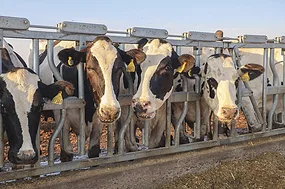
While most of us focus on how to move manure, store it and land-apply it, there's a growing interest in what else manure can do for the dairy. One of the more intriguing ideas? Turning it into bedding.

Giving sand its due
For a long time, if you asked what the best bedding was for dairy cows, the answer was easy: sand. Soft, inorganic, non-supportive of bacterial growth and cows love it. It doesn't pack like sawdust or get slick like manure solids, and it won't cost you in somatic cell count (SCC) if you keep up with stall management.
From a cow comfort standpoint, sand is tough to beat. It conforms to the body and provides traction when cows rise or lie down. Because it's inorganic, it doesn't feed bacteria the way organic bedding materials can. That means a lower mastitis risk, fewer hock lesions and higher lying time. Sand bedding makes cows happy. And when cows are happy, milk happens.
But while sand is excellent in the stall, it's not always so great everywhere else on the farm.
While it behaves well under cows, it behaves terribly in manure systems. Once sand leaves the stall, it begins its journey as an abrasive slurry that doesn't care what it grinds. Pumps, valves, agitators, nothing's off-limits. Constant abrasion leads to premature equipment wear, clogged pipes and maintenance headaches. The sand often settles in inconvenient places: Anywhere it can accumulate, it will. Eventually, someone's going in to dig it out, and they won't be happy about it.
Recovering sand: Making the gold standard a bit more sustainable
Recognizing the challenges sand brings downstream, many dairies have turned to sand separation systems to recover and reuse it. And credit where credit is due: Modern sand recovery has come a long way.
What started as rudimentary settling lanes has evolved into engineered systems with slope, flow rate, turbulence control and even mechanical separation. Systems now range from passive gravity lanes with automated scrapers to hydrocyclone-based setups and vibrating screens. These aren't just bolt-on fixes; they're management tools that help close the loop on bedding.
 This is an example of a sand settling land with a sand separation system included. Image provided by Daniel Andersen.
 When dialed in, a good sand separation system can recover 85% to 95% of the sand and do it consistently. That's sand you don't have to buy again, which translates directly into cost savings. It also means less buildup in your manure storage and fewer surprises when the pumper shows up.
Recovered sand typically needs time to drain and dry. Some operations go the passive route, move, stack and let sun and time do the work. Others go mechanical, investing in sand washers and dryers to speed up turnaround and pasteurize sand quickly. It's ready for another round in the stall once it's clean and back to the proper moisture level.
Still, even with good recovery, sand is heavy, hard on equipment and doesn't always play nicely with manure systems. While sand remains a gold standard, some farms are starting to look in a different direction, one that turns a liability into a resource.
Manure as bedding: Engineering a closed-loop solution
Traditionally, we've focused on storing it, moving it and getting it out to fields in ways that keep nutrients in the soil and out of the water. But more recently, some farms have started asking a different question: Can we close the loop? Can manure, the very thing we work so hard to manage, also serve a productive role right back in the barn?
That's where recycled manure solids come into play as a potential bedding source. At first blush, it sounds like a bad idea. You want me to bed cows on manure? But the science and practice has shown us it can work.
Recycled manure solids systems capture the fibrous material in manure, essentially what the cow couldn't digest, and repurpose it as bedding. It's a circular economy model that asks: What if waste isn't waste at all?
Turning manure into bedding isn't a plug-and-play solution. You can't just scoop it out of the pit and toss it in a freestall. You need the right equipment, treatment and daily management to make it work.
Separation systems: Getting the fiber
The first hurdle is separating the solids from the liquids.
On the simpler end, you've got screw presses and roller presses. These low-energy, relatively affordable machines push manure through a screen, leaving you with a moist, fibrous material, typically around 30% to 35% dry matter. With some additional innovations, companies have gotten dry matter up to the low 40% range. It is not exactly fluffy dry sawdust, but it is not sludge either.
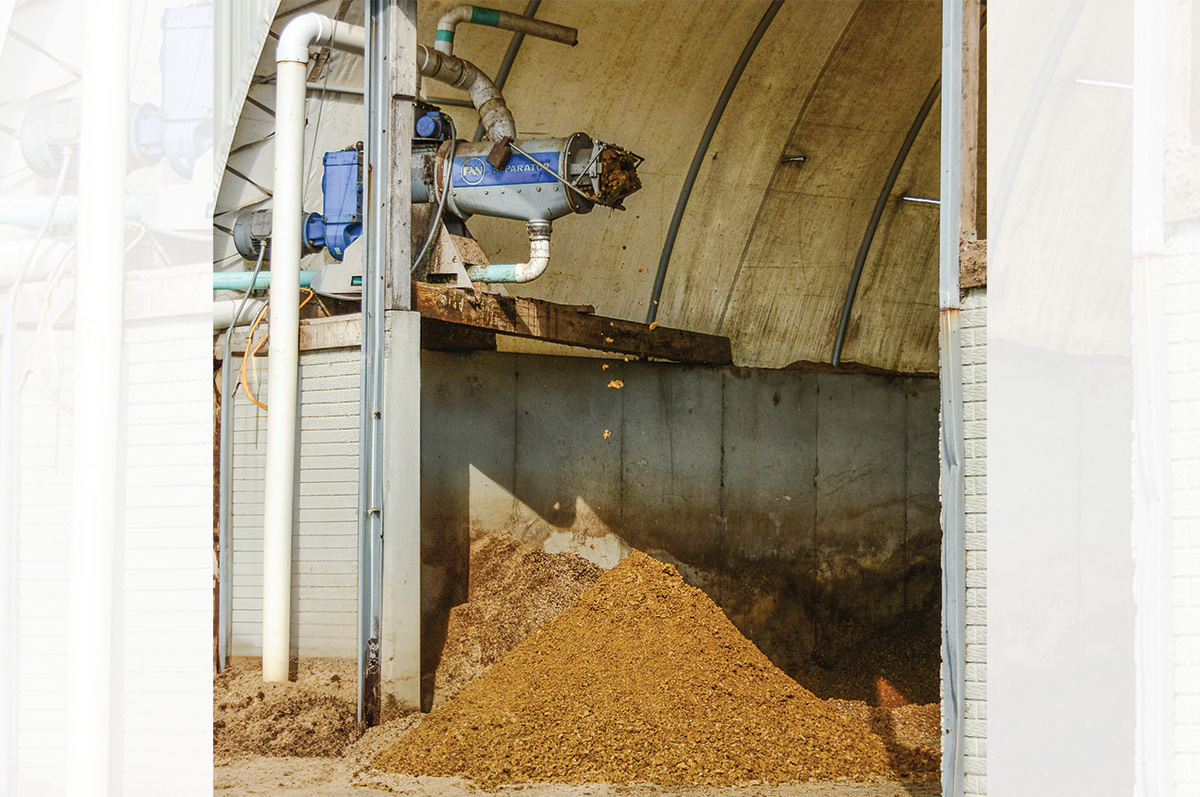
A FAN screw-press separator separates manure fibers at a deep-pit dairy barn in northwest Iowa. Fibers are recycled as a bedding material for cows at that farm. Image provided by Daniel Andersen.
You might use a centrifuge if you want more solids or to capture finer particles. These systems spin the manure to separate solids based on density. They're more capital- and energy-intensive but can produce a drier material and capture more solids.
Some farms dealing with dilute manure, like in flush systems, might use slope screens or vibrating screens. These are effective at removing larger solids but often must be paired with secondary separation (like presses) or drying steps if targeting use for bedding.
No matter your system, the goal is to isolate a consistent, fibrous product with enough structure to serve as bedding. While doing so, get the pathogen load and moisture content low enough that it won't cause problems in the stall.
Treatment options: Heat, time or bugs
You've got solids, but you're not bedding cows yet. Solids often need additional treatments to reduce pathogens and moisture before becoming viable bedding material. While solids may be dry enough to use as bedding material in some cases, they won't be in many situations.
Fresh solids can be composted in static piles for three to 10 days, in windrows turned every few days for a couple of weeks or in mechanical drum composters for one to three days. Properly composted material can reach internal temperatures over 130°F, reducing pathogen loads including E. coli, Streptococcus and Klebsiella. But composting takes space, time and management. You'll need to monitor pile temperatures and moisture content to ensure consistent success.
There is such a thing as too much composting. Leave it too long, especially under high heat and aerobic conditions, and the solids can degrade past the point of usefulness, turning fluffy fiber into crumbly fines instead of a springy, supportive material for stalls. Overcomposted material ends up with smaller particles and less structure, so when used as bedding, it goes from being OK to too wet quickly. The trick is to hit that sweet spot – enough heat and time to knock down pathogens but not so much that you compost away your bedding value.
If composting is part science and part art, drum composters are the Swiss Army Knife of bedding prep: compact, contained and engineered for consistency. Load the solids into a rotating drum, let it tumble, heat and aerate, usually in one to three days. They give a more uniform mix that hits high temperatures quickly and keeps your particle size intact by getting the job done fast. These systems require capital investment, electricity and maintenance but may fit the bill if you're tight on space or need predictability.
If you want dry material fast, heat's your friend. Mechanical drying systems, whether rotary drums, belt dryers or even forced-air beds, can drop moisture in solids down into that nice, workable 45% to 55% range. At that point, you've got a product that stores better, handles cleaner and spreads more like sawdust than sludge, and given the heat in their systems, leads to pathogen reduction.
The catch? Drying manure takes energy. That's where waste heat comes in. If you're running a digester with a combined heat and power (CHP) system, capturing that thermal energy helps make this a practical, sustainable solution. Some farms opt for anaerobic digestion as a pretreatment for the solids. While digesters don't sterilize the material, they reduce volatile solids and pathogens, and the post-digested fiber is often easier to separate. The digester route also opens the door to energy production via biogas and the potential for waste heat.
What's left behind? Manure as fertilizer after bedding recovery
When we use manure solids for bedding, we inevitably change what ends up back in the pit and ultimately makes it to the field. If you're like me, someone who thinks about nutrient cycles as much as cow comfort, that shift is worth discussing. When we separate solids for bedding, we're essentially skimming off the manure's carbon and organic nitrogen pool. More phosphorus might also move with the solids, depending on the particles we capture. The liquid manure that gets left behind is a thinner, more liquid fraction richer in ammonium. For most operations, manure entering the pit becomes a faster-acting nitrogen source. That's not all bad. It can be a win for spring or sidedress application strategies, especially if you're chasing quick nitrogen response.
Also, those solids aren't leaving the farm; they return to the stall, get used and are collected with manure again. As this is happening, some of the solids and organic nitrogen will break down into smaller pieces and ammonia. Fewer particles will be captured when they pass through the separator the second time, eventually making it to the storage. The nutrients captured are still there, and they will either eventually pass through the separator with the liquid or reach a field with the extra solids generated. These systems will do little to change a farm's nutrient budget, but they might modify the form nitrogen takes when it makes it to the field or the ratio present due to some being in the solids.
Not a silver bullet, but a thought worth having
Using solids takes upfront investment, consistent management and a willingness to rethink parts of your manure system. But in a world where bedding costs keep rising and sustainability matters more yearly, it's worth asking the question. After all, you've already paid for the feed, the cow to chew it and to collect what came out the other end. Why not see if that manure can do more work before heading to the field?
References omitted but are available upon request by sending an email to the editor.