One of the drawbacks with getting older is that you remember, hopefully, what things used to cost as compared to today. This is a very common and frequently brought up concept among dairy producers and farmers we work with when it comes to talking about capital investments, especially equipment. The comment is two-sided: “It’s expensive to fix this thing” is then followed by “Have you seen what a new one costs?” After reminiscing for a bit about a time when equipment purchases seemed easier, the final question is, “So what should I do, repair it or replace it?”

On the surface, this dilemma has many considerations, and the general answer is that in some cases it is better to repair and other times it is better to replace. Knowing when to take action on one versus the other is also part of a bigger strategy for managing your operation.
Understand ownership vs. operating cost
It is first important to understand the difference in your ownership and operating cost of the equipment. Ownership cost encompasses its purchase price along with financing cost. You can track this through your monthly payments on the equipment or its depreciable value. A tractor purchased two years ago that you are still paying off has a higher ownership cost than a 15,000-hour tractor that has been paid off for 10 years. That older tractor is likely at its salvage point, so it doesn’t cost much to own it.
On the flip side, operating cost is what you would typically think of in terms of fuel, oil, tires, insurance and repair costs. These costs are variable based on the number of acres or hours the equipment is running. Again, several clients track the fuel usage and maintenance cost for individual pieces of equipment to track and trend the operating costs. Over time, they can see if their operating expense is increasing while their ownership cost decreases and whether the operating expense is increasing at a rate that would be offset by higher ownership cost and lower operating expenses.
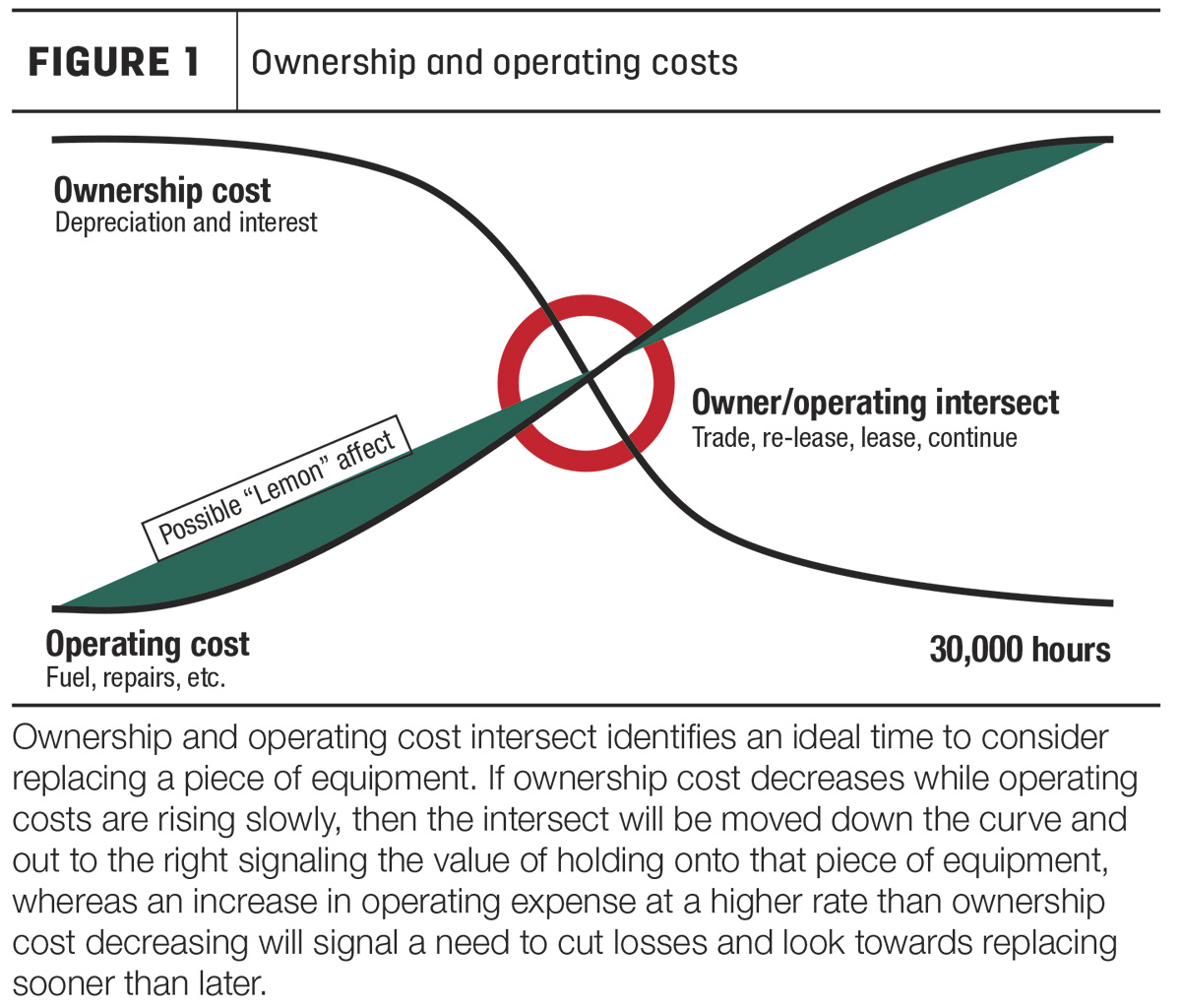
Keep in mind, the intersect of ownership and operating costs generally is an ideal time to consider a trade. If operating costs are not increasing significantly while ownership is dropping, it might be a piece of equipment you could hold onto for quite some time to maximize its full value, whereas if operating costs are skyrocketing very early on, this might be a sign the piece of equipment is a “lemon” and statistically will not have lower operating expenses in the future, and an earlier trade than desired might be warranted (Figure 1).
Consider what is in front of you
Take into account the history of the piece of equipment in question.
- Has it been reliable up to this point?
- How old and how many hours are you at currently?
- What has its useful life cost you per acre or per hour?
- Are you happy with the overall performance, but you are simply seeking an upgrade of horsepower or technology offerings?
Does the current piece of equipment align with your size of operation or supporting equipment (something smaller would be insufficient and anything larger might not reach its full efficiency)? Do you have a standardized line of duplicates already? Many of our clients have standardized skid loaders, for example, and are running the same ones with hand controls so employees moving from one to the next don’t really have to adjust. Perhaps replacing one or two skidloaders would affect this and an entire evaluation of line might need to be considered.
Maybe the tractor you have is at 25,000 hours. It has been reliable and achieves what you need it to do; however, you are worried it will quit one day. It is good to consider that this equipment will have little trade-in value likely, you have maximized its full ownership cost and maybe maintenance has been reasonable. In this case, this piece of equipment doesn’t owe you very much and is likely best to keep around as a backup in case a new piece of equipment goes down. When evaluating the replacement, it gives you a clean slate to consider all options, as you are not limited to trade-in considerations.
How much of the repair cost could go toward the cost of a new piece of equipment? Sometimes when we evaluate repairing equipment with major investments, such as overhauling engines or replacing transmissions, we need to estimate the useful life of that investment and whether we are better to make the repair and run the equipment or look to replace it. Sometimes we evaluate mid-level repairs and even a $10,000 or $15,000 repair could go a long ways toward making payments on a newer piece of equipment. This situation is sometimes challenging to make because there is an assumption around the useful life after a major investment in a repair or whether the repair is going to be recurring frequently.
Consider the replacement
When considering a new or newer piece of equipment, there are several key questions to consider. Answering “yes” to one of these is necessary for purchasing the new equipment.
- Did we determine, through our analysis, that purchasing a newer piece of equipment is cost-effective in replacing old and poor-performing equipment? This has arisen with the example of TMR mixers. Many of our clients routinely trade mixers at roughly five years of life and finance them on the same timeline. They do so because the analysis has told us that mix quality, size, mixing efficiency and timeliness is better in newer mixers as compared to replacing the lining or screws of older mixers.
- Is it needed for expansion or will it help reduce hours on existing equipment? Sometimes, the issue is not that the existing piece of equipment is poor or growing in operating cost, but rather that its operating costs are rising faster in relation to the decrease in its ownership cost. In this case, we are simply running the tires off of the equipment and having to run it longer to replace it faster than ideal. In this case, a secondary piece of equipment to help reduce hours may help better align the existing equipment.
- Will an investment help make gains in production or reduce costs? Again, based on the trend analysis of increasing repair costs, it might be worthwhile to replace, but even if the analysis shows a breakeven, will a newer piece of equipment improve productivity? Again, we evaluated with a client that he only needed a quarter of a pound of milk production increase to make the payment on a TMR mixer. Not only did a slightly larger mixer improve shaker box scores, but he reduced his mixing time each day by almost an hour. That is an hour less fuel, less labor and 365 less hours on the mixer tractor each year. At this point, it made sense to trade up.
- Will the investment create efficiencies within the operation? Again with our mixer example, the upgrade reduced the number of hours we spent mixing feed. This improved equipment and labor efficiency. Many dealers will “sell” the concept of efficiency, but unfortunately for a variety of factors, efficiencies are rarely fully realized. It isn’t that newer equipment cannot be more fuel, labor or performance efficient, but rather the circumstances or conditions on the farm need to be just right in order for them to be fully achieved. Be cautious of overestimating efficiency.
Dealer specials and warranties
Sometimes dealers will be able to offer package deals on equipment that can make the analysis more challenging. For example, let’s say you are considering trading in three older, higher-operating-cost tractors for two newer, larger tractors with more technology and horsepower. In this case, it is not an apples-to-apples comparison. However, be mindful of the steps listed in this article along with a longer-term focus on what is really needed on your operation. Sometimes “deals” are there to distract you from the analysis you performed. Warrantees carry a lot of value in the final analysis as well. In some cases, extended warrantees can reduce the cash outlay for future repair costs and are more manageable to budget. Consideration of leases could be evaluated as part of the decision and carry their own sets of benefits and risks we did not highlight in this article.
Understand and track ownership and operating costs of existing equipment, evaluate and weigh the needs of the operation with projected costs to carry existing equipment versus replacements, and consider alternatives in a larger view of your equipment needs.
This article is provided for information purposes only. Readers should consult their own professional advisers for specific advice tailored to their needs. Information contained in this article may be subject to change without notice.