For more than 30 years, Forage Genetics International (FGI) has led the alfalfa industry by breeding, developing and producing alfalfa seed and technologies that have advanced farms and ranches across the U.S.

Decades of research in alfalfa genetics, trait development and variety selection have resulted in multiple patented innovations that continue to shape modern forage systems. As a recognized leader in seed technology, FGI staff have advanced conventional breeding and trait integration to deliver the only traited alfalfa options available – spanning dormant, semidormant, and nondormant varieties – providing producers with the flexibility to tailor forage systems to their specific climate, harvest schedules and livestock performance goals.
“Our dormant, nondormant and semidormant products can be utilized across the U.S., as well as internationally,” says Dr. Emily Meccage, director of research, development and innovation. She adds that one of their traited alfalfa options combines herbicide tolerance with reduced lignin content, which means the plant remains more digestible even as it matures, giving producers greater flexibility in harvest timing. Producers can either use traditional cutting intervals and benefit from improved forage quality or extend those intervals to capture more yield – without sacrificing nutritional value.
Recently, FGI, which is a subsidiary of Land O’Lakes, held a research facility and plot tour at the facility in West Salem, Wisconsin. Attendees got a first look at what is next in alfalfa and access to forage experts. Meccage provided an overview of research capabilities, technologies and the ongoing commitment to innovation. She also focused on how FGI is advancing forage products that help growers with their farms and ranches while bringing advancements to market more efficiently than ever before.
Long- and short-term sustainability
When asked how they balance short-term profitability with long-term sustainability in their research priorities, Meccage says that it’s one of the things she gets passionate about, because alfalfa has so many benefits to offer.
She explains one of the long-term effects when alfalfa is in a rotation is that it can help to decrease erosion, keeping organic matter in the fields a lot longer.
“We're actually seeing in some research, two times the soil retention, even on sloped fields, with alfalfa in that rotation, and because it's a perennial and not planted every year, we're not tilling up the soil,” says Meccage, who was drawn to alfalfa research because of its flexibility in how it’s grown and used – it’s a very adaptable plant. “Every year, those roots hold that soil; it holds the nutrients in that field a lot longer as well, and because those roots are able to grow very deep, again, they're able to transport those nutrients and water throughout the soil profile much better than an annual plant can.”
She points out another characteristic of alfalfa is that it's great at absorbing toxic and heavy metals from soil, which helps to create a safer water source for people.
“Some places in the Chesapeake Bay watershed, and places in Minnesota, are asking people to plant alfalfa where they have pollutants like phosphates in their water to help soak up those excess nutrients and make it a safer water source,” adds Meccage.
Some of the short-term benefits of alfalfa include adding nitrogen (N) back to the soil. For example, if a producer is thinking about growing alfalfa in Minnesota for three to four years then terminating it to plant corn, because the alfalfa can add that N back to the soil, it can supply the N the corn crop needs that first year and 50% of what it needs for the second year.
“We're significantly reducing the amount of nitrogen that we have to apply to that field, and then also that's going to help to decrease our overall greenhouse gas emissions from the production of nitrogen as well,” says Meccage.
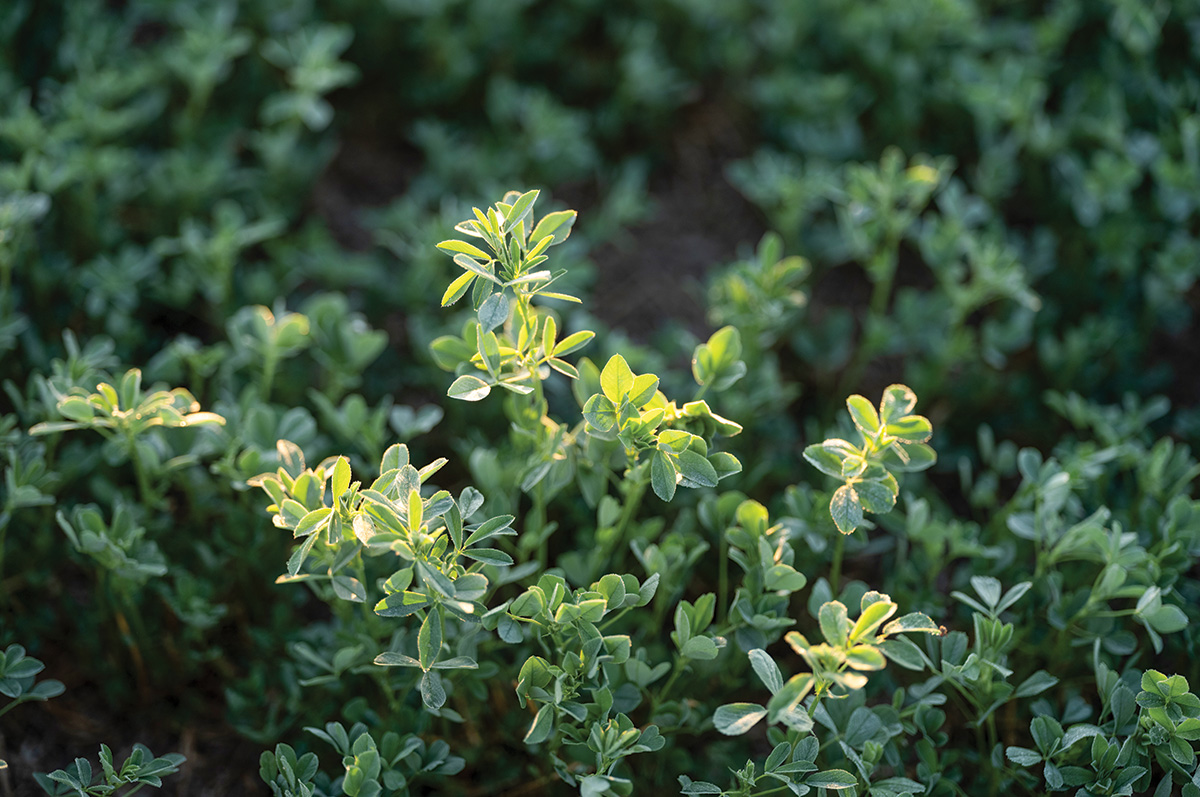
As a perennial, alfalfa is very adaptable and is flexible in how it is grown and used. Image courtesy of Forage Genetics International.
Breeding priorities
In the world of forage genetics, few crops offer the versatility, sustainability and nutritional value of alfalfa.
“When we evaluate new varieties, it’s always yield, yield, yield,” says Meccage. “We’re constantly asking how we can develop a plant that performs under any condition.”
With trial sites across diverse geographies, the breeding program targets region-specific challenges while maintaining broad adaptability.
“Improved resistance doesn’t just protect the plant – it boosts yield and resilience, even against threats we haven’t even identified yet,” says Meccage.
Besides forage quantity, she says they are also looking at forage quality.
“They might look great, they might produce well, but if they don’t meet the minimum forage-quality requirements, they don’t become a commercial product,” says Meccage. She adds that yield quality and pest resistance are two other factors they explore. “It’s a rigorous process, but it ensures that only the best make it to market.”
Rethinking alfalfa’s underestimated role in dairy diets
Despite its widespread use, alfalfa’s nutritional value is often underestimated in dairy diets.
“Current models don’t fully capture alfalfa’s buffering capacity or its rumen undegradable protein content,” says Meccage. “There’s a perception that alfalfa’s protein is mostly rumen degradable, feeding microbes but not the animal directly. But our internal research shows higher rumen-undegradable protein levels than previously thought – across dormant, semidormant and nondormant varieties.”
While they don't have enough published research yet to change the models, Meccage says they are teaming up with researchers at universities across the U.S. and that they are also looking at fiber digestibility.
“Once we get more information and research to back it, then, hopefully, we'll be able to update the models.”

Alfalfa has a deep root system that can fix nitrogen back into the soil, absorb nitrates and phosphates, and reduce runoff and erosion. Image courtesy of Forage Genetics International.
Increasing alfalfa acreage
Growers often weigh alfalfa against high-yield alternatives such as corn silage or distillers grain, but when viewed through a systems lens – soil health, crop rotation, livestock nutrition and long-term sustainability – Meccage says alfalfa reigns supreme. “It’s not just a forage crop; it’s a multifunctional asset that benefits every acre.”
And then add in the flexibility that alfalfa has to offer.
Engaging urban audiences in alfalfa sustainability potential
Alfalfa often gets mischaracterized with urban audiences – especially concerning water usage.
Meccage says to counter this, they are:
- Sharing how alfalfa improves water quality by absorbing nitrates and phosphates, and how its deep roots reduce runoff and erosion
- Publishing articles from plant pathologists, agronomists and nutritionists to add credibility
- Collaborating with environmental groups and water conservation and sustainability advocates
Alfalfa’s hidden values
Alfalfa often loses out to corn silage in yield comparisons, but that’s only part of the story, and that’s why FGI staff focus so much on yield.
Meccage says that another major hurdle is the lack of crop insurance, which discourages lenders and limits grower options. “For several years, our national alfalfa group has been working on an alfalfa insurance program for growers, and our hope is that for the crop year 2026, there should be an alfalfa insurance program for growers."
Also, alfalfa is an investment because it's there for multiple years – it seems like a significant capital investment in that first seeding year, Meccage says, that can sometimes deter people.
“Because it's a perennial, and when we look at the inputs spread out over that period of time, generally, alfalfa is going to be a lot lower costing than some of the annual alternatives,” adds Meccage.
With better risk tools and long-term economics, alfalfa deserves a second look – not just as a forage crop, but as a strategic asset.