The integration of automated milking systems into modern dairy operations represents a significant technological advancement, primarily driven by the desire to reduce labor costs and address persistent labor shortages. While these systems are widely recognized for their capacity to increase milk yield and enhance cow welfare, their sophisticated data collection capabilities offer substantial advantages for optimizing reproductive management in dairy cattle.

Research indicates that automated milking systems can markedly improve heat detection accuracy and consistency through 24-7-365 activity monitoring and in-line milk analysis, thereby overcoming the limitations of traditional manual observation. The extensive, individualized data automated milking systems generate provides opportunities for more precise and proactive reproductive management decisions and potentially improve conception rates, pregnancy rates and reduce the critical days open period. However, the direct impact of automated milking systems on overall reproductive efficiency is contingent upon farm-specific management strategies, successful cow adaptation to the automated environment and the effective utilization and interpretation of the collected data. Recommendations emphasize the critical role of comprehensive training, optimized facility design and a data-driven management approach to maximize the reproductive potential offered by automated milking systems.
Automated milking systems typically contribute to increased milk production, with reported increases ranging from 3% to 8%, with some installations achieving a 15% increase in daily production. This enhancement is largely attributed to higher milking frequencies, with cows in automated milking system environments averaging 2.5 to 3.2 milkings per day. This voluntary milking process creates a more natural, gentle and predictable experience for the animals, a stark contrast to the fixed schedules of conventional milking. While we often see examples of cows entering a holding pen, or even running to the pen, it is a trained response, not an indication of a stress-free environment.
Accurate data
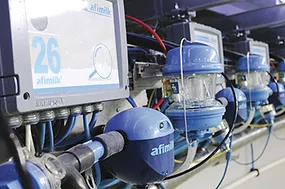
A benefit of automated milking systems is their capacity to generate large-scale, individualized data on a routine basis, providing for precision management across many animals. This shift from manual labor to a data-centric management approach represents an opportunity for change in farm operations as well.
Reproductive efficiency stands as a critical determinant of profitability and sustainability within dairy herds. It directly influences calving interval, the length of productive lactation cycles and the rate at which replacement animals are needed. Key performance indicators (KPIs) in reproductive management include heat detection rate, conception rate, pregnancy rate, days open and calving interval. Undetected estrus periods and prolonged days open lead to significant economic losses for dairy producers, underscoring the need for efficient reproductive management programs.
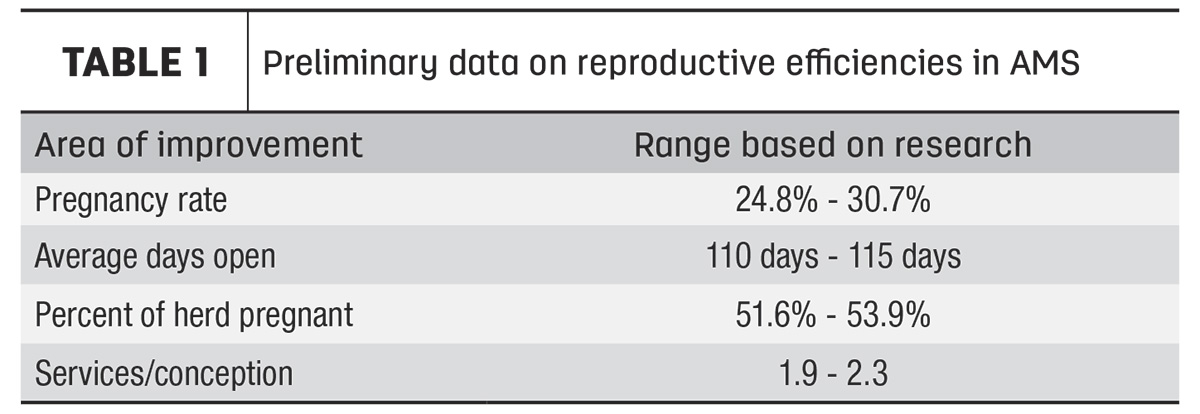
Improvements in reproductive efficiency are being recorded in a research project which is currently underway. This study compares herds in automated milking systems to conventional dairies at the same location. Early data shows strong improvements in several areas of reproductive KPIs (see Table 1).
Wearable technology
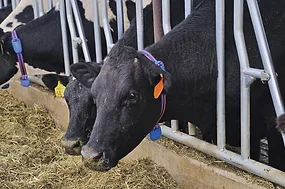
Automated milking systems integrate wearable technologies, such as neck collars, leg bracelets or eartags, which are equipped with accelerometers or pedometers to continuously monitor the activity levels of individual cows. These systems operate by comparing a cow's current activity to her established baseline (e.g., her average activity over a period of time) to identify significant deviations that are indicative of estrus.
Automated milking system-integrated sensors also monitor rumination time, which serves as a valuable indicator of a cow's health and welfare status. A significant decrease in rumination time is often observed around the period of estrus, offering an additional complementary indicator for heat detection when combined with activity data. Furthermore, a reduction in rumination minutes can serve as an early warning sign for various health events – such as metabolic disorders or lameness – often before visible clinical symptoms appear. Early intervention based on these alerts can prevent negative impacts on reproductive performance.
Bodyweight monitoring remains crucial for determining heifer breeding eligibility and assessing overall herd health, which profoundly affects future productivity and reproductive success. Automated milking systems can collect bodyweight data, and their integration with other parameters could further refine reproductive management, not to mention feeding strategies, in the future.
Taking a moment to look ahead, sensor technology will continue to innovate at a rapid rate, aimed at further enhancing the accuracy and effectiveness of cow reproduction and overall well-being. For example, consider camera technology that will be an “eye in the sky” within the barn environment that can monitor individual cow behaviors, eating patterns, social interactions, resting periods and body condition scoring. Automated milking systems in combination with current and future sensor technology data will continue to bring farmers closer to their cows than ever before, without standing close to the cows.
Integration
The true strength of automated milking systems in reproductive management lies in their ability to integrate these diverse data streams. For example, a drop in rumination time combined with increased activity strongly indicates estrus. Conversely, a drop in rumination without increased activity might signal a health issue. This multimodal data approach allows for more accurate differentiation between physiological states (e.g., estrus versus illness) and facilitates proactive health management. By addressing health issues early, the negative impact on reproductive performance is mitigated, thus indirectly supporting reproductive success. This integrated diagnostic capability extends beyond single-parameter monitoring, providing a more comprehensive picture of a cow's well-being and reproductive readiness.
Automated heat detection technologies integrated with automated milking systems have consistently demonstrated significant improvements in heat detection rates when compared to traditional visual observation methods. Manual observation is known to be inefficient, with estimates suggesting that up to 50% of estrus events can be missed. In contrast, automated milking system-based activity monitors can detect heat in a high percentage of cows, ranging from 81.4% to 91.3%.
In a study published in 2025, researchers found that cow behavioral traits related to automated milking system efficiency, such as average milking time, time interval between milkings and the number of successful milkings, are heritable. This has profound long-term implications for dairy breeding programs. If these traits can be incorporated into genetic selection schemes, future dairy cattle populations could be bred to be inherently more compatible and efficient within automated milking system environments. This could indirectly lead to improved reproductive performance by reducing stress associated with the system and encouraging more consistent voluntary visits, thereby optimizing milking frequency and overall health.
References omitted but are available upon request by sending an email to the editor.