The 21st century has brought many advances for farmers and ranchers, including precision agriculture (GPS and sensors), precision livestock monitoring (smart tags and bolus sensors), genetically engineered crops, virtual fencing, improved software and overall better data-driven decision-making.

Artificial intelligence (AI) in agriculture has revolutionized a lot of the ways farmers and ranchers run their operations across the U.S. One of the biggest ways AI has changed things is through predictive analytics. The ability for American agriculturists to accurately predict weather, soil health, genetics, crop or livestock disease, market trends and so many other factors is paramount to the survival of the agriculture industry and, as a result, our nation.
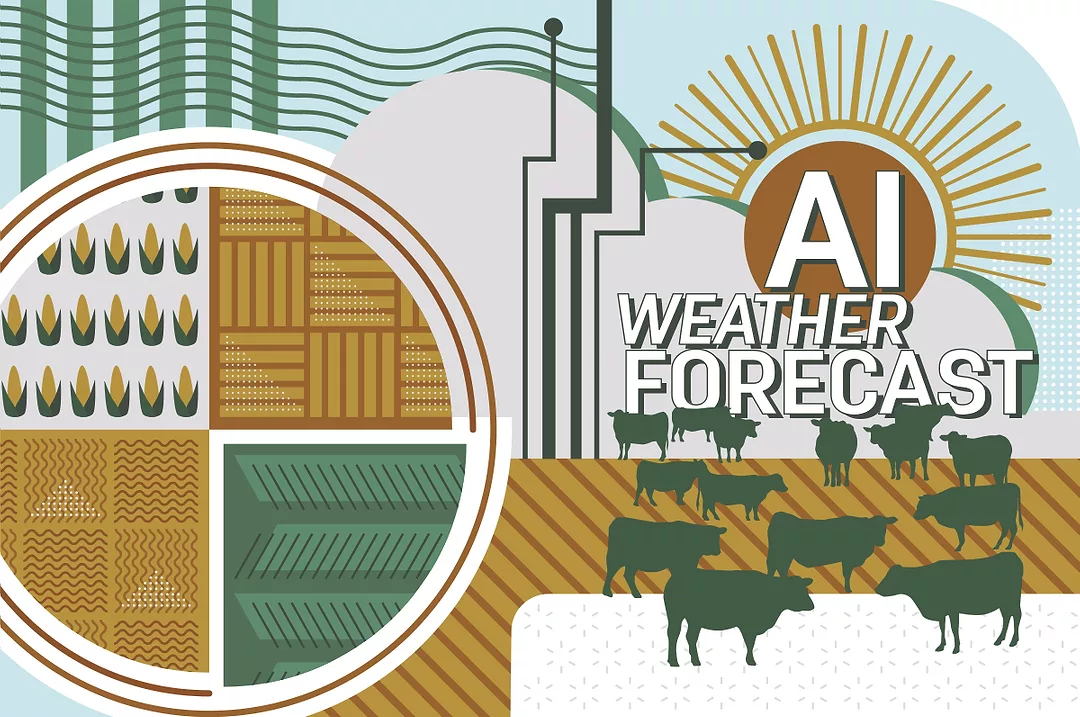
Just as the global population continues to increase, so does the need for security in our agricultural commodities. AI weather prediction is one of the many ways the U.S. is moving towards a new, and hopefully more secure, future in agriculture.
Every farmer and rancher knows the great weather uncertainties that come with planting, harvesting, grazing, livestock water management, etc. A sudden rain or hailstorm wipes out a freshly planted crop. An early or extreme freeze destroys a crop ready for harvest or kills a herd of livestock. A severe drought drives ranchers to downsize their herds. Weather has long been one of the primary uncertainties that ranchers and farmers face.
Most modern weather forecasting has been around since the 1950s, while seasonal climate forecasting dates back to the 1990s. Prior to this, many agriculturists used almanacs, weekly outlooks, radiosonde and military radar. Although AI weather forecasting has been around for more than a decade, deep thinking AI-powered weather forecasting is newer and has the potential to provide accurate and localized predictions with less computational cost.
The traditional method of weather forecasting involves using equations representing elements in the atmosphere. AI compares those equations to the actual weather and interprets them quickly to determine accuracy. This ultimately means farmers and ranchers can expect to see more accurate and specific weather data for their local area up to two weeks ahead of time. This gives farmers the ability to plan more accurately for planting, harvesting and pest control. Farmers and ranchers have a better ability to engage in proactive decision-making and protect/manage their herds.
On a larger scale, this also means ranchers and farmers will have increased efficiency, enhanced productivity, sustainability and data-driven decisions. The ability for farmers and ranchers to have accurate weather-related information so far in advance also means a lessened likelihood of waste or decreased production.
Critics of deep-thinking AI weather forecasting are wary due to the inability to determine how AI makes its decisions. Specifically, some worry that unprecedented changes in weather patterns could cause AI to not be able to accurately predict the weather. However, the ongoing simultaneous use of labor-intensive numerical model forecasting and AI forecasting means that the accuracy of weather prediction will continue and actually increase in its reliability. The data used in the numerical models feeds the AI models, so it’s the hope of AI weather prediction proponents that the reliability will simply increase as more data is interpreted by AI.
AI-powered weather prediction is readily accessible to most farmers and ranchers in the U.S. through mobile apps and online platforms. Companies such as Cordulus, AccuWeather, Climavision and Climate AI have their own specialized platforms dedicated to AI weather predictions for agriculture. Agriculturists seeking precise and hyperlocalized forecasts and data can download and use specific apps associated with AI weather prediction based on their preferences or needs.
References have been omitted but are available upon request by sending an email to the editor.