Dairy farms across the country have been asking for a solution to the looming labor crisis.

“There is just simply not enough domestic workers to fill the jobs in American agriculture. Some agriculture can use the H-2A program, but it is too expensive, outdated and only available to seasonal workers. The rest of agriculture, including dairy, livestock and other year-round producers, like the mushroom industry, have no program to find relief in their worker shortage,” said James O’Neill, director of legislative affairs for the American Business Immigration Coalition (ABIC).
In addition, immigration enforcement is disrupting the country’s existing workforce.
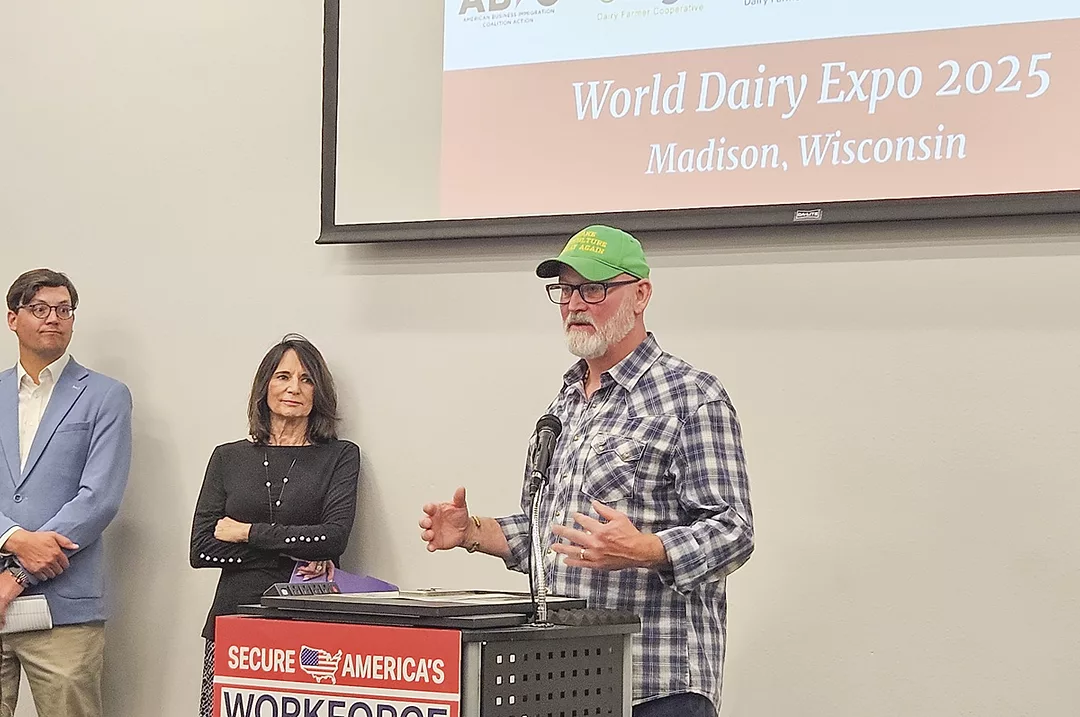
At a press conference at World Dairy Expo in Madison, Wisconsin, on Oct. 2, O’Neill said no one wants to stand in the way of holding violent and dangerous criminals to justice, but dairy farmers and processors need reforms that can keep current workers without criminal records and expand access to visa programs to solve the worker shortage.
Rep. Derrick Van Orden (R-Wisconsin) was on the bipartisan Agricultural Labor Working Group in the last Congress and developed a piece of legislation that offers an alternative visa program for current members of the agricultural workforce.
Currently, the U.S. Customs and Border Protection agency has an app (CBP One) that allows users to notify the U.S. government of their intent to deport. They get a plane ticket and $1,000 to return to their home country. Once deported from the U.S., an individual is barred from ever entering the country again.
“I just want another button added on there, where you push the button and you go into a legal protected status for a year,” Van Orden explained.
The individual will have to physically exit the country and then return to the U.S. through a legal port of entry.
He said it is important to acknowledge people who previously entered the country illegally did break the law and that this sends a signal around the world that if you’re going to enter the U.S. to work or become a citizen, you’re going to do it legally.
“This is why this is not amnesty, and it is not a pathway to citizenship, other than one that exists already,” Van Orden said.
When they come back into the country, they can go back to work and choose to become a citizen, just like every other person that enters the country lawfully.
“We have to get back to normal where we follow the law,” he said. “I’ve gotten a lot of flack from this, but I’ve also got massive amounts of support.”
If created, this option will allow these individuals to re-enter the country with protected status. It will be good for up to a year to allow time for employers to rotate their workforce out and back in to the country.
When they return legally, that becomes their born again date for citizenship.
This piece of legislation is the Agriculture Workforce Reform Act of 2025 (H.R. 4748), and Van Orden needs help in moving it along.
“I need you to talk to your representatives. I need you to talk to your senators. I need to you to talk to your neighbors and have them understand what’s going on and that we’re actually trying to fix this problem,” he said.
“There’s a tremendous amount of support, but when we get a groundswell from industry talking to different members of Congress, that’s how things get done in Washington, D.C.,” Van Orden added. “So I’m asking you to help me, help you.”
Dairy producers call for action
Following the congressman, dairy farmers and industry representatives stressed the need for a reliable, year-round workforce to prevent farm closures and ensure food security.
“The current U.S. agriculture economy is at risk from a persistent and deepening labor shortage that has reached a critical point,” said Brian Rexing, an Indiana dairy farmer and farmer-leader for Dairy Farmers of America (DFA).
He continued, “A century ago, nearly one-third of Americans lived on farms located in rural communities that offered abundant labor. Today, less than 2 percent of us operate farms that produce the food and nutrition that sustain our families. This dramatic shift has put a strain on our food system and now relies heavily on foreign labor to assist with many responsibilities it takes on farms.”
Another Indiana dairy farmer, Sam Schwoeppe, said farms rely on year-round workers to do essential jobs that are difficult to fill locally.
Representing the American Dairy Coalition, Schwoeppe said, “Many of these foreign-born employees have already proven their skills in cow care and that they’re dependable on our farms. Yet, because they may lack legal status, they remain vulnerable, and it’s critical to provide a legal basis for documentation so that our farmworkers can be recognized as part of a safe, stable and secure workforce.”
Donald Grady, senior director of legislative affairs at the International Dairy Foods Association (IDFA), echoed that vulnerability and how it creates instability in the workforce.
“Unlike many other agriculture sectors, the U.S. dairy industry is not seasonal. Cows must be milked, and processing plants transform that milk into all the delightful products we enjoy each and every day,” Grady said. “This amazing work is done without a specific program designed to provide a legal, reliable source for U.S. dairy farmers and processing plants to hire workers that they need.”
He cited the $11 billion investment America’s dairy manufacturers are making in new and expanded facilities over the next three years. Not only will these projects bring in billions more in economic activity and expand access to nutritious dairy products for consumers, but they will add thousands of jobs.
“These investments are at risk if we cannot secure a stable, legal workforce. IDFA is urging Congress to act to pass new guest worker legislation and are encouraged that multiple members have introduced legislation to do just that. It will take the collective work of members like Congressman Van Orden to see this finally achieved,” Grady said.