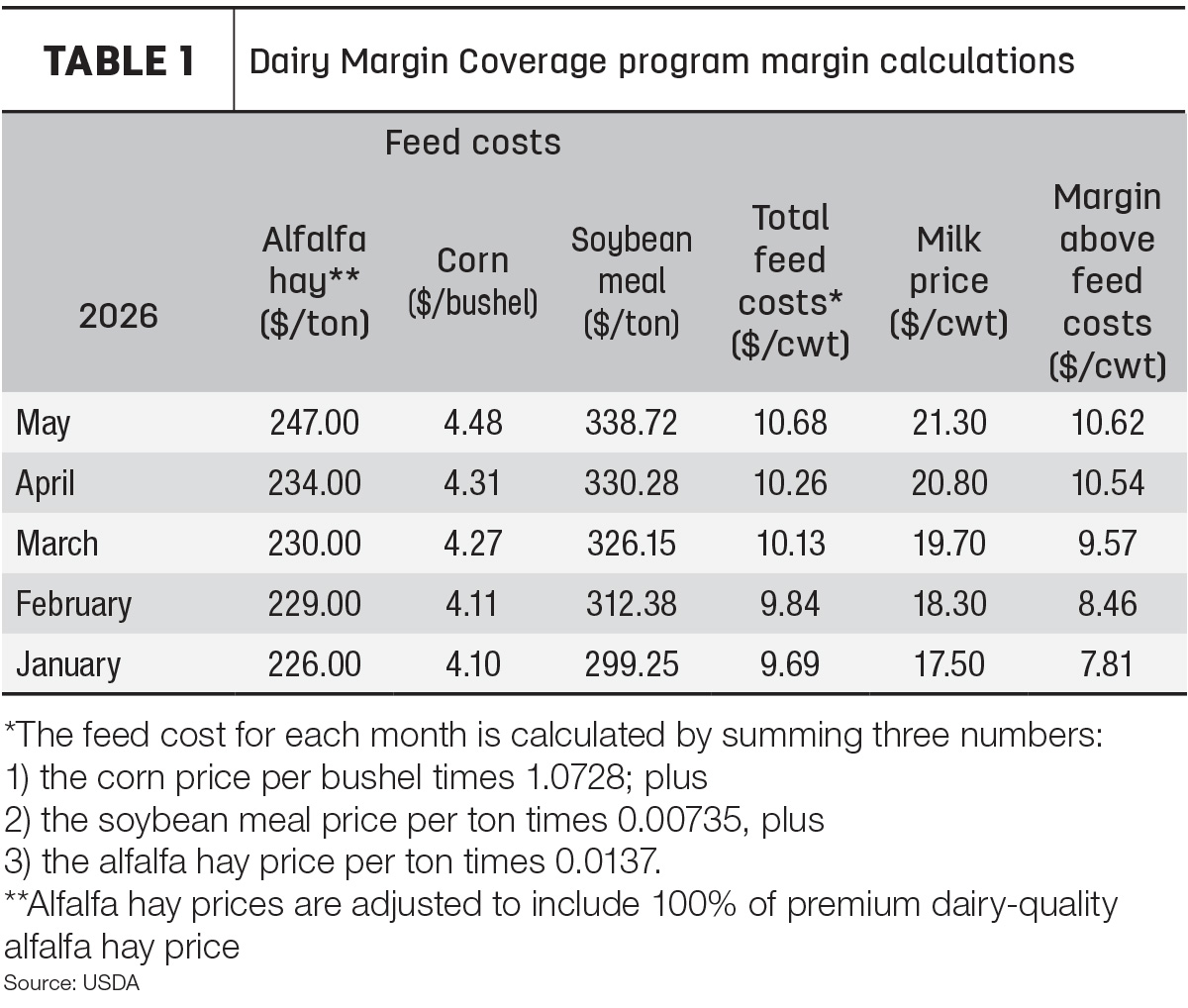
The USDA National Agricultural Statistics Service (NASS) Agricultural Prices report, released June 29, established May’s Dairy Margin Coverage (DMC) program calculations. As the all-milk price rose 50 cents, the total feed costs rose 42 cents, boosting the DMC margin 8 cents to $10.62 per hundredweight (cwt) for the month. May’s margin is the highest realized in eight months and resulted in no indemnity payments for enrolled operations.

A peek at May DMC
Prices for major dairy feedstuffs that influence the DMC program margin were reported in the USDA’s Agricultural Prices report for May (Table 1).
DMC program margin factors for May compared to the month prior were as follows:
- Dairy alfalfa hay: $247 per ton, up $13
- Corn: $4.48 per bushel, up 17 cents
- Soybean meal: $338.72 per ton, up $8.44
- Total feed costs: $10.68 per cwt, up 42 cents
- Milk price: $21.30 per cwt, up 50 cents
- Margin above feed cost: $10.62 per cwt, up 8 cents
All-milk price surpasses $21 per cwt
The average all-milk price in the 24 major dairy states surpassed $21 per cwt as most every state recorded a positive price improvement from the previous month. Strong dairy markets gave way to an average all-milk price of $21.30 per cwt, up 50 cents from April and a dime less than May 2025 (Table 2).
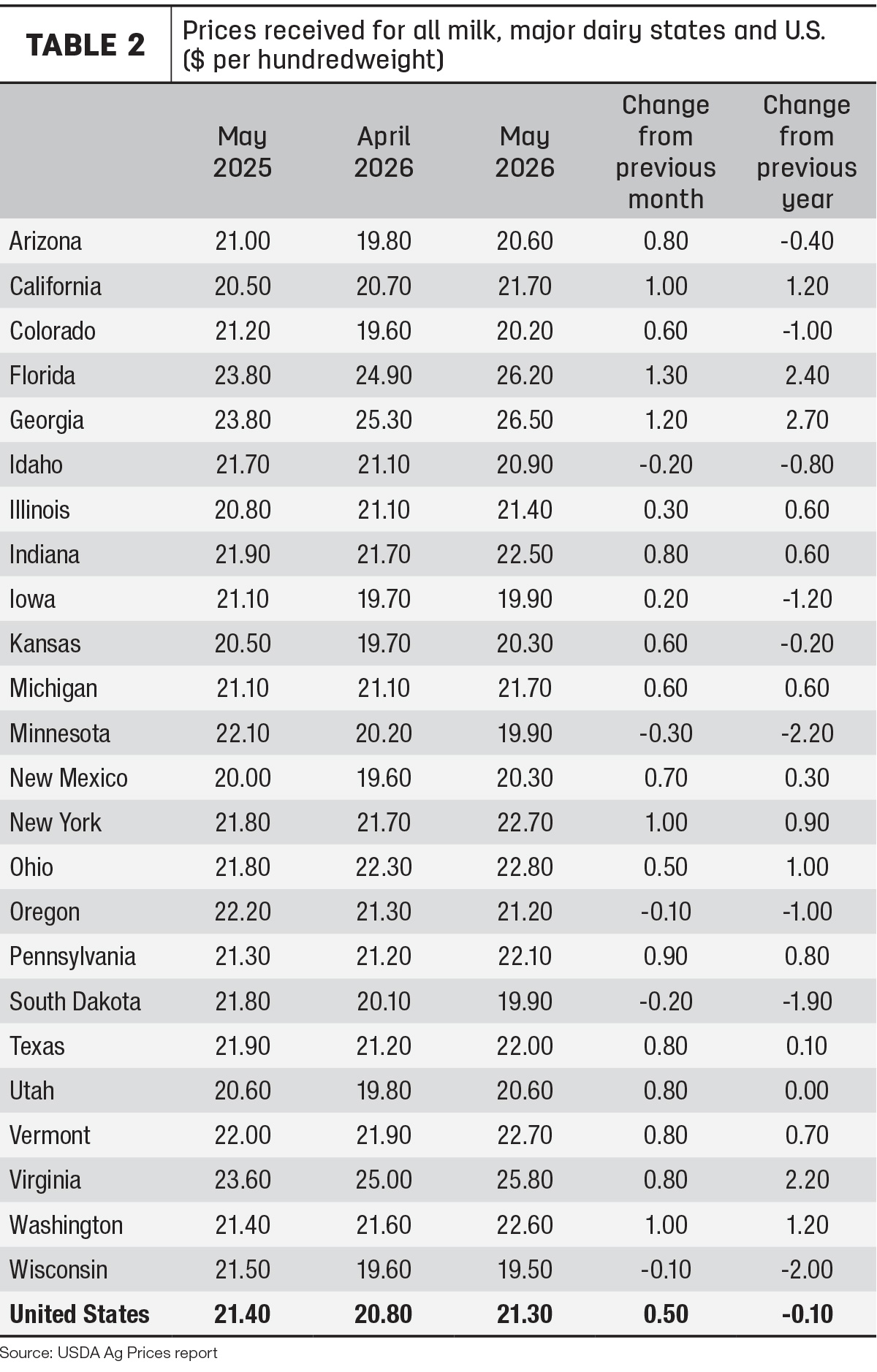
However, not every state saw equal gains. Five states reported a month-over-month increase in the all-milk price of $1 or more, with Florida and Georgia rising to the top with gains of $1.30 and $1.20 per cwt, respectively. California, New York and Washington also reported a price improvement of $1 per cwt. Yet, the Midwest states of Minnesota, South Dakota and Wisconsin all reported a price decrease of 30 cents, 20 cents and 10 cents, respectively. Idaho and Oregon were also included in the states to see their all-milk price fall, each losing 20 cents and 10 cents from the previous month, respectively.
In year-over-year comparisons, the price spread was greater. While the average all-milk price in May was only 10 cents lower than May 2025, for some states, it was $2 or more below last year’s milk price. The states reporting the greatest declines were Minnesota (down $2.20 per cwt) and Wisconsin (down $2 per cwt). Yet, states like Florida, Georgia and Virginia reported this May’s all-milk price more than $2 above that in 2025, up $2.40, $2.70 and $2.20 per cwt, respectively. The remaining major dairy states saw prices fall or climb somewhere in between.
Feed costs rise moderately from April
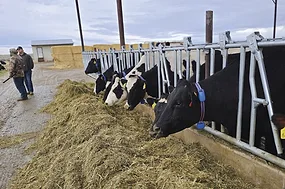
Throughout May, the feed costs rose moderately from April with corn leading the way. The price per bushel of corn was up 17 cents from the previous month, yet down 16 cents from May 2025. Additionally, soybean meal rose $8.44 per ton from April and was a striking $35.25 per ton above the commodity price last year, and dairy-quality alfalfa hay was up $13 per ton from the month prior but down $30 per ton from May of last year.
The DMC feed cost for each month is calculated by summing three numbers: 1) the corn price per bushel times 1.0728; plus 2) the soybean meal price per ton times 0.00735; plus 3) the alfalfa hay price per ton times 0.0137.
Given another month of a strengthening all-milk price, comparable to that of May 2025, and an equally sturdy feed cost, the DMC margin rose by a modest 8 cents. A margin of $10.62 per cwt positions all enrolled dairy operations $1.12 per cwt above the $9.50 per cwt coverage level and will result in no indemnity payments for the month.
Looking ahead
As of June 29, the DMC margin forecast for June rises nearly $1 to $11.51 per cwt. While the all-milk price is predicted to dip back into the $20 range, it is the feed cost forecast that is boosting the margin. Current market conditions are forecasting the price of dairy-quality alfalfa hay to drop $37 per ton to $210 per ton, soybean meal slipping $27 per ton to $311.72 per ton and corn falling 61 cents to $3.87 per bushel, all resulting in a feed cost forecast of $9.32 per cwt.
If June’s margin is realized, it will be the highest margin since August 2025, and the mid-year peak of this year before margins are expected to constrain in the months ahead before rising again as the year comes to an end.