Managing methane emissions is an effective strategy for reducing greenhouse gases, given its significant near-term impact on the Earth’s climate. Recent studies have shown that it can also help optimize feed efficiency and animal performance.

In cattle, methane is produced by certain anaerobic rumen microbes, the archaea. These microbes serve to reduce rumen acidity by combining acidic hydrogen ions with carbon dioxide and thereby forming methane gas.
In addition to producing methane, this process also means a loss of feed energy for the cow, with between 2% and 12% of the diet energy lost as methane. If some of this feed energy can be saved, production efficiency should improve, resulting in less feed needed per unit of milk. Thus, reducing methane has the potential to contribute to improved production. This has been shown to occur with some feed ingredients and with some oil products.
Vegetable oils, particularly oils that are high in monounsaturated fatty acids such as canola oil, have been shown to reduce methane output and improve energy efficiency. In addition, some secondary plant compounds can likewise modify fermentation to reduce methane production. Canola meal has been extensively studied for its ability to reduce methane production and improve efficiency when compared to soybean meal.
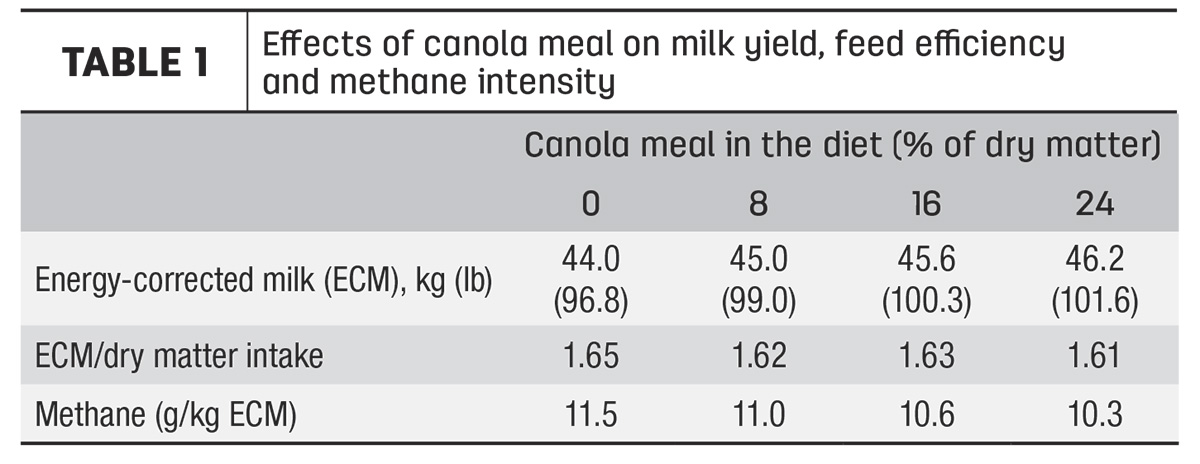
Results from a recent feeding trial are shown in Table 1. All diets provided 16% crude protein (CP), with canola meal replacing soybean meal. Additional studies have shown that less methane is produced when canola meal is used in place of soybean meal, providing the potential to capture the energy for the benefit of the cow. The reduction in methane/unit of energy-corrected milk is typically in the range of 7% to 10%.
Certain seaweed products, on the other hand, have been demonstrated to lower methane output on a much larger scale. The active component in seaweed is the chemical bromoform, and it has an inhibitory effect on the methane-producing archaea.
Studies with beef and dairy cattle have shown that seaweed products can reduce methane output by half, and sometimes even higher reductions have been reported. However, the seaweed products work differently than the monounsaturated fatty acids in products such as canola meal, and the theoretical capture of energy does not occur. Much of the hydrogen is exhaled as free hydrogen gas. Furthermore, in many feeding trials, dry matter intake (DMI) and milk yield are linearly reduced as the dosage of seaweed increases.
Recent studies have also investigated how integrating canola oil, canola meal and seaweed into diets can influence methane emissions. The rationale stems from the need to address agricultural greenhouse gas output while maximizing animal health and productivity.
In a beef feeding study, canola oil infused with a bromoform-containing seaweed was compared to canola oil alone in diets for beef cattle. Methane intensity was reduced by 55% (Table 2). DMI was consistent between the two groups. Average daily gains (ADG) were greater with the canola oil/seaweed product, indicating that some of the energy from methane became available for growth.
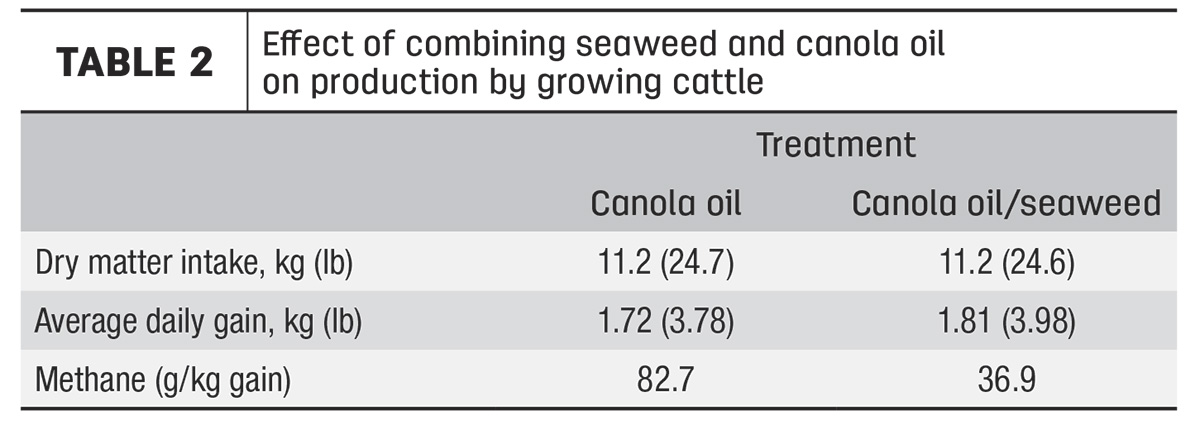
In a pioneering dairy feeding experiment, researchers assessed the combined use of canola meal and seaweed. The results demonstrated a 38% reduction in methane intensity; however, both DMI and milk yield declined by 6%. The growth study reported in Table 2 suggests that these two products should exhibit synergistic effects. Given that dairy cows consume more than growing cattle, lactating cows may respond more favorably to lower doses of bromoform-containing seaweed. The current guidelines for adding seaweed are based on the amount of bromoform per unit of feed, without specifying a maximum total intake.
As research continues, leveraging the unique properties of canola meal and seaweed may offer an effective and sustainable strategy to curb methane emissions, contribute to climate change mitigation efforts and improve energy availability of milk yield.
References are omitted but available upon request by sending an email to an editor.