Reproductive efficiency is critical for the profitability of dairy herds. It is as simple as cows need to calve to produce milk. However, having consistent and high pregnancy rates continues to be a challenge. The foundation of a reproductive program on farm consists of breeding cows in a timely manner and having non-pregnancy diagnoses and a rebreeding program. Poor reproduction is directly linked to increased metabolic disorders, decreased longevity, decreased milk production and increased rate of involuntary culling.

Having a systematic reproduction program is standard practice and essential for the profitability of the herd. Whether your program includes all natural, all timed breeding or a combination of both, it is important that it is consistent and compliant.
Reproduction management needs to be a holistic approach. Some major factors affecting reproductive efficiency include genetics, management and facilities, health and disease control and nutrition. Consider fine-tuning these categories to improve overall reproductive efficiency.
Genetics and genomics
Genetics is the DNA blueprint of the animal and will determine her future potential. Genomic testing identifies which genes a calf possesses such as high milk production, good health and favorable management qualities such as reproduction. Genomics is a vital tool for breeding management decisions.
The formula for genetic improvement per year is based upon the accuracy of the genetic predictions, multiplied by the selection intensity and genetic variation in the trait, divided by the generation interval. We are limited to improvements on genetic variation or generation interval; however, we can change the selection of females in the herd and the accuracy of our predictions. Using parent averages only, the reliability of genetic predictions is approximately 30%. Using genomic testing on a calf, the reliability increases to 70%. This means at 2 months old you can tell if the calf is four or five times more likely to become the best (or worst) female when she enters production. This can change your selection intensity. Choose the genetically superior replacements for sexed semen and use conventional or beef semen on the bottom percentage of the herd. Over time, this will reduce replacements. A word of caution: If not enough replacements are raised, there is a risk that do-not-breed cows are kept too long. With no replacements, cows stay in the herd longer to fill quota. These cows may become lame, thin or just unfit for transport, which becomes an issue for animal welfare.
Using existing data will help determine the status of your herd. Where is this data found? All registered dairy cattle can be found online. Anyone can have access to this information. This site is useful to assess the current herd situation. By performing an "Animal Query" and "Search by Name" using herd prefix and selecting "female," a list of all registered females under that prefix is generated. The list gives an overall perspective on the genetic status of the herd. Also on the website, you can find Compass. Compass is a genetic management software that allows you to visualize your herd data and look at trends and performance. You can also create your own index, calculate inbreeding and look at profitability. It benchmarks where your herd stands in terms of phenotype versus genetic potential and compares you to other Canadian herds. It’s a free tool. If you are a member of Holstein Canada, you can also access your Herd Performance Report. It can benchmark your performance against other herds in your region and Canada. Remember, if you can’t measure it, you can’t manage it.
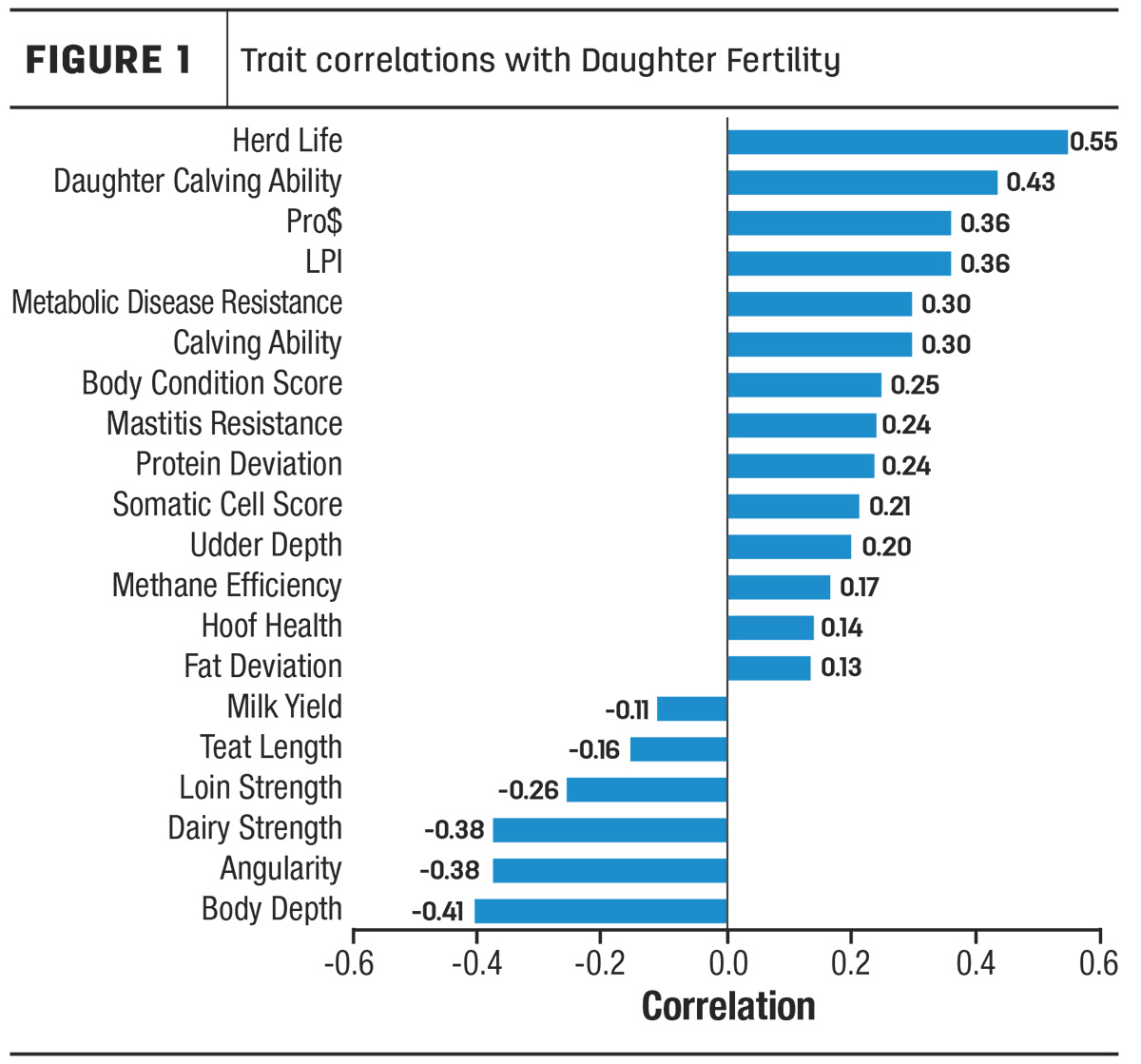
What traits are associated with fertility? Currently, in the Canadian system, Daughter Fertility (DF) is an index included in the Lifetime Performance Index (LPI) and Pro$. DF includes four traits: age at first insemination of virgin heifers, the 56-day non-return rate for virgin heifers, interval between calving and first insemination for cows and the 56-day non-return rate for cows. Other traits that are positively and negatively associated with DF are shown in Figure 1. The Health and Fertility component of the LPI is closely correlated with DF (92%) because of the significant weighting of DF in the LPI index. Individual traits strongly correlated with DF are Body Condition Score (BCS, 25%), Metabolic Disease Resistance (22%) and Mastitis Resistance (21%). Important to note, Body Depth, Angularity and Dairy Strength are negatively correlated with DF. Selection for milk production also negatively selects for reproduction. Therefore, if you are selecting for these traits, you also should directly select for DF; otherwise you risk decreased reproductive performance. The heritability of DF is 4% to 7% compared with milk production traits at 30%. Although heritability is lower, progress can be made to improve DF over time.
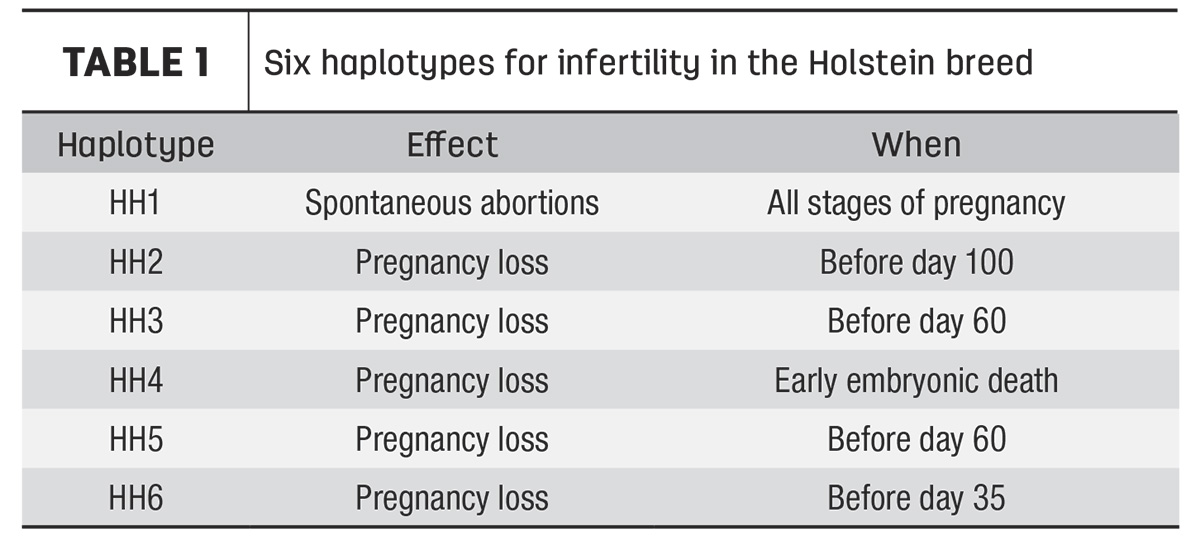
Genomic testing can also identify haplotypes that impact fertility. There are six haplotypes for infertility in the Holstein breed, Holstein Haplotype No. 1 (HH1) to HH6 (Table 1). The negative effects of these haplotypes can be seen throughout a pregnancy and vary from pregnancy loss, abortions and early embryonic death. All commercial bulls are genomic tested and have known status of these traits. Mating programs can be used to limit the effects of these negative traits on future progeny.
The power of genomics is in its ability to reliably rank animals at an early age. This allows for genetically superior females to produce the next generation, to identify animals to produce beef-on-dairy cross or sell. Sit down with someone you trust and establish a sound breeding strategy that highlights the herd objectives and corrects any undesirable traits.
Epigenetics
To maximize genetics, you must optimize the environment. Epigenetics is the measure of the effects of the environment on phenotype expression. Epigenetics is the change in gene expression without altering the DNA sequence. It is the new buzzword for measuring the effects of environment on phenotype. Epigenetic programming is related to gene expression such as weight gain, reproduction, mammary development and milk production.
Many studies have documented the deleterious effects of BCS loss on conception rate. Research from 2014 demonstrated that cows that lost, maintained or gained body condition had major differences in conception rates at 22%, 36% and 78%, respectively. Changes in BCS in the first three weeks postpartum have the greatest negative effect on conception rates.
Preventing heat stress is extremely important because it has deleterious effects on fertility. Heat stress decreases dry matter intakes, increases risk for increased negative energy balance, which can induce changes in ovarian follicular dynamics, decrease estrus detection and increase early embryonic death. The drop in fertility can be seen in cyclical drops in the conception rates during the hot seasons. Ensure your facilities have heat abatement systems for both dry and lactating cows.
Health and disease control
Uterine health is essential to support pregnancy. Inflammation in the reproductive tract alters the natural reproduction cycle and decreases fertility and pregnancy success. Postpartum diseases such as metritis, purulent vaginal discharge and endometritis negatively impact reproductive performance. Focus on transition cow health to reduce disease incidence. Work closely with your veterinarian to identify bottlenecks, determine the prevalence of fertility limiting diseases such as leptosporosis, neospora and bovine viral diarrhea (BVD), and make an action plan. There is also a genetic component to health. Metabolic Disease Resistance is a genetic trait that has been positively correlated with daughter fertility.
Nutrition
Nutrition plays a substantial role in fertility. High-quality forage needs to be fed year-round. A balanced ration needs to be delivered not only for lactating cows but also for dry cows. Fine-tune your ration to eliminate any deficiencies and prevent negative energy balance postpartum and consider using nutraceuticals. Transition cow rations that prevent negative energy balance postpartum will have a positive effect on fertility.
Manage to measure
Knowledge is power. The more you know about the overall approach to reproductive efficiency in your herd, the more you can change the narrative. Improving reproduction requires consistency and attention to detail. Identify the limiting factors. Genomic testing to find undesirable fertility traits while selecting for fertility will improve reproduction but is futile without close attention to breeding protocols, management and facilities, health and nutrition.