It wasn’t long ago that the status quo mating strategy for dairy herds was to breed every eligible female to conventional dairy semen. Genetic improvement was primarily driven by artificial insemination; commercial dairy herds purchased semen from a roster of genetically elite dairy bulls to sire the next generation of replacement heifers, which were randomly born to half of the females in the herd each year. The odds of having a replacement heifer were the same across the genetically best and worst cows in the herd, about 50%.
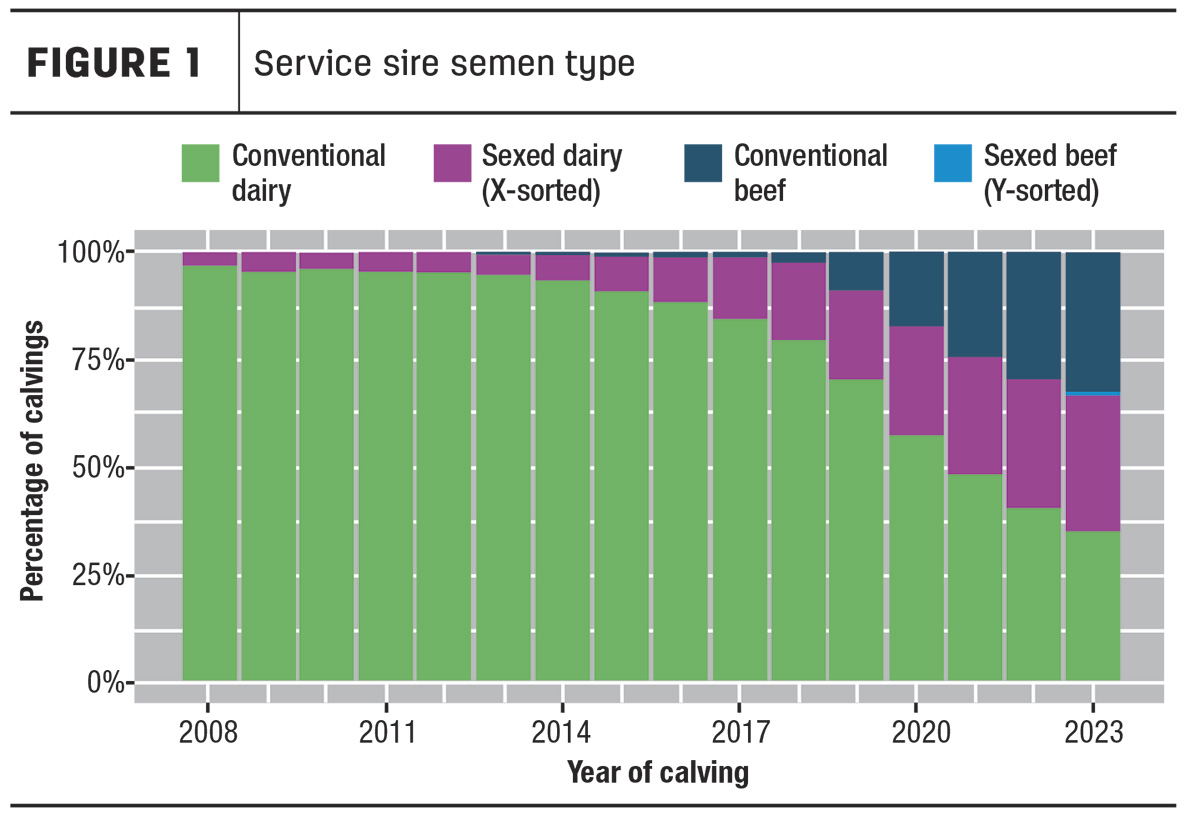
Last year, I had the privilege to join the USDA Agricultural Research Service (ARS) Animal Genomics and Improvement Laboratory in Beltsville, Maryland. Both the technology for sex-sorting semen and the dairy cattle genomic evaluation were developed by ARS researchers in Beltsville. In recent years, the status quo mating strategy for the dairy industry has changed; the proportion of calving to female sex-sorted semen and beef semen has increased year over year (Figure 1).
Genotyping of replacement heifers has also grown in recent years. Genotypes provide more accurate predictions of genetic merit. This allows for more precision when determining which females to mate with sexed semen to generate replacement heifers with, and which cows to mate to beef semen to ensure their genetics will not be propagated in future generations. Many models suggest that there are economic and genetic advantages to incorporating genomic information and sexed and beef semen in dairy mating programs. However, there was no data on how farms were actually adopting these practices and if they were resulting in accelerated genetic progress. Thus, we set out to answer two questions:
- What mating strategies are U.S. dairy herds actually using?
- Does the average genetic merit of a herd differ by mating strategy?
The data
The National Cooperator Database – stewarded by the Council on Dairy Cattle Breeding – contains production, health and reproduction phenotypes of dairy cattle in herds enrolled in dairy herd improvement programs and over 11 million genotypes of dairy cattle. Breeding and calving records from 5,613 herds in the database from the year 2023 were used in this study. Two pieces of information were used to determine the mating strategy a herd employed: 1) the type of semen (conventional dairy breed, sexed dairy breed and/or beef breed) calves were conceived with and 2) if heifers in the herd were genotyped within the year.
Using these two parameters, we defined six different mating strategies. There were herds that used only conventional dairy semen (CON), herds that used conventional and sexed dairy semen (SC), herds that used conventional and beef semen (BC) and herds that used a combination of all three (BSC). We separated the SC and BSC herds that also genotyped heifer calves into their own categories – SC-GT and BSC-GT, respectively – but did not separate CON and BC herds because they almost never genotyped calves. From there, we compared the predicted transmitting abilities (PTA) of the heifers born in 2023 by herd mating strategy.
The findings
Table 1 shows the average Net Merit Index PTA of the heifers born in 2023 by herd mating strategy. Calves born in herds that used all mating strategies (genotyping, sexed dairy semen and beef semen) had the greatest net merit, followed by those in herds that used all semen types but did not genotype heifers. Heifer PTA on the three other merit indexes (Fluid Merit, Cheese Merit and Grazing Merit) followed an identical pattern by mating strategy. In fact, across the four selection indexes and individual production, longevity and fertility traits, heifer calves could generally be ranked by herd breeding strategy from most to least favorable PTA as follows: GT-BSC, BSC, BC, CON, GT-SC, and SC.
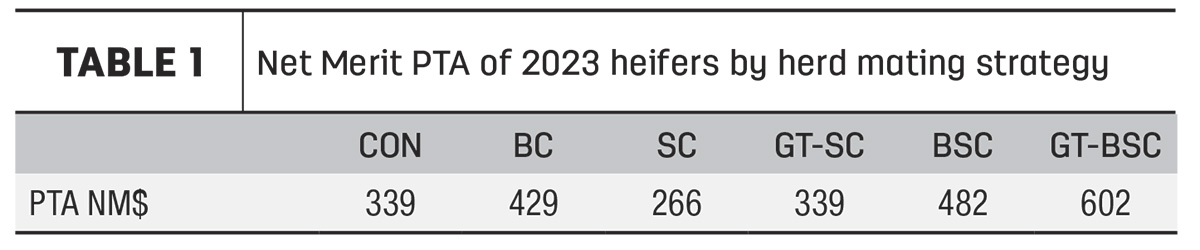
It was no surprise that heifers in GT-BSC and BSC herds had greater PTA than those in herds that used only conventional dairy semen. As described earlier, mating programs that combine sexed dairy semen and beef semen allow herds to selectively generate replacements, while cows with lesser genetic merit produce value-added surplus calves. Similarly, herds that use a combination of beef and conventional semen produced calves with greater genetic merit than those that only use conventional semen because low genetic merit cows produced beef calves instead of replacements.
A surprise was that calves born in GT-SC and SC herds had similar or worse genetic merit than calves born in herds that only used conventional semen. Initially, I was flummoxed. Especially when combined with genomic testing, selective use of sexed semen in a herd should also result in greater genetic improvement than strategies that use exclusively conventional semen. Calves in GT-SC and SC herds did have the greatest PTA for type trait composites (Table 2).
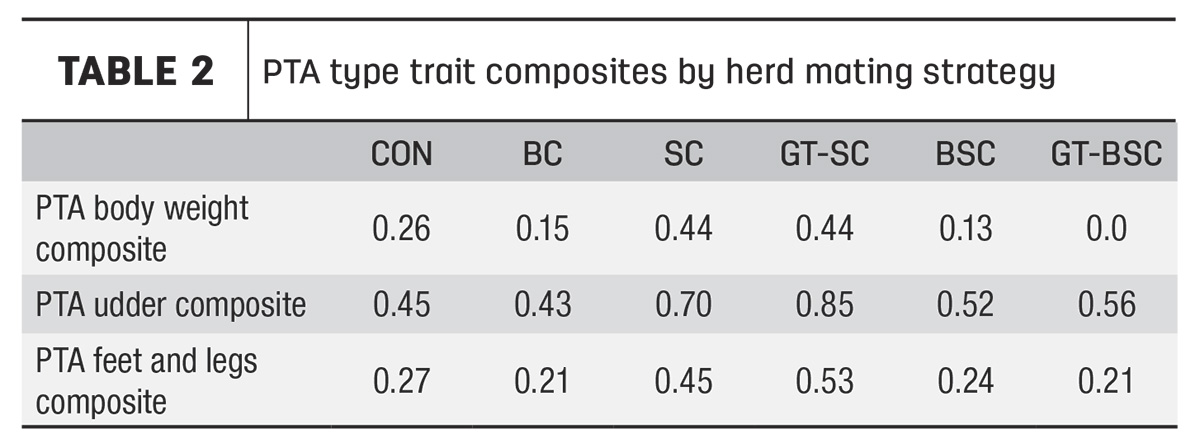
While GT-SC and SC herds produced calves with the lowest merit on economic indices, their calves were genetically superior for udder and feet and leg conformation. From an efficiency standpoint, a lower bodyweight composite is more economically favorable; however, larger-framed dairy cattle often have an advantage in the show ring. Knowing this, I theorize that it is not the use of sexed and conventional semen that led to calves with the lowest genetic values on economic indices, but a difference in the breeding goals of the herds using these strategies. It appears that herds that use the other mating strategies investigated select for a variety of economic traits while the GT-SC and SC herds primarily breed for conformation.
To genotype or not to genotype?
Herds that genotyped and used all semen types had heifers with more than a $100 advantage in net merit than those that used all semen types but did not genotype heifers. Likewise, calves in GT-SC herds had greater genetic merit on economic indexes and for udder and feet and leg conformation than calves in the SC herds. However, calves born in herds that used all semen types but did not genotype heifers still had substantially greater genetic merit than calves born in herds that did not use a combination of beef, sexed and conventional semen in their mating programs.
If your current breeding program does not use both beef and sexed semen, I would recommend adopting that practice prior to investing in genotyping. If you are already using beef and sexed semen and you want to take the next step toward elite genetics, or you have excess heifers to market, you may want to consider genotyping heifers to enhance your breeding program further.
A new status quo
The U.S. dairy industry has moved far beyond the strategy of mating every eligible female to conventional dairy semen. The new mating strategy status quo uses sexed semen to generate replacements from heifers and value-added beef-on-dairy calves from older cows to accelerate genetic progress. Herds that also genotype produce calves with the greatest genetic merit. The advanced mating strategies being adopted in modern dairy herds have been made possible by U.S. tax dollars being invested in dairy cattle genetic improvement.