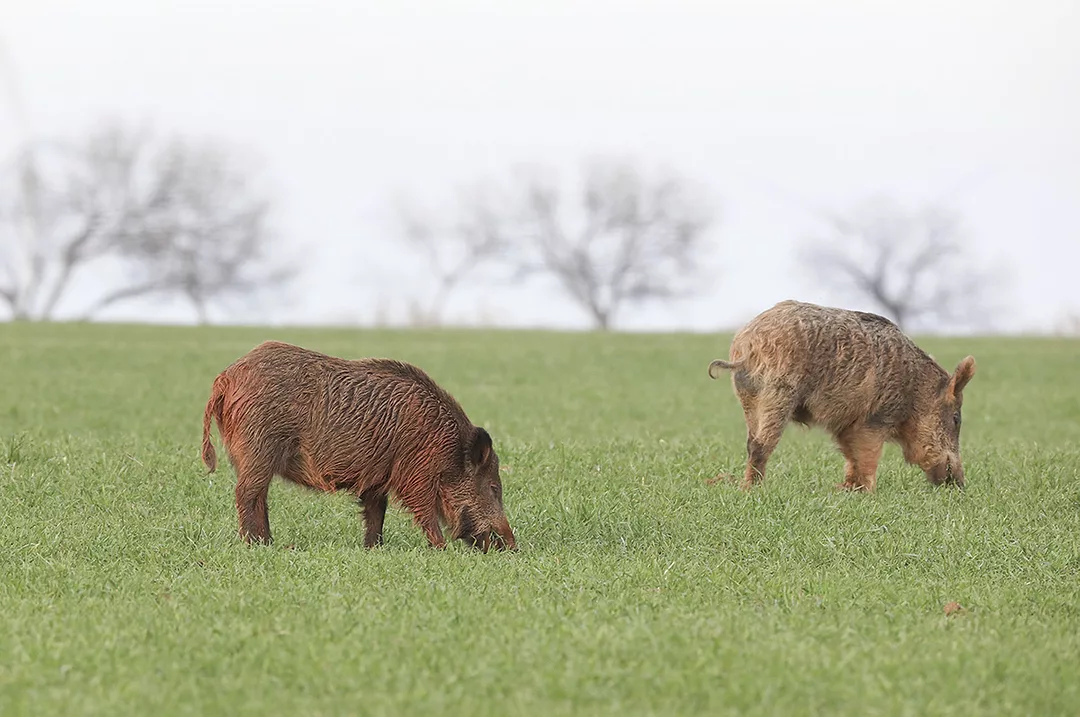
The U.S. has 6 million feral hogs, and 3 million of them live in Texas, followed by Oklahoma at 1.5 million and Louisiana at 750,000. They were initially brought to Texas from Spain by the Hernando de Soto expedition in 1542. Later, hunting enthusiasts imported Eurasian wild boars to Texas. This invasive species causes $1.5 billion in agricultural and ecological damage annually in the U.S.

Destructive rooting and wallowing are the obvious signs of a feral hog population moving into a farm, ranch or suburban neighborhood. Using their long, distinctive snouts, they dig up and turn over soil as they search for grubs, worms and vegetative material in pastures, corn crops and golf courses. Once they find water, often along the banks of a pond or stock tank, they wallow in it to cool off. When producers are preoccupied when moving cattle or cutting hay, they may not notice pig tracks, which are similar to deer tracks. Savvy ranchers check for stiff hairs that catch on fences after these animals crawl through or under them. Operators can also find hairs on trees or fence posts where feral hogs like to rub.
Management strategies
James, “Jay” Long, project coordinator for the Texas A&M Natural Resources Institute, says feral hogs have no defined mating season, and females can conceive soon after weaning, between 6 and 8 months old. Females tend to have four to 12 piglets per pregnancy and are able to produce up to two litters a year.
“Because the human population is growing, more open spaces that were pig habitats are becoming neighborhoods, ranchettes or shopping malls,” Long explains. “There are now fewer resources, forcing feral pigs to move [to new territory]. Hogs must have water for thermoregulation because they don’t sweat. As various parts of Texas see decreased water due to drought, feral pigs search different areas to find the water they need.”
Management strategies include trapping, hunting or thermal-scope hunting. Aerial gunning, another option, is expensive, especially if state or federal programs are unavailable to help with expenses. The landowner must have 1,000 acres or more to give the helicopter pilot room to turn and stay within property lines. Aerial hunting also depends on the ranch’s location and surrounding structures. Long recommends that the landowner collaborate with neighbors to temporarily combine acres, share expenses and potentially remove more feral pigs. Instead of 1,500 acres, they could have 6,000, giving the helicopter more room to maneuver.
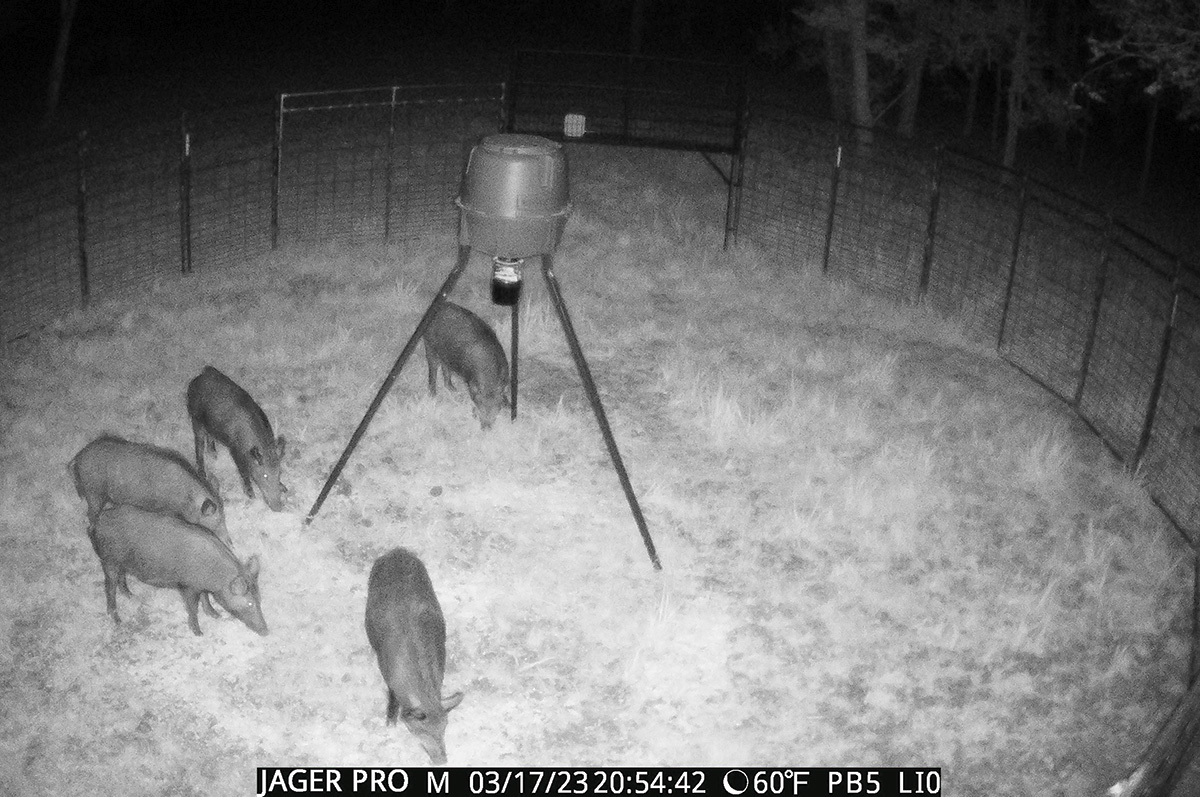
This night shot captures feral hogs as they eat corn. Once they are accustomed to the trap and corn, they can be easily trapped. Image by James Long.
Setting out warfarin-based Kaput Feral Hog Bait is another tactic. This product became available in February 2024. “It’s effective, but it’s not a silver bullet,” Long reports. “Producers must have an applicator’s license to buy it. It utilizes an involved prebaiting, toxic baiting and postbaiting process, and if ranchers follow the label, it takes five to six weeks to remove hogs. Landowners I’ve talked to say it took 10 to 12 weeks.”
Other states manage feral hogs as wildlife, providing more protection for these animals, and many states do not want an economy based on pig hunting. However, some recognize that this invasive species is creating havoc. For instance, the Arkansas Department of Agriculture recently initiated a Feral Hog Eradication Program. The Lone Star State classifies feral hogs as exotic livestock, giving landowners control options, while sportsmen have opportunities to hunt them.
The most effective hog control method
Edward Dickey, owner of Texas Wild Hog Control, removes wild hogs for farms, ranches, homeowner associations, private corporations, and the Texas Parks and Wildlife Department.
Wild hogs are omnivores and will eat anything. They have reduced indigenous wildlife populations by consuming quail and turkey eggs. They also devour amphibians, reptiles and even newborn fawns.
“They wreak havoc on crops,” Dickey explains. “Trapping is the most effective method of control, when done correctly. In the past, younger hogs entered a trap first, often activating a pressure pad or pulling on a cable. The older, smarter hogs standing outside just had their previous education reinforced. They learn quickly to avoid contraptions that look like boxes or corrals. Now with technology, we can capture the entire sounder [family group of pigs] when we want to,” Dickey explains. “We wait for the entire sounder to come into the trap and close the trap electronically [from a remote location]. I don’t want to leave any educated hogs behind on a property.”
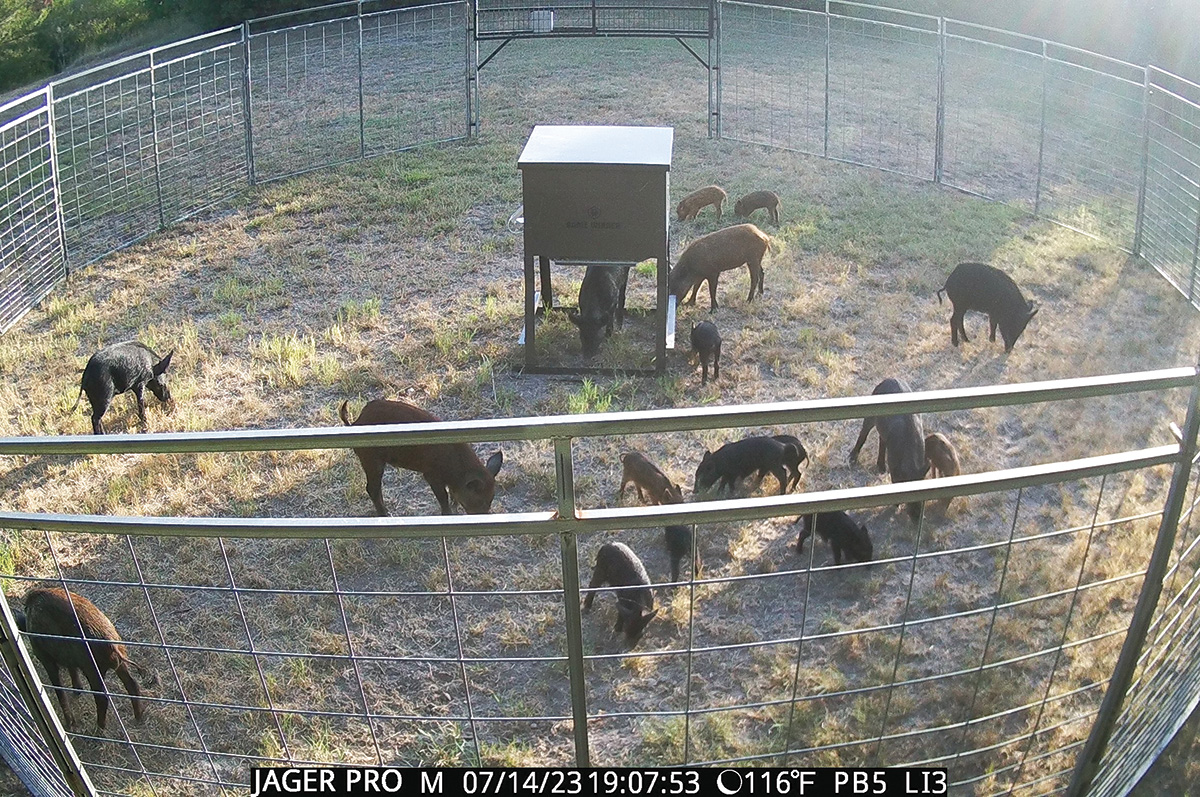
This sounder or family of hogs has been captured in a commercial trap. Image by James Long.
Safety is also a concern. “If you have feral hogs, you need to take care of them,” Dickey urges. “They can be a danger to you, your family and your pets. I’d recommend trapping that group of hogs to get them away from your home and off your ranch, farm or business. Even a 300-pound boar or sow with piglets wants to run away from you, but if either one feels cornered or threatened, or if the sow is concerned for her piglets, they will attack. It’s critical to get them off your property for the diseases they carry, the damage they do to the landscape but also for safety concerns.”
Tracking diseases spread by feral hogs
Michael Bodenchuk is an independent wildlife biologist who has extensively studied the 30 or more diseases feral hogs transmit to beef cattle, horses and other livestock. Wild pigs often test positive for serious illnesses yet do not show symptoms. They can transmit anthrax and pseudorabies, also known as Aujesky’s disease, to sheep, goats, cattle and horses. They carry the brucella bacteria, which cause brucellosis, also known as Bang’s disease, in beef cattle.
Texas Hill Country ranchers provide water troughs for livestock. During an anthrax outbreak, Bodenchuk and other researchers investigated the cause of this disease. He learned that feral pigs carry the anthrax bacteria in their noses. When they drink, they stick their noses into the water, spreading anthrax bacteria to the livestock drinking from these infected troughs.
Other diseases spread by wild hogs include leptospirosis, toxoplasmosis, giardia and tularemia. “They won’t kill a cow, but they reduce her performance, resulting in economic loss to the rancher,” Bodenchuk explains. “They decrease the amount of milk she gives her calf, and the calf is 50 pounds lighter.”
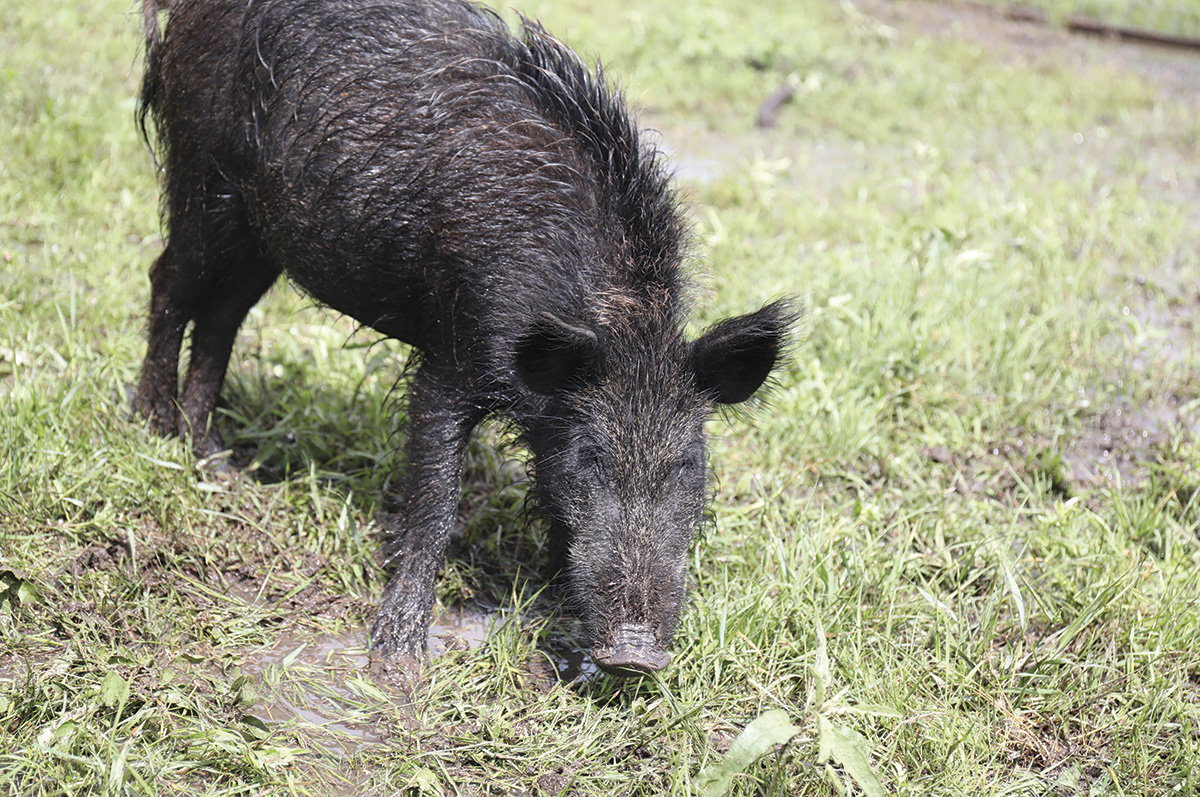
Feral hogs damage crops, golf courses and pastures with their rooting behavior. They also spread serious illnesses to cattle. Image by Hunter Bodenchuk.
Bodenchuk recalls a cattleman who was preconditioning cattle with feed. He lost $10,000 because feral pigs ate the feed. This producer kept excellent records and quickly realized that his animals were only gaining 1 pound a day, not the normal 2. “One aspect about production diseases and loss is that it’s probably a bigger economic factor than the number of cattle that might die from disease,” Bodenchuk reports. “It’s something stockmen are thinking about.”
Experts stress that controlling feral hog populations is critical. Bodenchuk’s favorite feral pig control method is the 50-pound net trap. “It’s affordable, and you don’t have the monthly cell charge that goes with electronic traps,” he explains. “The landowner can move it around the landscape without hiring a crew, and he can put up a net trap in an hour.”
These animals have no predators except for humans. Bodenchuk says their rooting behavior changes plant populations. Their hooves transform grassland into a weed patch. They tear up the soil, spreading invasive plant species and diseases through their droppings and rooting behavior.
Between 2006 and 2010, the feral hog population in Texas doubled. Bodenchuk stresses that when there is 20% annual growth, it takes 21% control to achieve negative growth. “If you’ve got pigs, you need to control them,” Bodenchuk advises. “Don’t get frustrated; don’t expect eradication. That ship sailed a long time ago. Keep some control over the landscape by keeping the pig population down and reducing their damage and disease. You can live with the darn things if you practice control.”