Futures prices are rising with news of competitive international prices and strong U.S. dairy exports coupled with the government’s announcement of dairy product purchases, all making for a bullish outlook for U.S. dairy producers in March. It's a stark difference in sentiment from a month ago, when economists were predicting income over feed cost margins below $9 per hundredweight (cwt) for much of 2026, a reminder how quickly markets do change and the importance of having risk management strategies in place.

Here's Progressive Dairy’s look at important dates, reports and advice affecting risk management decisions, as well as information that will affect dairy producers.
Dairy Margin Coverage (DMC)
Both feed costs and milk prices fell month over month in December 2025, leading to a DMC margin of $9.42 per cwt and triggering the first and only indemnity payment in 2025 for those producers enrolled under the DMC Tier I coverage level of $9.50 per cwt. Participants will see an 8-cent per cwt indemnity payment, subject to a 5.7% sequestration deduction. (Read: December DMC margin triggers first, only payment in 2025)
Margins have improved in the last month, with the outlook significantly better than when Progressive Dairy last reported on the DMC program. January’s DMC value will be calculated tomorrow, Feb. 27, following the release of the Agricultural Prices report. As of Feb. 25, analysts are forecasting a milk price of $17.87 per cwt and a feed cost of $9.54 per cwt for a margin of $8.33 per cwt. If realized, this value would trigger indemnity payments for dairy operations enrolled in three coverage levels under Tier I: $9.50, $9 and $8.50 per cwt.
February margins are forecast to fall more for a DMC margin of $8.13 per cwt before the margins improve for the remainder of the year with much stronger milk prices. Remember, markets do change though.
Dairy Revenue Protection (Dairy-RP)
Dairy producers managing risk through Dairy-RP are eligible to cover revenue quarterly, up to five nearby quarters. In March, Dairy-RP coverage is available for the second quarter of 2026 (April through June) through the third quarter of 2027. Coverage for the second quarter of 2025 closes Sunday, March 15.
The market changes daily and Dairy-RP endorsements must be purchased between the Chicago Mercantile Exchange (CME) market closing and the next CME opening. Dairy-RP is also not available on days when applicable futures contracts move limit-up or limit-down, or on days when CME trading is closed due to holidays.
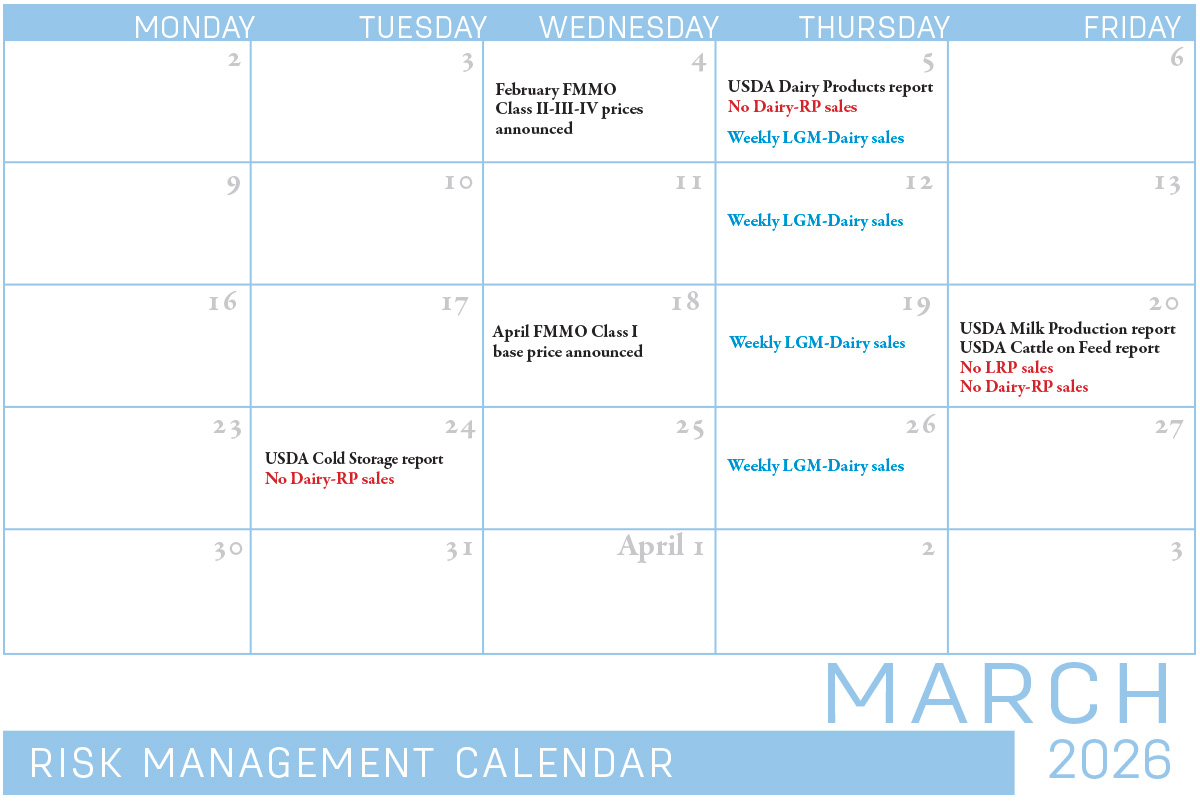
Also, typically Dairy-RP coverage cannot be purchased on days when major USDA dairy reports that could impact markets are released. This includes Milk Production, Cold Storage and Dairy Products reports (see Calendar).
Livestock Gross Margin for Dairy (LGM-Dairy)
LGM-Dairy is a subsidized insurance program administered by the USDA Risk Management Agency (RMA).
LGM-Dairy provides protection when feed costs rise or milk prices drop, and can be tailored to any size farm. The program uses futures prices for corn, soybean meal and milk to determine the expected gross margin and the actual gross margin. LGM-Dairy is similar to buying both a call option to limit higher feed costs and a put option to set a floor on milk prices.
Coverage for LGM-Dairy can be purchased on expected milk marketing over a rolling 11-month insurance period. So the coverage period during March includes the months of April 2026 through February 2027. Sales periods for the LGM-Dairy program are open on a weekly basis. Unlike Dairy-RP, LGM-Dairy is available even if a sales period falls on the day of a USDA report.
Livestock Risk Protection (LRP)
LRP is another subsidized insurance program administered by the RMA. The program is a valuable tool for dairy producers as beef-on-dairy and strategic culling decisions are key parts of herd management and business decisions. For dairy producers, LRP coverage is available as LRP-Feeder Cattle (beef-on-dairy calves) and LRP-Fed Cattle (cull cows) with four additional options to select the appropriate coverage, including head count, targeted marketing weight, and coverage length and level. No more than 12,000 head can be covered in a specific coverage endorsement with an annual limit of 25,000 head per farmer per crop year (July 1 to June 30).
The sales period for LRP coverage is open each afternoon after futures prices are settled and closes the following morning. Similar to Dairy-RP, LRP is not available on days when CME trading is closed due to holiday or when major USDA reports impacting prices are released, such as Cattle on Feed. RMA also has the right to close sales at their discretion.
Production and price outlooks
- The Federal Milk Marketing Order (FMMO) advanced Class I base price rose 77 cents in March to settle at $15.47 per cwt. (Read: Economic Update: March Class I base price to offer reprieve for producers)
- The new year will not be starting out strong for most dairy producers as they can anticipate weaker milk checks in January based on FMMO milk class prices. (Read: January milk prices reach new lows)
- FMMO uniform milk prices dwindled more than $1 from December 2025 in most orders, the result of robust production and waning consumer demand. (Read: FMMO prices fall in January to kick off the new year)
- The February World Ag Supply and Demand Estimates report predicts milk production for 2026 at 234.5 billion pounds, raised on faster growth in milk per cow despite lower expected cow inventory. (Read: USDA raises 2026 milk and beef outlook, feed prices steady)
- Based on the latest USDA monthly Livestock Slaughter report data, the number of dairy cull cows marketed through U.S. slaughter plants in January was about 246,800. (Read: January dairy cows culled for beef lowest since 2010)