Federal Milk Marketing Order (FMMO) uniform milk prices dwindled more than $1 from December 2025 in most orders, the result of robust production and waning consumer demand.

Administrators of the 11 FMMOs reported January prices and pooling data Feb. 9-14. Compared to December 2025, January uniform prices were down in all FMMOs. Here’s Progressive Dairy’s monthly review of the numbers to provide some additional transparency to your milk check.
Uniform milk prices, PPDs
Regional uniform milk prices are used as a baseline measurement to calculate milk check levels, although not an indicator of the specific milk prices received by producers. In January, uniform prices throughout the 11 FMMOs declined from December 2025 (Table 1) for a frustrating start to the new year. The smallest change in price was noted in the California FMMO, down 48 cents from the month prior to $14.85 per hundredweight (cwt), while the Florida FMMO recorded the largest change, down $1.86 to $21.30 per cwt.
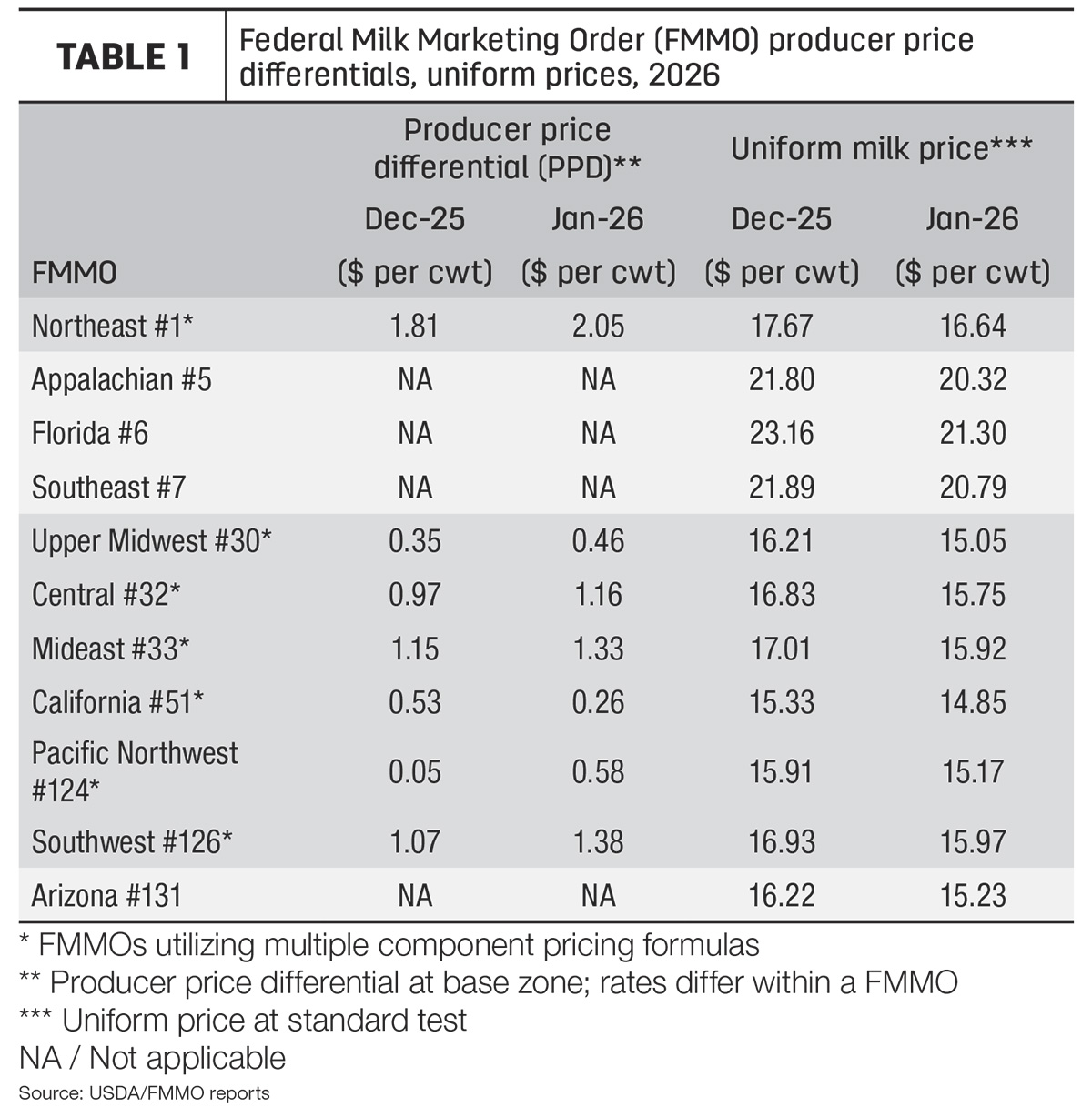
Only three FMMOs reported uniform milk prices above $20 per cwt, as the remaining eight orders were all below $17, which brought the average uniform milk price across all FMMOs to $17 per cwt. The previously announced January Class I base price dipped to $16.35 per cwt – down $1.86 from December 2025 and the lowest since April 2021 – weighed heavily on the uniform prices.
Comparing producer price differentials (PPDs) in January, all affected FMMOs, except California, posted incremental increases (Table 1). The California FMMO saw a decline of 27 cents. PPDs have zone differentials, meaning some PPDs could be negative, and milk handlers may also apply PPDs and other “market adjustment factors” differently to the milk check.
Class prices for January
The new year began with milk prices weaker month over month in all classes for January:
- Class I base price: The January advanced Class I base price was $16.35 per cwt, down $1.86 per cwt from December 2025, and $4.03 per cwt less than the same month a year ago.
- Class I base price zone differentials: Class I zone differentials are added to the base price principal pricing points to determine the actual Class I price in each FMMO. With those additions, January’s Class I prices averaged about $20.47 per cwt across all FMMOs. The highest price was in the Florida FMMO at $23.15 per cwt, and the lowest price was $18.95 per cwt in the Arizona FMMO.
- Class I mover formula: The January 2026 Class I base skim milk price was $11.17 per cwt, a decline of $1.57 from December 2025. The spread in the monthly advanced Class III milk pricing factor ($11.17 per cwt) and advanced Class IV skim milk pricing factor ($8.43 per cwt) was $2.74, with Class III being the “higher-of” and used as the Class I mover in the milk pricing formula.
- Class II: At $13.92 per cwt, the January Class II milk price is down 42 cents from the previous month and a staggering $7.66 per cwt less than January a year ago. The industry has not seen prices this low since November 2020.
- Class III: The January Class III milk price fell $1.27 from December 2025 to $14.59 per cwt. It’s $5.75 per cwt less than January 2025 and the lowest since June 2023.
- Class IV: At $13.55 per cwt, the January Class IV milk price stumbled 9 cents from the month prior and $7.18 from the same month a year ago. This is the lowest Class IV milk price since February 2021.
The gap between January Class III and Class IV milk prices was $1.04 per cwt, continuing incentives for depooling of higher-priced Class III milk from some FMMO pools.
Component values, tests
The values of butterfat and protein fell in January. Butterfat dropped 13 cents from the month prior to $1.45 per pound. That’s $1.50 less than the same month a year ago. Also, January’s price for protein was $2.17 per pound, settling 27 cents below December 2025’s price and 15 cents from January 2025.
The January value of nonfat solids was 94.3 cents per pound, up from December 2025’s 90.6 cents. Other solids also climbed to 44.5 cents per pound.
Influencing statistical uniform prices “at test,” January’s average butterfat and protein tests in pooled milk were down in all FMMOs providing preliminary data. Somatic cell counts in the few FMMOs reporting monthly averages were mixed in comparison to December 2025.
Pooling totals
The total milk volume pooled through FMMOs in January was 12.241 billion pounds, about 1.5 billion more than what was pooled in December 2025.
On a volume basis, each class saw an increase in the amount of milk pooled during the month of January, although Class III was the only class to increase month over month on a percentage basis. Class III pooled milk total was at about 3.4 billion pounds, accounting for 28% of the milk pooled in January, up 0.07% from December 2025 (Table 2).
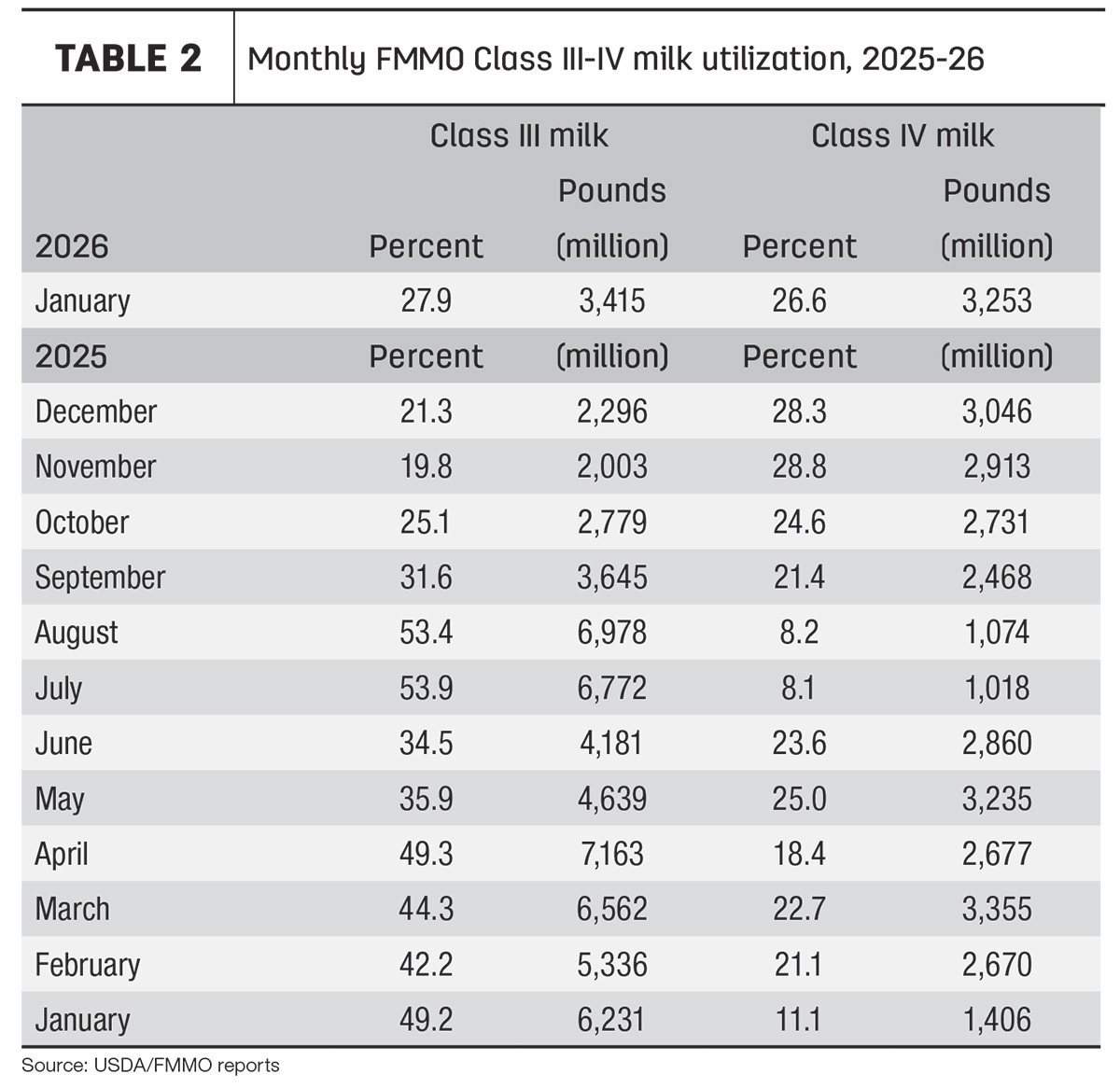
The remaining classes were down less than a percent from the month prior. Class II had the least pooled milk at 16%, representing 1.9 billion pounds of milk. Meanwhile, Class IV had 3.3 billion pounds, representing 27% of the total pooled milk, and Class I pooled 3.6 billion pounds, representing 29% of the month’s total.
Looking ahead
Based on FMMO advanced prices and current futures prices, February regional uniform milk prices will continue to decline.
- Class I base price: As previously announced, the advanced Class I base price will cast a small shadow for February, dipping to just $14.70 per cwt. The February base price is $1.65 per cwt below the base price for January 2026 and $6.57 per cwt less than February 2025. It’s the lowest Class I base milk price since June 2020.
- Class I base price zone differentials: Class I zone differentials are added to the base price principal pricing points to determine the actual Class I price in each FMMO. With those additions, February’s Class I prices should average about $18.82 per cwt across all FMMOs. The highest regional price is in the Florida FMMO at $21.50 per cwt, and the lowest price is $17.30 per cwt in the Arizona FMMO.
- Class I mover formula: The February 2026 Class I base skim milk price was just $9.99 per cwt, a decline of $1.18 from January. The spread in the monthly advanced Class III milk pricing factor ($9.99 per cwt) and advanced Class IV skim milk pricing factor ($8.72 per cwt) was $1.27, with Class III being the “higher-of” and used as the Class I mover in the milk pricing formula. The advanced butterfat pricing factor was $1.44 per pound, a 15-cent fall from January.
- Other class prices: February Class II, III and IV milk prices will be announced March 4. As of trading Feb. 13, the Chicago Mercantile Exchange (CME) February Class III milk futures price settled at $15.06 per cwt and the February Class IV milk futures price closed at $15.53 per cwt. If Class III-IV futures prices hold, the February Class III-IV milk price gap will be 47 cents with some incentives for Class IV depooling.
Other information
- The enrollment period for the 2026 Dairy Margin Coverage (DMC) program closes Feb. 26. Margin forecasts have also been posted for 2026, indicating indemnity payments could be distributed in the first two months of the year. Monthly predicted margins range from just above $8 per cwt for January and February. (Read: 2026 Dairy Margin Coverage enrollment underway, payments predicted)
- Falling milk prices influenced December 2025’s DMC margin of $9.42 per cwt, which led to the program issuing its first and only indemnity payment of the year. (Read: December DMC margin triggers first, only payment in 2025)
- The USDA’s World Agriculture Supply and Demand Estimates (WASDE) raised 2026 milk production and prices, increased beef output and fed cattle prices, and projected steady corn, soybean and cottonseed prices in the latest report. (Read: USDA raises 2026 milk and beef outlook, feed prices steady)