More than 120 producers and industry stakeholders sat in on Lactanet’s first open industry session of 2026 to learn of the organization’s directions relating to genetics and evaluations. Five presentations provided updates and research highlights geared to streamlining reporting processes and identifying quality- and trait-related trends within the industry.

The Feb. 25 session began with an update of the Genetic Evaluation Board’s (GEB) activities since its meeting last October. Monthly female evaluations and calf health were addressed, including requests for minimum insemination information for Brown Swiss Semen Fertility Ratings (SFR) and for Guernsey. Updates were also provided on the list of best heifers and cows, limiting those to only animals that have had a genetic test appear on that list.
The GEB report also mentioned the Crampy Project, dealing with bovine spastic syndrome, a neuromuscular disorder affecting cows. The project has three phases: data collection and industry partner consultation, communication and training, and a national roll-out with genomic evaluations.
“The research has shown there is no single gene to tell us that a cow will have crampy – it is polygenic,” said Cindy Jaton, Ph.D. and Lactanet’s director of genetics and traceability. “If we want to resolve this problem, genomic evaluation is the way to go.”
Research findings
The ever-changing demand for high-quality dairy underscores the importance of ongoing evaluations. Peter Sullivan, Ph.D., senior geneticist at Lactanet, offered a follow-up on monthly female genetic evaluations and other discussions reflecting the use of automated milking systems.
Monthly updates will now include all active cows – roughly 1.25 million – to maintain the integrity of monthly top lists updated on Lactanet's website the first week of every month. Updates in the second and subsequent weeks will cover females (and males) with new pedigree or genotypes.
“One of the things we realized is that the extra processing wasn’t too onerous,” Sullivan said. “Lactanet could handle more cows, the artificial insemination partners and Holstein Canada could handle more updates in the first week of the month. A big motivation was to make sure all active cows that are in top female lists would be updated; even if their Lifetime Performance Index (LPI) change was small, it would reflect their current evaluation.”
Sullivan also covered the impact of foreign cows, nearly all of which are not active. Although it doesn’t warrant a monthly update, they want to continue monitoring foreign cow numbers and will provide those in official releases in April, August and December.
Another change that Sullivan mentioned was allowing cows from electronic Dairy Herd Improvement (eDHI) herds on automated milking systems to qualify for official publication of genetic evaluations. To make that change, qualification criteria had to be based on milk yield, not protein. The reasoning is that automated milking systems are not approved by the International Committee for Animal Recording (ICAR) for components to be included in genetic evaluations, as of yet.
Growing concern
Genetic diversity in Canadian dairy is becoming a greater concern as breeding levels continue to rise across breeds, including a pipeline for computing within-herd R-values to identify outcross sires at the herd level. Liuhong Chen, Ph.D., research geneticist with Lactanet, provided an in-depth look at the impacts of inbreeding, noting the Holstein breed has seen the greatest increase since 2016 – up to 10% – compared to Ayrshire, Jersey and Brown Swiss. Since 2020, yearly increase in Holsteins has risen to 0.31.
“Both the level of inbreeding and the rate have become a real concern,” Chen said. “Since genomic selection was implemented, inbreeding started to accelerate, especially in Holsteins. And even though genomic selection gives us more options to select young sires, it also shortens the generation interval.”
Inbreeding causes the loss of genetic diversity which can lead to long-term genetic gain and cause inbreeding depression, often expressed as reduced performance in traits such as fertility, survival, growth and production. It isn’t always negative and sometimes can help increase the frequency of beneficial alleles. However, it can also raise the frequency of deleterious genes. Ancient inbreeding tends to be less harmful than recent inbreeding and Chen stressed the rate of inbreeding is more important than the level. Inbreeding can be managed by avoiding matings between parents that are highly related. Tools that identify sires less related to females in a herd can help control the rate of inbreeding.
Within-herd R-value is a useful tool in identifying candidates for inbreeding. Chen noted that average inbreeding of future progeny from a bull is determined by its within-herd R-value, where a low number indicates a potential outcross bull. The objective of the within-herd R-value is to compute figures between bulls and herds in the seven different Canadian dairy breeds, then characterize the distribution of those values and demonstrate their use for selecting outcross sires (Table 1).
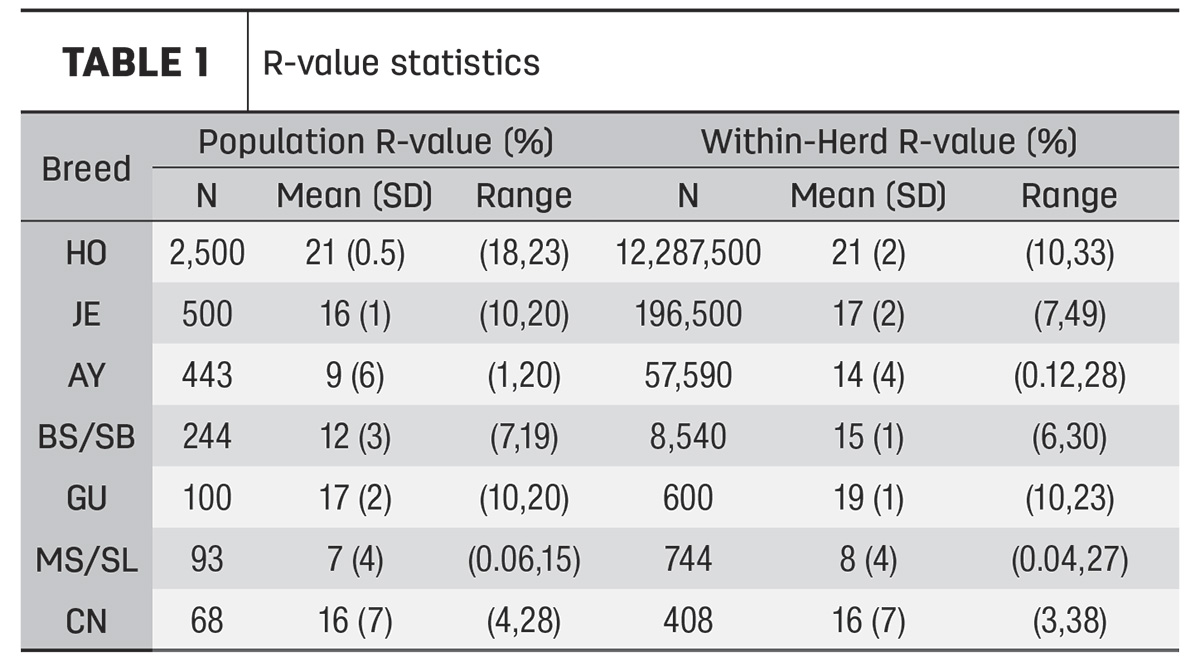
Currently, Lactanet is working to develop a genomic-based within-herd R-value tool, including extension and communication resources for producers. Possible features include an inbreeding calculator to highlight outcross sires and an expansion of the Compass platform to provide each user with a list of outcross sires for their herd, sorted by LPI or Pro$.
In other news
Allison Fleming, Ph.D., manager of genetic evaluation services, presented on the Health and Welfare Subindex of LPI, introduced in April 2025 for all breeds. In Holsteins, the index covers four traits: mastitis resistance (47%), metabolic disease (27%), hoof health (21%) and cystic ovaries (5%). Calf health was also introduced in April 2025 for the Holstein breed, with initial 50-50 weightings for diarrhea and respiratory issues, acknowledging different economic values for each – $350 and $185, respectively. The incident rates since 2007 are 20.7% and 18.7%, respectively.
As a result of the disparity in cost and incidence, weights will shift to a 60-40 ratio for diarrhea to respiratory problems, effective in April 2026.
Hannah Sweett, Ph.D., and Cindy Jaton, Ph.D., wrapped the day’s session with a presentation titled ”Genetic Trends for Fat and Protein.” Consumer and processor requests for more protein are driving changes to payment structures, and the GEB called for gathering information and consultations with the breed associations on weighting of protein in the LPI production subindex.
“Lactanet has been in contact with the Canadian Dairy Commission (CDC) to understand future trends in the solid-not-fat (SNF) and butterfat (BF) markets,” Jaton said, stressing the need to understand future trends. “That’s because genetics is a long-term question, and we can’t change things easily.”
The research Sweett and Jaton are conducting crosses phenotypic and heritability traits in Holsteins, genetic correlations involving fat and protein, fat and milk, and protein and milk. Genetic trends identified last December in Holsteins, Jersey and Ayrshire breeds included those from 1996 to 2025 based on the average of genetic values by birth year for 305-day fat yield and protein yield.
Lactanet’s goal is to align its national selection indices to reflect the industry’s direction. But as Jaton noted, these traits and indices are genetics-based, which is a long-term process.
Presentations from the event can be viewed online.