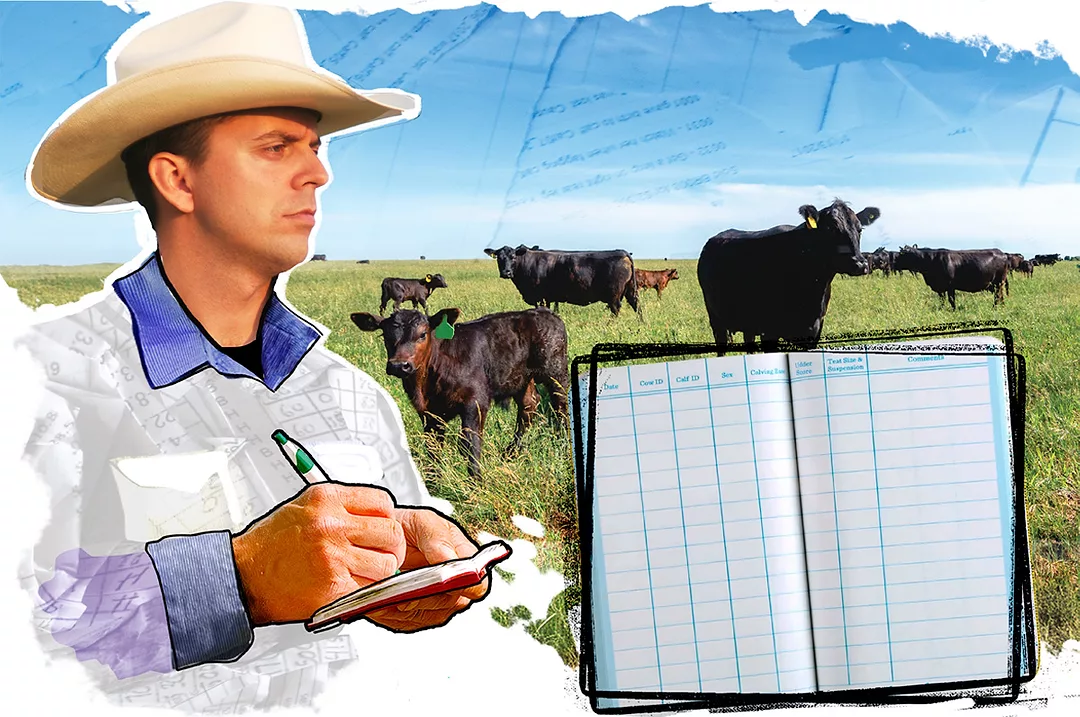
Many beef producers keep a decent set of calving records, but what good are they if you don’t use them to analyze your management and herd performance? Before we can dive into a few suggestions to measure your management success, we need to look back at the previous year’s breeding season.

Maybe the hardest number to remember is the number of cows exposed, which is used in almost all benchmarking calculations. For example, let’s say you turned 100 cows with calves out to be bred last summer. Most benchmark targets would indicate 94 of those cows should be pregnant in the fall (pregnancy rate), and 93 should calve the next spring (calving rate).
Evaluate your nutrition program
If you fall short of target benchmarks, one of the first areas to evaluate is the nutrition program, especially since one of the biggest factors impacting pregnancy rate is the cow’s body condition at calving time. Key questions to ask yourself are:
- What was the body condition score (BCS) of the cows at calving and again at the start of breeding, especially for those cows that did not conceive?
- What was the condition of your pastures during the breeding season?
- What was your mineral and vitamin program as cows went to grass?
- Did a particular age group have the worst conception rate?
Once a cow calves, she enters her highest metabolic requirements during peak lactation. If she is at a BCS of less then 5, she will struggle to have enough energy to establish a new pregnancy while prioritizing nutrients for lactation.
Evaluate your bull power
Another key factor driving conception rate is bull power. If your conception rate was low, ask yourself:
- Did you have enough bulls to breed 100 cows?
- Did they all pass a breeding soundness exam prior to this breeding season?
- Is the breeding season length appropriate?
- Did they all have acceptable libido?
- Was there a hierarchy issue among the bulls?
- Did any bulls go lame or get injured during the breeding season?
Especially when evaluating bull power, there is value in calculating performance indicators on a pasture group basis to try and narrow down which bull or bulls might be the culprit of poor performance.
Evaluate your calving distribution
Were most of your calves born early in the calving season, uniformly throughout the season or mostly late in the season? Some might argue that a live calf is all that matters, but in terms of economics, age and uniformity of the calves make a big difference come sale time. Let’s compare two calves: one born on the first day of the calving season and one born on the 60th day. Assuming both are the same weight at birth and gain the same while nursing (about 2 pounds per day), the first calf will be 120 pounds heavier at weaning time simply due to the age advantage. What is an extra 120 pounds worth?
The calving distribution calculation takes a little work and is based around determining the number of calves born in each 21-day estrous cycle. First, count the number of cows that calved in the first 21 days, then the first 42 days and finally the first 63 days, and divide each by the total number of cows that calved that season. Note that this calculation used cows calved and not exposed females as the denominator like the prior calculations. Using North Dakota State University’s CHAPS (Cow Herd Appraisal Performance Software) data as a benchmark, a herd should have 63% of the cows calve in the first 21 days, 89% calve by 42 days and 96% within a 63-day period. If you are below these marks, ask yourself:
- What was the body condition of the cows, especially those who were in the later calving period?
- What was the distribution last year? It takes time to move cows earlier in the season, so don’t expect late cows last year to move up much in one year.
- Did you have adequate bull power?
- What age group of cows calved later in the season?
- Were females allowed adequate time to recover and return to estrus before being expected to breed?
Evaluate your calving distribution by cow age groups. This will allow you to identify age groups that need more attention or changes in management. For example, if the 3-year-old group is falling behind, ensure the postpartum interval allows a longer recovery time for heifers and that they receive adequate nutrition after calving.
Evaluate your heifer development program
Heifers seem relatively easy to breed if they are fed and developed appropriately, typically to about 65% of mature weight at first breeding. It’s the second conception that seems rather elusive for most. Consider breeding your heifers two to three weeks before the mature cow herd. First-calf heifers need more time to recover from calving because they are still growing and lactating for the first time. Breeding them earlier allows you to focus on them during calving while also providing a few more weeks for them to recover before breeding season.
Nutrition is also key for this age group. Especially if young cows are losing body condition and falling later in the calving season, separate first- and second-calf heifers from the mature cow herd during late gestation and early lactation feeding time. Young females need more nutrient-dense diets, have a lower gut capacity and can be timid when competing with mature cows for feed.
Evaluate your heifer selection
What heifers are retained? Use the calving book to make the first cut on replacement heifers. Retain heifers from early-calving cows, as their dams are best adapted to your environment and have consistently conceived and calved early. Heifers that calve early in the first calving season are most likely to continue to calve early in subsequent pregnancies, resulting in more lifetime pregnancies, more pounds at weaning and more profit potential. Young, late-calved heifers will be the last to reach puberty during the breeding season and result in fewer first conceptions.
Evaluate sire selection
Finally, evaluate your bull selection priorities. Bulls should be selected to complement the weaknesses of the cow herd and aid in making progress in desirable traits. Often, herds focus on birthweight expected progeny differences (EPDs) that result in small calves born early and give up pounds at weaning. In reality, the focus should be placed on calving ease for calves that are born easily, get up and nurse, and don’t need much assistance. Evaluate what percentage of the heifers needed assistance at calving and why assistance was needed. Were there correlations between dystocia issues and breeding group or sire?
These are just a few of the analyses you can pull from your calving records before you put them away for the season. Rather than guessing at ways to improve your operation, make sound decisions based on the data you already spent the time to collect.