Heat stress is no longer a seasonal inconvenience for dairy cows. For high-producing herds, it is a production and welfare challenge that can show up earlier in the day and earlier in the year than many producers expect. Research led by Dr. Robert Collier has shown that cows producing more than 35 kilograms of milk per day can begin experiencing negative impacts when average daily temperature-humidity index (THI) values exceed 68 or when minimum daily THI stays above 65. In practical terms, cows can be under heat stress well before afternoon temperatures peak. When that stress is not managed effectively, the consequences show up quickly in reduced dry matter intake (DMI), lower milk yield, compromised reproduction and increased health risk.

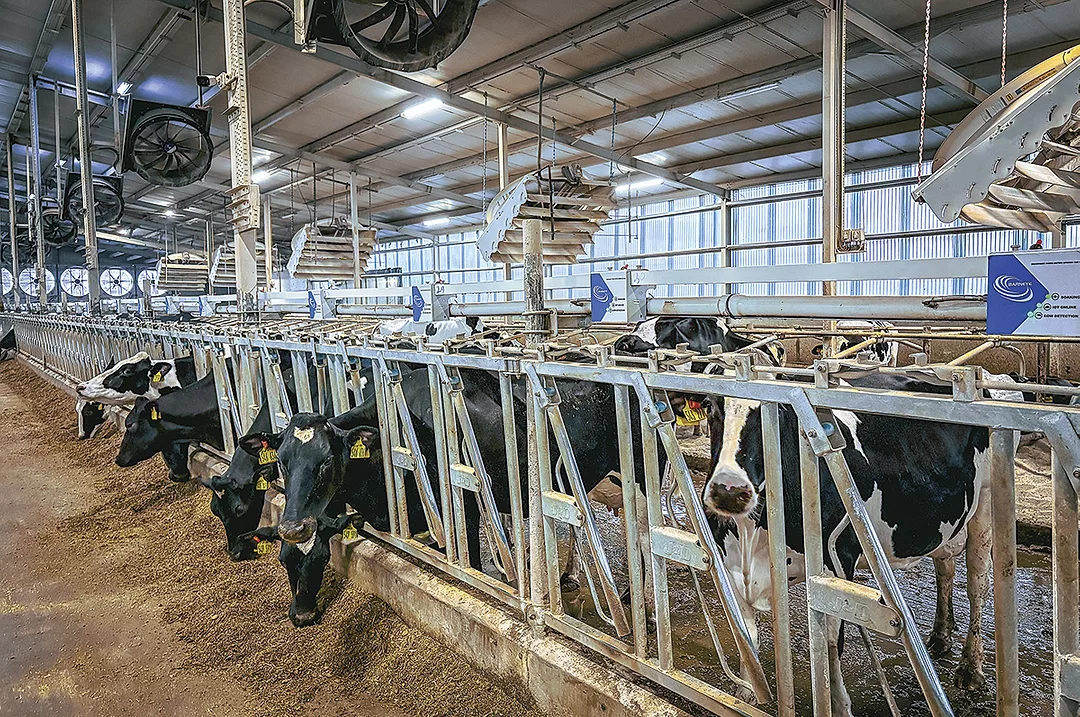
Evaporative cooling remains one of the most effective tools available to help cows manage heat load. The basic principle is straightforward. Apply water directly to the cow’s back and flanks, then use airflow to evaporate that water and remove heat from the body. Numerous studies have shown that combining soaking with adequate air movement lowers body temperature, reduces respiration rates and helps cows maintain feed intake during periods of heat stress. Cooling at the feedbunk is especially effective, since cows spend a significant portion of their day there, and cooling encourages them to continue eating when temperatures rise.
Traditional soaking systems typically rely on fixed timers or temperature set points. These systems can be effective, but they operate on the clock rather than on cow behaviour. A cow that walks up to the feedbunk just after a soak cycle ends may have to wait several minutes before the next cycle begins. During periods of high heat load, that delay matters. Timer-based systems also apply water regardless of whether a cow is present, leading to water hitting empty alleys, feed or equipment, while increasing barn humidity and water use.
Sensor-based soaking systems shift control from time to cow activity. In many designs, sensors are installed directly on the water line at each nozzle or group of nozzles. When a cow steps into position at the feedbunk, the sensor detects her presence and opens the nozzle, allowing water to flow immediately. When the cow leaves, the nozzle closes. Other systems achieve the same outcome using camera-based detection, where visual sensors monitor cow activity and signal individual nozzles to activate only when a cow is present. While the sensing technology differs, the operating principle is the same. Nozzles are controlled based on cow presence, not preset cycles.
This immediate, cow-driven response is a meaningful advantage. Cows receive cooling as soon as they arrive at the feedbunk, rather than waiting for a timer to restart. In hot conditions, even short delays can limit the effectiveness of cooling. Immediate soaking helps reduce body temperature and respiration rate right away, encouraging cows to stay at the bunk longer and maintain feed intake during peak heat periods.
From a cow-comfort perspective, the benefits are tangible. Heat-stressed cows reduce feed intake as a natural response to lower metabolic heat production. That reduction often occurs during the hottest parts of the day, precisely when cows should be eating. Immediate cooling at the bunk helps counteract this behaviour by lowering body temperature and respiration rate as cows approach feed, making them more willing to stand and consume feed. Research evaluating evaporative cooling strategies consistently shows improvements in physiological indicators, such as core body temperature and breathing rate, along with behavioural improvements including increased feeding activity and more stable daily routines.
These comfort gains translate directly into production outcomes. Cows that maintain intake during heat stress are better able to sustain milk production and avoid secondary issues tied to negative energy balance. Reproductive performance is also closely linked to heat abatement. Elevated body temperatures are known to impair estrus expression and conception rates, and cooling strategies that reduce heat load can help mitigate those losses. While soaking alone is not a cure-all, it is a critical component of a broader heat-stress management strategy that includes ventilation, stocking density and ration management.
Sensor-based soaking also brings measurable efficiency benefits. Field data and manufacturer testing suggest water use reductions of 50% to 70% compared to continuously cycling or timer-based soaking systems. Because water only flows when a cow is present, less water enters the manure system, and less excess moisture is added to the barn environment. This helps ventilation systems perform more effectively during heat events and reduces overall water and energy costs.
In addition to cooling, sensor-based systems can provide valuable data. Depending on the technology used, producers may be able to track how often individual nozzles activate, total soak time and patterns of cow activity at the feedbunk during hot weather. Over time, this information can help verify that cows are using cooling systems as intended, identify changes in feeding behaviour during heat stress, and fine-tune soak duration and airflow settings. While data alone does not cool cows, it gives producers better visibility into how cows interact with the system and how effectively heat abatement strategies are working.
As with any cooling approach, the details of installation and setup matter. Sensors need to be positioned so they activate when a cow is actually standing in the correct place at the feedbunk, not when she is walking past or shifting her head. Soak duration also needs to match the amount of airflow available. Without enough air movement, water does not evaporate efficiently, and cooling is limited. On the other hand, applying water too frequently or for too long without adequate drying time adds moisture to the barn without improving cow comfort. When sensor-based soaking is set up to match cow behaviour and ventilation capacity, it becomes a reliable and responsive tool for managing heat stress.
As margins tighten and environmental conditions become more variable, precision in cow cooling is increasingly important. Sensor-based soaking is not about adding technology for its own sake. It is about delivering cooling when and where cows need it and using cow activity to drive system response. When nozzles open because a cow is present and close when she leaves, cooling becomes both more effective and more efficient. That combination benefits cow comfort, resource use and the farm’s bottom line.