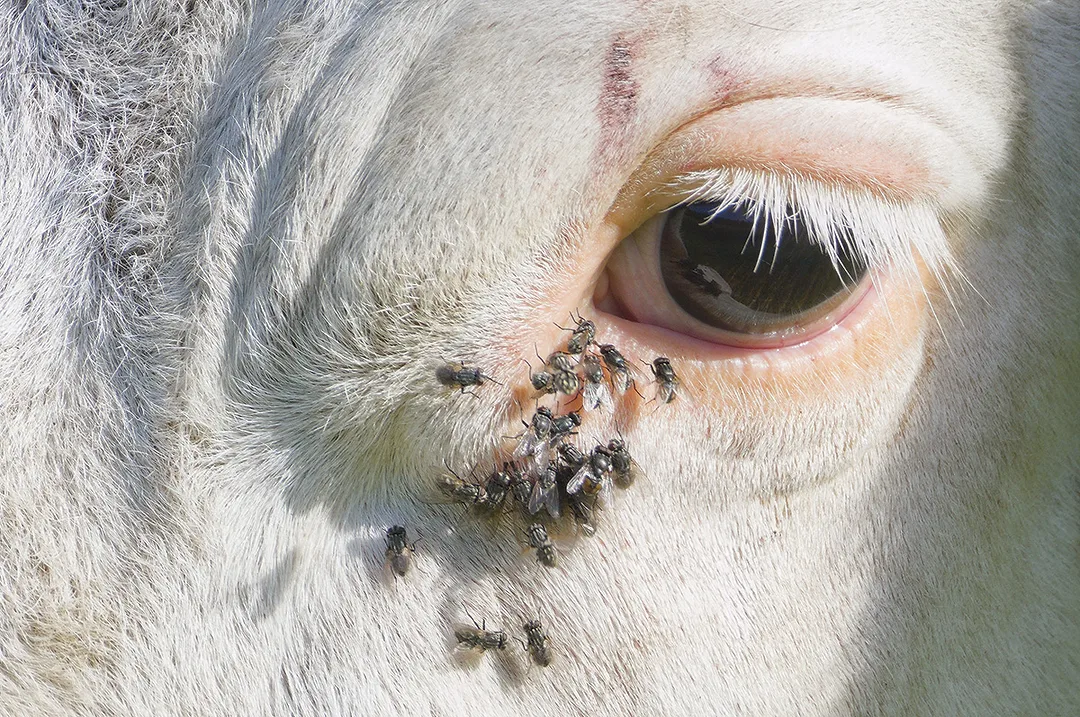
Managing and mitigating ectoparasites (filth flies such as horn/face/house flies, as well as lice and ticks) continues to be a challenge due to increasing tolerance of insecticide treatments available in the market. Producers should consider garlic to aid in the repellency of external parasitic insects. Livestock producers need an integrated pest management plan (IPM) to control the loss of production due to filth flies while cattle graze summer pastures. An IPM plan may include the movement of livestock, mechanical disruption of grazing areas, mechanical removal of flies and the use of natural and chemical insecticides or repellents. The goal in all these methods is to reduce defensive movements of cattle to “fight” flies, reduce total fly load and reduce blood loss. An IPM plan is evaluated by producers based on cost and potency of reducing overall stress for livestock throughout the summer grazing season.

Garlic oil, as part of an IPM plan, is a natural repellent to manage an infestation of horn flies. These filth flies compromise animal performance of both stockers and cow-calf pairs grazing pastures. The economically injurious number of horn flies has been established to be 200 flies per animal for mother cows or stocker calves. In the southwestern U.S., where horn fly densities are up to 1,000 flies per animal, spending $1 for fly control results in a return of $8.38.
Ectoparasite resistance to chemical treatment calls attention to the need for a multipronged IPM approach. The effectiveness of pest management is influenced by the type and breed of cattle, environmental conditions and timing in the horn fly cycle. Horn flies feed 20 to 38 times per day. Male flies consume 0.6 to 1 milligram of blood per day; female horn flies consume 1.7 to 2.7 milligrams and require a total of 33 milligrams of blood to complete the first batch of eggs.
Considering these numbers, 100 male horn flies will consume 1.7 grams of blood per day, and 100 females will consume 6.38 grams, for a total of 8.08 grams per day at an estimate for 200 flies per animal. The natural repellent of garlic oil would decrease the total blood loss, stress and agitation caused by horn flies.
Horn flies can thrive in diverse environments, overwintering as active adults in southern regions of the U.S. and in a dormant pupal stage in northern regions. Their development out of dormancy is dependent on environmental temperature. During the grazing season, horn fly egg hatching and pupal maturing occur in the fresh manure pats at temperatures from 68° to 90°F. The optimal temperature of 86°F hatches eggs in 11 hours, and the pupal development requires 12 to 13 days. More time is needed at lower temperatures.
As temperature increases and cattle graze, the horn fly feeds on its host. When active adult flies are feeding, they mate, and females are able to lay eggs three days after pupal emergence. Five-day-old females can deposit eggs daily in fresh manure pats and return to the host. Females oviposit up to 400 eggs in their lifetime. Eggs are oviposited in the lower portions of a manure pat or the soil beneath the manure pat. In southern regions of the U.S., 12 to 14 generations of horn flies are produced annually. In more northern regions, two peaks in horn fly populations are late spring and late summer/early fall.
Due to the short generational time of the horn fly, adaptations for resistance develop as a small number of flies are able to survive the intervention being applied. The priority of the dietary intake repellent as part of the IPM is efficacy and cost. Elimination of horn flies has not been achievable in grazing cattle, so the objective is to minimize the presence of this pest. When the specific intervention is used repeatedly in that same herd, a few generations or a year later, the success of that intervention will be diminished due to resistance.
Now an additional focus of IPM is to bring multiple modes of action to disrupt the life cycle of the horn fly or to simply repel them from the host. Insecticides and their modes of action are listed online and in other publications. Essential oils (EOs) are generally delivered to the host topically. Several other EOs such as citronellol and citronellal from lemongrass, camphor from Asian evergreen trees and thymol from oregano have been evaluated as topically applied repellents.
Frequent reapplication of the repellent is not a functional component of an IPM plan, but an EO with a different route of application is garlic oil. The bioactive components of garlic oil are not stored in the plant but rather the secondary metabolites which, when consumed as part of the diet, transition to be the bioactive elements. Many of the bioactive components found in EOs are part of defense systems in the native plant against herbivory or parasites of that plant.
When garlic cloves are crushed to make garlic powder, the disruption of the plant tissue releases alliin, which mixes with the enzyme allinase and is converted to allicin. When crushed garlic is heated and dried, allicin is converted to polysulfides. Polysulfides are the bioactive compounds that function to repel horn flies and other ectoparasites when absorbed into the bloodstream. Stabilized allicin or polysulfides with known inclusion rates allow garlic to be used throughout the grazing season as part of a dietary supplement. Garlic powder has been fed as a component of a salt supplement, resulting in decreased horn fly counts. Efficacy of a fly control ingredient in a grain supplement depends on the consistency of consumption of that supplement, as demonstrated in a separate study when feeding an insect growth regulator at different time intervals.
The repellency mechanism of allicin and secondary polysulfides has been evaluated using test organisms: fruit flies, mosquitoes and the tsetse fly (the vector for malaria). These are well-known model ectoparasites to evaluate management options for horn flies. Allicin and the secondary polysulfide metabolites disrupt feeding, mating and egg-laying. An outcome of exposing these insects to the polysulfides is that a satiety hormone is increased, which results in less feeding and less reproduction of the insects. For a repellent to deliver its mode of action to the pest by its feeding, the bioactive components must be present in the bloodstream and/or secretions of the host. As cattle consume a supplement containing an adequate inclusion of stabilized garlic oil, the intake of allicin and polysulfides impact the ectoparasites by disrupting their life cycle, resulting in the reduction of the parasitic pressure on the host.
Research has shown multiple results of garlic oil – through its secondary metabolites in multiple types of ectoparasites – minimizing the potential adaptations that would result in resistance. As a part of a dietary supplement for cattle, garlic oil is a good and effective choice that functions by disrupting the life cycle of blood-feeding parasites such as the horn fly. These impacts make garlic oil a good choice as part of an integrated pest management plan.
References omitted but are available upon request by sending an email to the editor.