Cutting greenhouse gas (GHG) emissions is no longer just a regulatory checkbox for U.S. dairy processors. As customers, retailers, investors and consumers place increasing pressure on food companies to address emissions, dairy processors are becoming more actively engaged in carbon footprint reduction efforts. Since the Innovation Center for U.S. Dairy launched the Net Zero Initiative (NZI) in 2020, which brings together stakeholders across the dairy supply chain, dozens of processors have pledged to support the industry’s goal of achieving GHG neutrality by 2050.



Despite the growing number of public commitments, an important question remains: How are U.S. dairy processors working toward the net zero pledge, and in what ways do their approaches differ?
A recent study by the authors, based on sustainability and public information from the top 100 U.S. dairy processors, shows an industry gaining momentum on net zero initiatives – but not yet moving with a common roadmap.
Among the top 100 U.S. dairy processors, 42 companies have publicly pledged to achieve net zero emissions by 2050, either through individual corporate climate goals or by joining the U.S. Dairy Stewardship Commitment, an industry-wide initiative focused on advancing sustainability and environmental stewardship across the dairy supply chain.
That number is significant because dairy processing in the U.S. is a highly concentrated industry. A relatively small number of firms handle a large share of the nation’s milk supply, giving these processors substantial influence over both their plant operations and farm-level milk production practices. In fact, the two largest processors alone – Dairy Farmers of America and Land O'Lakes – process more than one-third of U.S. milk production.
This means that the majority of the U.S. milk supply is now tied to processors with a net zero commitment. When large processors commit to sustainability, the effects can reach far beyond their own facilities. They influence hauling systems, supplier standards, packaging decisions and, ultimately, producer management practices. Net zero is becoming part of the mainstream dairy business planning.
A 2050 net zero pledge might sound ambitious. Perhaps an important reference question is what happens between now and 2030. It is here that significant differences among dairy processors begin to emerge.
The study found that only 25 of the top 100 processors publicly disclose intermediate emissions-reduction targets that cover all three categories of emissions: Scope 1, Scope 2 and Scope 3, which refer to direct operational emissions, indirect emissions from purchased energy, and supply-chain emissions such as farm-level production and transportation. In practical terms, many processors have committed to the end destination, but far fewer have publicly mapped out the route.
This gap matters because long-term credibility depends on near-term milestones.
Among companies with measurable interim reduction targets, most aim to lower Scope 1 and 2 emissions by roughly 25% to 50% by 2030. On the other hand, targets for Scope 3 are typically lower and often in the 20% to 30% range.
Some companies, including Nestlé, have gone further with more aggressive supply-chain targets. But across the industry, intermediate reporting remains uneven, and some large processors still provide little public detail on pre-2050 action.
The result is an industry with growing ambition but inconsistent accountability.
For dairy processors, operational emissions are the easiest place to start. Companies can install LED lighting, reduce refrigerant leakage, shorten milk-hauling distances and purchase renewable electricity. Many processors are already doing this because these investments can reduce both carbon output and also operating costs.
Land O'Lakes, for example, has reported renewable energy investments at several facilities. Retailer-processors, such as Albertsons and Meijer, have highlighted refrigeration upgrades and lower-impact cooling systems as part of their climate strategies.
But plant improvements only address a fraction of dairy’s total emissions. As shown in Figure 1, roughly 70% of the dairy carbon footprint occurs upstream, largely from milk production and feed production. Methane from enteric fermentation, manure management and on-farm energy use make these Scope 3 emissions the dominant challenge in the dairy industry’s decarbonization goal.
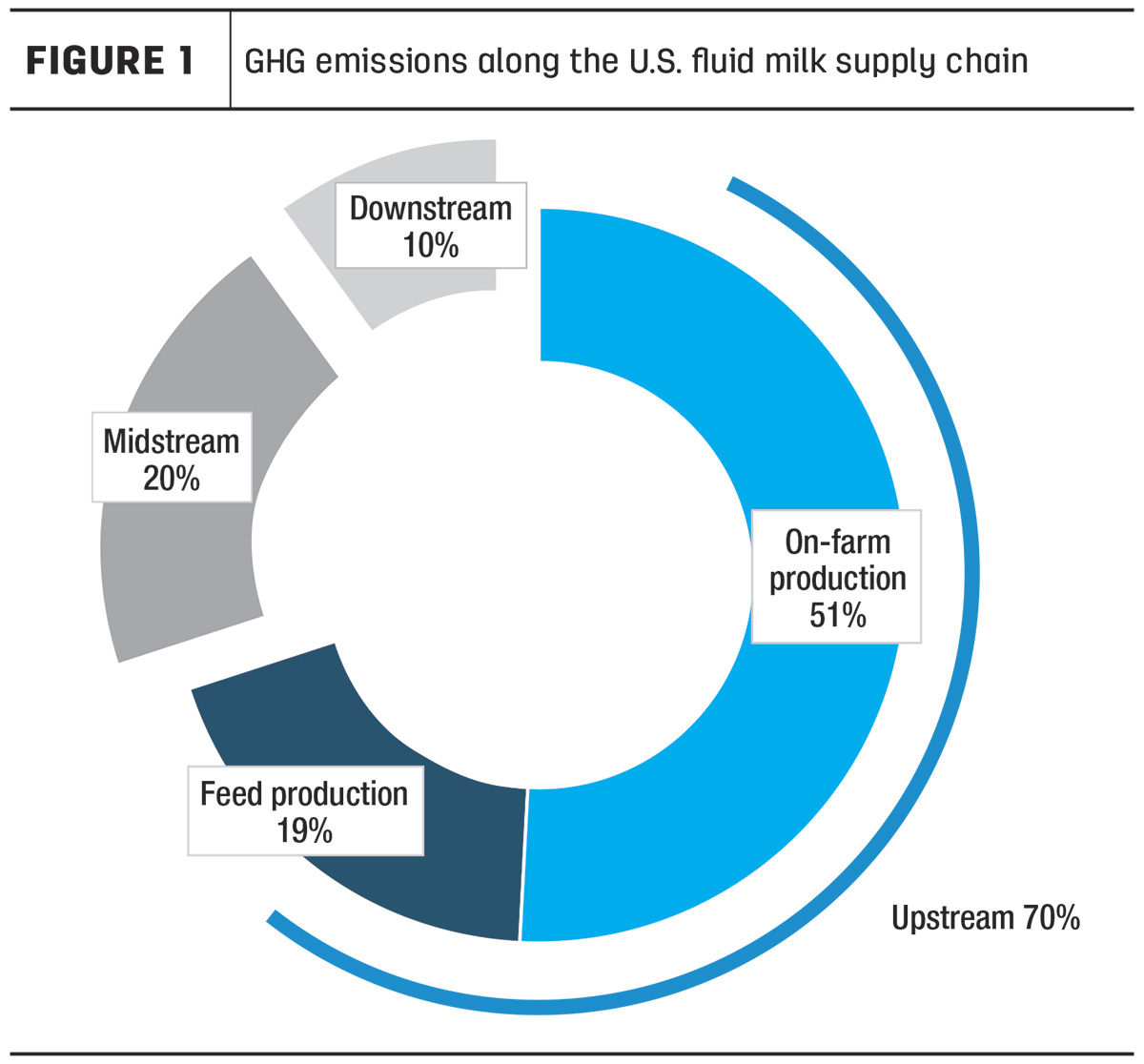
The remaining emissions, primarily from carbon dioxide, are linked to midstream and downstream activities such as processing, transportation, packaging and product disposal, which contribute approximately 20% and 10% of total emissions, respectively.
That creates a major challenge for processors: Achieving net zero will not be possible through plant efficiency improvements alone. Success will depend largely on what happens at the farm level.
Unlike plant emissions, farm-level emissions are outside a direct processor’s ownership and control. Consequently, reducing Scope 3 emissions requires processors to move beyond internal engineering projects and toward supplier partnerships, incentive systems and long-term producer engagement.
Dairy Farmers of America has expanded regenerative agriculture investments and farm sustainability programs. Danone has emphasized feed optimization and manure-management efforts in its milk supply chain. In addition, several dairy operations are investing in biodigesters and low-carbon hauling systems, as well as joining the FARM Environmental Stewardship program to improve on-farm benchmarking and identify measurable opportunities for emissions reduction.
Nonetheless, Scope 3 emissions remain the least standardized and most difficult part of the net zero equation. Processors must rely on data collection, farmer participation and incentive alignment across independent operations – none of which can be addressed quickly or uniformly.
Another major challenge for processors is comparability.
Processors are not all measuring progress the same way. Companies use different baseline years, target years and reporting metrics. Some report total emissions reductions, while others report intensity reductions per gallon or pound of product. Some disclose full Scope 3 accounting, whereas others report only selected categories.
These differences make direct comparisons difficult and weaken the industry’s ability to measure collective progress.
A processor may claim to be on track under one reporting framework while another uses a completely different benchmark. This lack of standardization may become one of the dairy industry’s biggest barriers to demonstrating credible and measurable progress.
There is little doubt that dairy processors have entered a new era of climate awareness. Net zero commitments are expanding, operational investments are increasing and more processors are beginning to engage producers in farm-level emissions strategies.
The harder work now is building measurable 2030 and 2040 milestones, standardizing reporting practices and creating supplier partnerships that can deliver meaningful Scope 3 reductions.
For dairy processors, net zero will not ultimately be decided by who makes the boldest announcement. It will be decided by who can show a working plan – and deliver measurable progress – long before 2050 arrives.