For years, methane has loomed large over the dairy industry’s sustainability narrative. We know our cows produce this potent greenhouse gas as part of their natural digestive process and that manure management, feed choices and housing practices all play a role. But the question always remained: How much methane, exactly, does a particular dairy farm emit and how can we reliably measure that in a way that’s both practical and cost-effective?

Until recently, the honest answer has been: We simply didn’t know. Although farmers and researchers have attempted to rely on handheld sensors, on-animal breath analyzers and various on-ground sampling techniques to gauge methane output, these traditional methods are often limited. Dairy operations are inherently open systems, with barns and housing structures that seamlessly interact with the surrounding environment. Wind patterns, temperature fluctuations and the sheer complexity of methane dispersion make it nearly impossible to get precise – even rough – on-ground measurements. Despite a range of innovations – from feed additives to selective breeding for more efficient cows to manure-handling systems designed to trap emissions – producers and policymakers were essentially guessing about their real-world impacts. Trial-and-error approaches, incomplete data and a lack of reliable metrics left everyone in the dark. But that’s beginning to change with the advent of new research that leverages satellite technology, artificial intelligence (AI) and machine learning, offering a more accurate and comprehensive picture of on-farm methane emissions.
The missing piece in dairy sustainability
The dairy industry stands at a crossroads. On one hand, global demand for dairy remains robust and producers strive to meet the world’s need for high-quality protein. On the other hand, there’s rising pressure from consumers, investors and governments to reduce greenhouse gas emissions and align with climate goals. Methane is at the heart of this tension: It’s a short-lived but extremely potent greenhouse gas – roughly 80 times more powerful than carbon dioxide over a 20-year horizon – making it a top priority if we’re serious about turning the dial on climate change.
For producers who have been striving to improve both environmental stewardship and economic viability, this is an opportunity. If we could accurately measure methane at the farm level, we could identify exactly which practices drive emissions up or down. That data-driven insight is vital for developing effective reduction strategies that won’t compromise animal welfare or profitability.
From guesswork to ground-truth: Measuring methane via satellite
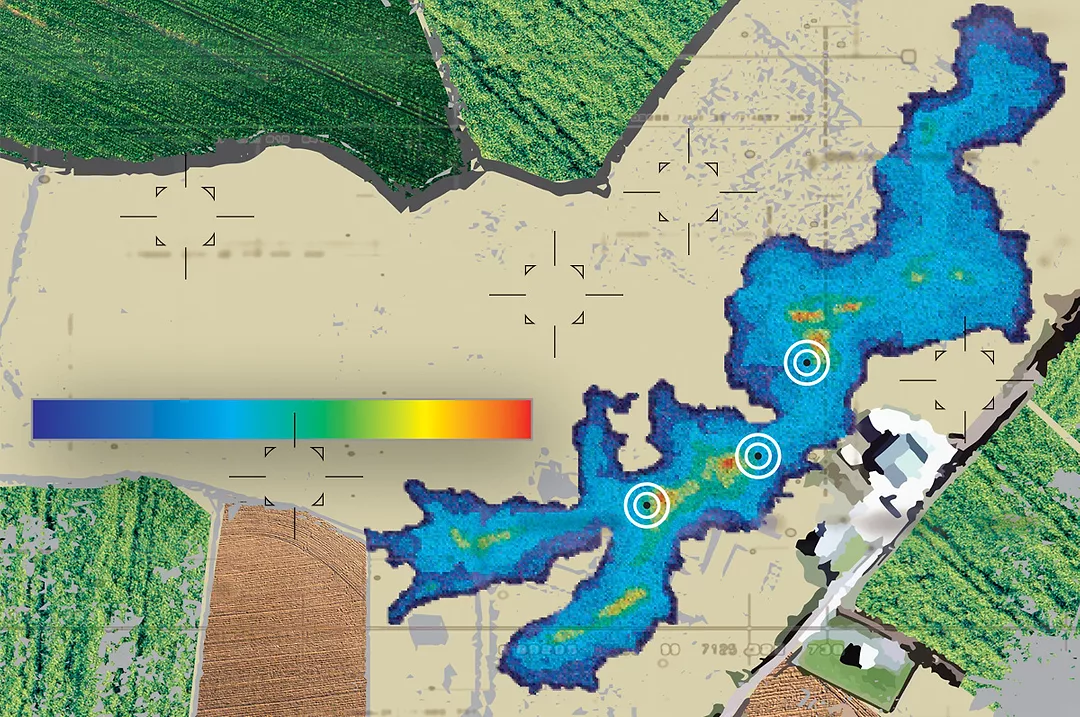
Here’s the breakthrough: By harnessing satellite data from NASA and the European Space Agency, combined with advanced AI-driven analytics, we can map and benchmark methane emissions from entire regions – right down to individual farms.
Recent research out of Dalhousie University analyzed methane concentrations from more than 575 Canadian dairy farms and 384 processors between 2019 and 2023. Instead of relying on patchy, on-ground measurements or modeled estimates, these satellite observations provide near-continuous, large-scale coverage.
Imagine an eye in the sky that can “see” the invisible gas emissions, track them over time and pinpoint hotspots that need attention. This aerial perspective reveals previously hidden patterns. For example, seasonal shifts emerged: Methane levels peak in the winter when cows spend more time indoors. Cow housing, feeding regimens and manure storage conditions differ markedly from summer, impacting how methane microbes thrive. Regionally, Ontario’s dairy sector showed notably higher emissions, likely reflecting its dense concentration of farms. Such precise data helps move beyond broad-brush assumptions and open the door to tailor-made interventions.
AI: The data detective that translates observations into action
Data, however, is only half the story. The other half is making sense of it. Satellite images generate massive amounts of information. To sift through these millions of data points, researchers employed sophisticated machine learning algorithms. These AI models can detect subtle trends, account for weather variations, filter out background methane from non-agricultural sources and identify which on-farm factors matter most.
The initial insights are eye-opening. Breeding strategies, for instance, can influence methane. A higher Estimated Breeding Value (EBV) for milk protein percentage in the herd is associated with lower methane emissions. The logic is that cows producing higher-protein milk are more feed-efficient and have different rumen microbial populations, potentially leading to lower methane output. This suggests that genetics, long understood as a lever for milk yield and composition, may also become a tool for environmental stewardship.
Other management factors also come into play. Bedding choice, for example, influences how manure decomposes. Organic bedding like wood shavings can trap moisture, encouraging anaerobic conditions that generate methane. Sand bedding, in contrast, does not decompose and may reduce methane production from manure. The goal here is not to impose one-size-fits-all solutions but to provide clarity, so producers can weigh trade-offs and make informed choices that align with their unique operations.
Turning numbers into benchmarks and incentives
Once we know how much methane comes from where and why, we can start setting benchmarks. Government policy, until now, has lacked precise data to enforce standards or provide targeted incentives. With accurate methane emissions mapping, regulatory bodies can establish meaningful, science-based thresholds.
Policymakers could design carbon tax incentives or credit systems for farms that stay below certain emission levels or successfully reduce their methane output over time. In Denmark, for example, a “flatulence tax” on livestock methane is being considered to drive reductions. While that approach might be unpopular or unfeasible here in Canada, we can still leverage financial tools – like carbon credits, low-interest loans or grants for upgrading manure management systems – to reward progressive producers who invest in mitigation technologies. This turns compliance into opportunity, fostering innovation rather than imposing burdens.
A holistic approach: Balancing productivity and sustainability
It’s important to remember that every intervention must be economically and practically viable. Producers can’t afford to slash productivity or spend beyond their means. That’s where accurate methane measurements become even more essential. With precise data, a farm can test a new feed additive or a manure management technique and see if it actually reduces methane. If emissions drop, the farm could earn carbon credits or other incentives, offsetting any added costs and potentially unlocking new revenue streams.
Quality data also quells doubts. Instead of going on a hunch, producers can rely on hard evidence. If a farmer notices that switching from one bedding type to another reduces methane levels by a measurable percentage, and if that reduction comes with incentive payments or premium contracts that emphasize low-carbon milk, everyone wins – the farmer, the environment and ultimately the consumer who demands sustainable products.
From reactive to proactive: Shaping the future of dairy
Imagine a future where dairy producers have real-time methane monitors – integrated data streams from satellites, ground sensors and a barn-level network of devices – feeding into a dashboard. The dashboard shows today’s emissions and forecasts tomorrow’s. It suggests when to adjust feeding, breeding or housing strategies and projects the financial implications of each decision. This predictive capability transforms environmental compliance from a guess-and-check game into a strategic tool for operational excellence.
The same data can help the entire supply chain. Processors, retailers and even consumers can know the environmental footprint of their milk. Transparent data can differentiate low-emission farms and create niche markets. Investors looking at sustainability scores can place their bets on the dairy operations that demonstrate clear, verified improvements.
Seizing the opportunity
The dairy industry has always been innovative, adapting to new challenges – be they animal health, nutrition or market volatility. Methane mitigation is just the latest challenge. But this time, we have powerful new tools: satellites to measure emissions objectively, AI to make sense of complex patterns and evolving policy frameworks that recognize agriculture’s central role in climate solutions.
Producers are no strangers to change. Over generations, farms have integrated automated milking, genetic testing, precision feeding and data-driven herd management. Adding methane monitoring and mitigation to that suite of best practices is a logical next step. Early adopters could reap the rewards of a cleaner environmental footprint, enhanced brand image and compliance with emerging regulations – all while maintaining or even improving profitability.
Canada’s dairy industry has set its sights on net-zero emissions by 2050. That’s not going to be easy. But accurate methane measurement and targeted strategies can turn an ambitious goal into a realistic pathway. Rather than pushing that goalpost further into the future, we can start making measurable progress now. The message is clear: By combining satellite-based methane data with AI-driven insights, we empower producers to identify emission hotspots, implement best-fit solutions and verify their impact. Producers, policymakers and processors can then collaborate on incentives that make sustainable practices both achievable and rewarding. Consumers, in turn, gain trust that their dairy products come with a lighter climate footprint. Small changes, guided by robust data and supported by the right policy frameworks, can compound significant reductions.
This is a turning point for dairy. Instead of methane being a shadowy menace we only guess at, it becomes a quantifiable metric we can manage – much like milk yield, somatic cell counts or feed efficiency. Armed with better data, we can confidently move toward a future where dairy’s role in climate stewardship is not just aspirational but quantifiable, provable and celebrated. We are finally filling a crucial data gap in the fight against methane. In doing so, the dairy sector can position itself as a model of sustainable agriculture – leading, not lagging, on the path to net zero.