You can often tell the dairies that have pride in their operation based on how they treat the appearance of the dairy.

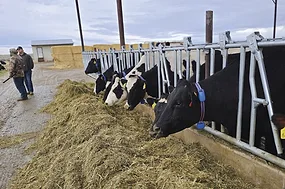
Recently, while hosting some visitors to Idaho's Magic Valley to see a few of its 400-plus dairies, my visitors commented about certain dairies that we passed versus others. The commonality that I noticed? They noticed how well kept they were.
This observation was highlighted by a singular instance.
While pulling into the driveway at one stop, the producer we were to meet was already driving up the lane toward us. He stopped his pickup, got out and picked up a single piece of tissue paper. It was likely a stray paper towel from the milking parlor. That didn't matter. It wasn't where it was supposed to be, and so he stopped to collect it.
The rest of the facility was just as garbage-free and well tended as the dairy lane.
Paying attention to the fact that something is out of place is the foundation of dairy success. The best make success a habit. Tiny habits repeated over time – a process – lead to excellence.
That kind of unconscious discipline made me wonder where it comes from – and it sent my mind to a phrase I'd heard a lot this year: “the process.” After Indiana won the national championship in college football in January, I started studying Curt Cignetti and his “process” more closely. His coaching lineage traces back to Nick Saban, well known for his own version of “the process.” With a little help from artificial intelligence, I had a workbook of materials to study how Cignetti and his teams approach success. One main principle he teaches his teams stood out to me.
I'd call it “stalking complacency” – staying alert to the small things that quietly erode standards. Cignetti hopes somebody, really anybody, on his teams don’t get complacent. He praises “effort, hard work and consistency.” I’d summarize his approach as: Winning happens because of the smallest detail.
We have a lot of processes on our dairy farms. I question if employees know the habit we are trying to form behind completing each of those processes – the reason the smallest of those details matter.
We follow the milking procedure because it leads to better milk quality. We do herd check a certain way to limit lock-up times because it leads to more lying time and more milk production. When we’re done tending to chores and caring for cows, we pick up trash because it’s an extension of the care we show in every other aspect of our work.
Building these “details matter” habits will lead to better teams on our dairies.
I think about that producer often when I drive past a dairy now – not because of the trash, but because of what stopping for it taught me. That producer didn't stop because his dairy was perfect. He stopped because not stopping wasn't an option – it wasn't who he'd trained himself to be. That's the process. Pick up the tissue paper today, and tomorrow, and the next day, until you don't have to think about it anymore.