Each year, shipping day is a momentous day. I’m quite certain that statement holds true for anyone who’s ever sold a calf. It’s harvest day – the culmination of a year’s worth of work, struggle, fear and anxious anticipation wrapped up in a tightly wound ball of nerves. For the past several years, since I started feeding my cattle all the way through the finishing phase, shipping day has turned into shipping days. I love watching my calves all the way through the cycle, and it’s particularly rewarding to see the real end product of what we produce. It can, however, be a wild ride sometimes. Hanging onto calves for an extra year or so is a practice that lends itself to nearly 400 more days of possible wrecks and catastrophes. If I sell the calves in the fall, they’re somebody else’s worry. Every year, if I lose one a month or so prior to slaughter, I find myself counting pennies and second-guessing every decision I’ve ever made.

The cattle looked really good on the day before I’d scheduled for a couple of loads to be shipped to the slaughter facility in California. I’d already sent some to Texas a couple weeks prior and was as tickled as I could be when I received the highest price I’d ever seen for my cattle. The outlook was even better for the cattle that I was sorting this time. We’d sorted a load of big heifers and were working our way over to another pen to sort off a load of steers.
We emptied the pen, and as the big, lumbering yet somehow still-athletic 14- and 15-weight steers barreled down the alley, I heard a sickening crack as the first of the steers came to the end of the alley, whirled around and headed back toward us and from whence they came. I could see a big black steer in the middle of the bunch hobbling, almost flailing, as the big old boys assessed their situation and slowed to a trot and finally stopped to mill around in the alley. As I slowly eased up closer to the group, I came upon a grotesque scene. In a freak incident, the big steer in question had broken his leg just below the hock. There were small bone fragments on the ground, and his broken leg flopped around like a ball on the end of a chain as the steer struggled to maintain his balance. Obviously, he was not going to be on a California-bound truck the next morning.
In kind of a funk now, I quickly called my friend Rogelio. A few years ago, Rogelio had taken over a tiny facility where he planned to do some custom butcher work on nights and weekends. His honesty and quality work quickly escalated his little side gig into a full-time business with several employees. I often regretted recommending Rogelio to anyone who ever asked me where the best place for custom butchering was because he was now booked up with work for months in advance. Gone were the days when I could simply call him the night before I planned to have a fat steer or a hamburger cow killed.
Even though it was late in the day and almost quitting time for his employees, and even though I told him it could probably wait until morning, upon hearing of my plight, Rogelio insisted I bring the injured steer in that evening. He was concerned that the steer may be under severe stress and prone to fever if we waited any longer. I finished sorting off a load of steers for the next day and then headed into town with my crippled cargo in tow, thankful that I wouldn’t have to do any homestead butchering that night.
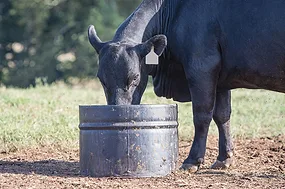
A day or two after the flailing leg incident, I was headed back home from a quick trip to town to have a tractor tire repaired. As I rounded the familiar S-curve in the road, about 5 miles from home, I passed a pair of familiar flatbed pickups on the side of the road. I figured it was just an ad hoc meeting of the cowboy committee members who’d missed the regularly scheduled 6 a.m. coffee shop market report. As I eased past them, so as not to clip them with my trailer, I noticed three or four 250-pound cracked and shattered supplement tubs on the pavement. I lifted a finger from the steering wheel in my customary local greeting. My two neighbors, Chris and Mike, nodded their heads and waved in return.
I was on my way home so I could log into a Farm Bureau policy committee Zoom meeting, and I was in a time crunch. It looked like they had everything under control, so I didn’t plan to stop, but when I glanced in my mirror at the scene, though there was no sense of emergency, I heard a voice, with just a hint of a Spanish accent, quietly yet ever so clearly whisper something in my consciousness. “WWRD. What would Rogelio do?” it said.
The answer was as clear and bright as the garish, broken orange plastic supplement tub at the side of the road. So I pulled over on the opposite side of the road and trotted back to see what I could do. I heard a good, mostly true story about how Mike had managed to lose four tubs off the back of his truck as he rounded the S-curve, and he caught me up on his early calving season adventures. In short order, another flatbed pickup rolled up, and two boys from the Three Bar outfit jumped out and helped us heft the sweet smelling molasses rocks into some empty tubs they were packing and lift them back onto Mike’s flatbed.
The whole incident lasted maybe 10 minutes. I was a little late to my meeting, but I think they managed without my wisdom. I was a little embarrassed at my tardiness, but I figured the tradeoff was fair. As I thought about it later that evening, I felt an uncommon yet familiar gratitude for the decency of the people of my “village” and their willingness and desire to “pay it forward” with no expectation of reward or praise. Right then and there I sent up a grateful prayer of thanks and a plea to help me to be deserving of the goodness that surrounds me. And you know what? I’ll bet that same prayer was offered up that same night in thousands of homes scattered all across cow country.