Nitrous oxide (N2O) is an important greenhouse gas (GHG) but it often takes a backseat in discussions about GHG emissions. This might be because it ranks third for GHGs emitted in the U.S. Carbon dioxide (CO2) is by far the number one GHG, making up 80 percent of GHG emissions. Methane (CH4) comes in second with 11 percent of the U.S. footprint from all sources. But for agriculture, the importance of all three gases is somewhat different than the national footprint.
Because agriculture does not contribute significantly to CO2 emissions (less than one percent), we tend to turn our focus to methane and nitrous oxide to target improvements on the farm. A little over one-third of U.S. methane comes from the burps of ruminant animals (also known as enteric emissions), mainly from beef and dairy cows, and from liquid or slurry storage of manure, mainly dairy and swine. Almost 80 percent of total U.S. nitrous oxide emissions come from agriculture and the management of our crop fields.
DAIRY FARM FOOTPRINT
The dairy farm GHG footprint is divided up across the areas of the farm into enteric (animal), manure, feed production, and energy. Roughly speaking, enteric emissions represent one-third to one-half of the footprint, manure if stored is about one-third or more, and feed production is another quarter to one-third. Energy use at the dairy is actually a small part of the dairy farm footprint, less than one-tenth.
Significant focus is on developing and testing feed and manure additives, and manure storage management options, to reduce methane emissions. This is not surprising given that the majority of dairy farm emissions are in the form of methane from the cow and from stored manure. However, the feed production portion of the dairy farm footprint offers other important opportunities. Most of the GHG focus in crop production has been on improving soil health, in part by sequestering carbon to build soil organic matter. Yet, carbon sequestration is only one part of reducing the GHG footprint of dairy feed production.
Here is where nitrous oxide comes into the picture. While nitrous oxide represents only six percent of overall U.S. GHG emissions, it is important for agriculture because about 80 percent of the U.S. total N2O emissions come from the management of our crop fields and it makes up roughly 50 percent of agriculture’s total emissions. Given the importance of feed production emissions for a dairy farm’s footprint, we need to look at the resources used to grow feed consumed by dairy cows. This means a focus on manure and nitrogen fertilizer, for both crops produced at the dairy, as well as crops grown off-farm that are used in dairy diets.
GHG FROM CROP FIELDS
The feed production footprint has two main elements: 1) carbon sequestration, or the removal of carbon dioxide from the atmosphere and retaining the carbon in soil; and 2) reducing GHG emissions by reducing nitrous oxide loss from soil.
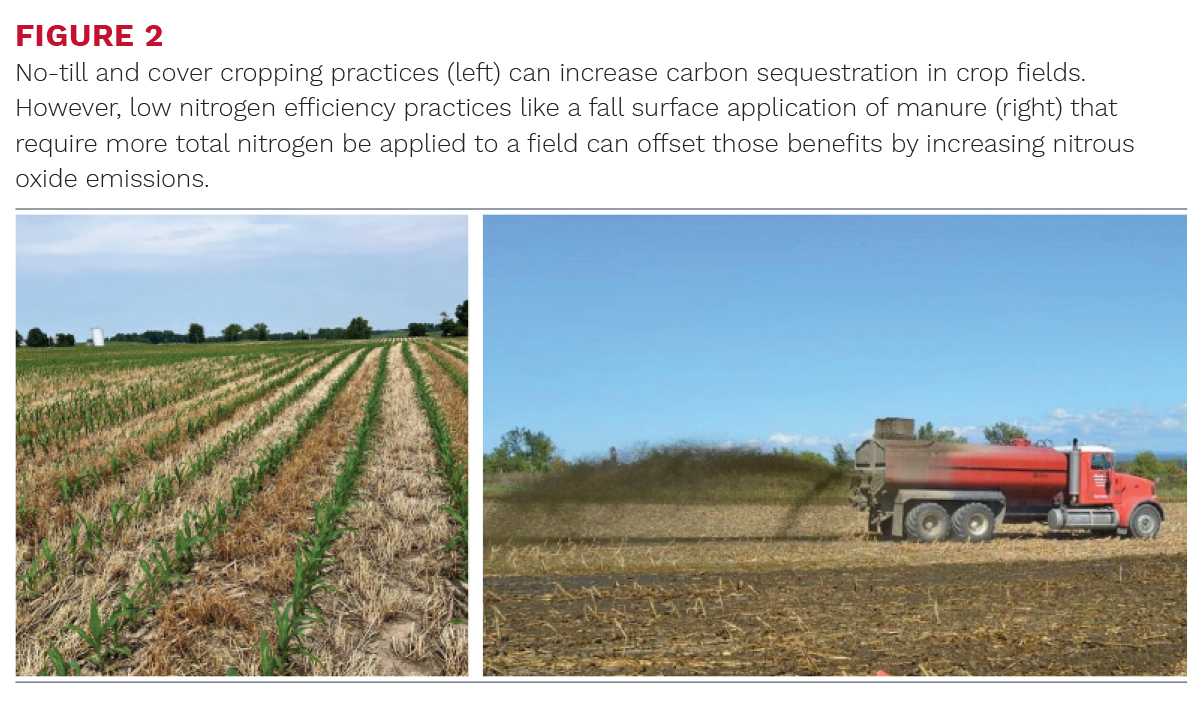
Carbon can be sequestered by limiting or eliminating tillage, increasing the addition of crop residue (from cash crops or cover crops) to soil, including use of perennials in the crop rotation, and adding manure or compost to fields. Depending on practices and local climate conditions, dairy crop rotations can produce a range of results from an annual net loss of carbon to an annual increase in soil carbon. A dairy farm in a humid region that is using continuous strip till or no till, cover crops after corn silage and perennial grass, or alfalfa in their rotation, may sequester as much as 0.5 metric tons of CO2 per acre per year, possibly more. It will be important for dairy farms to sequester more carbon in crop fields, and this will take significant management commitment and focus.
NITROUS OXIDE IS A POWERFUL GHG
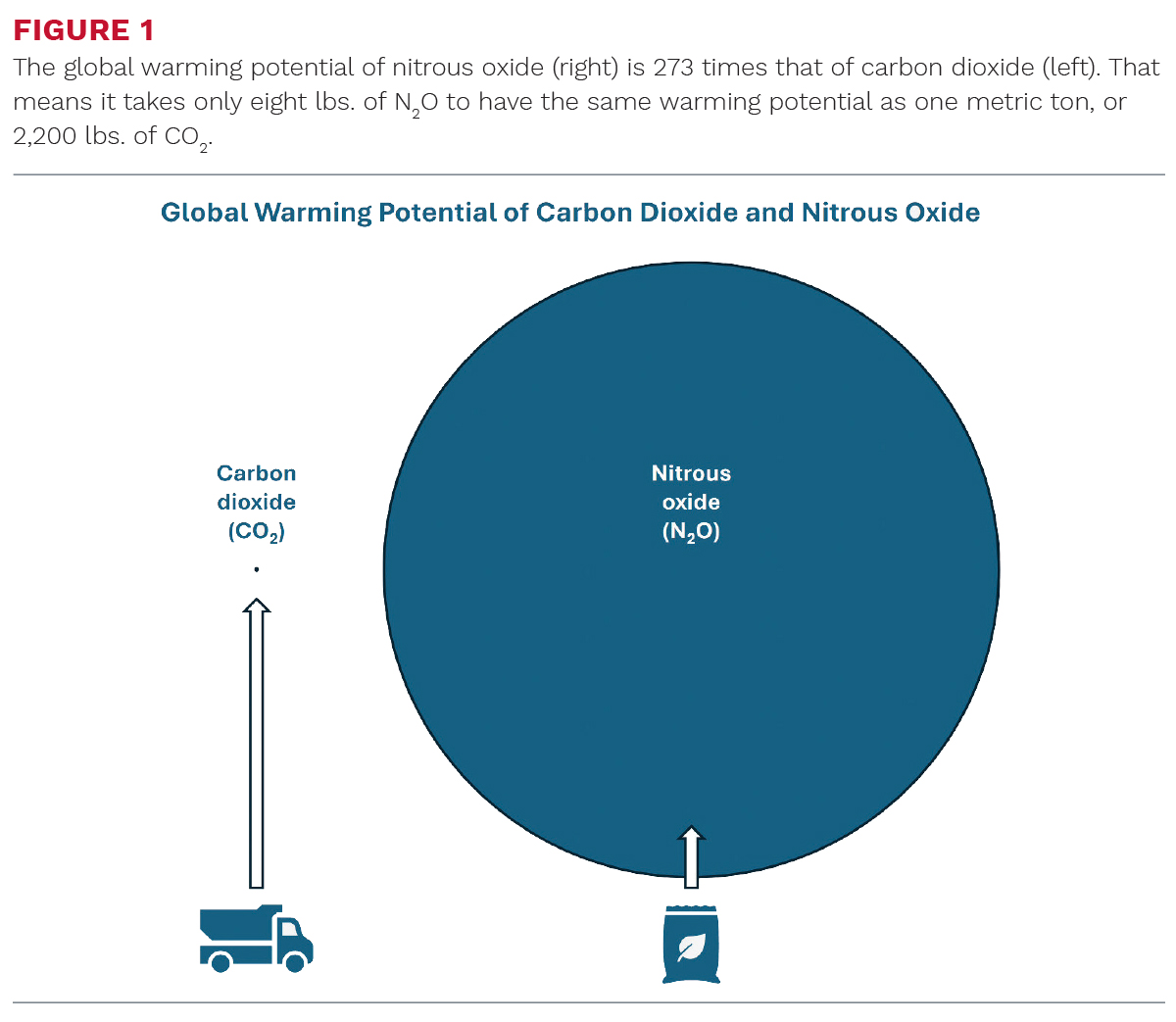
What about nitrogen management to reduce nitrous oxide losses? Let’s start with some information from the Intergovernmental Panel on Climate Change (IPCC). Over 100 years, nitrous oxide is considered to have 273 times greater heat trapping ability than CO2 (Figure 2). This means a little N2O goes a long way, as it takes a mere eight pounds of N2O to trap the same amount of heat as one metric ton of CO2. Further, the IPCC expects that on average, global loss of N2O is about one percent of total N applied.
The key here is total nitrogen applied. Dairy manure consists of fast-release and slow-release nitrogen pools and the nitrogen efficiency of these nitrogen pools can range widely depending on timing and method of the manure application. Based on the IPCC general rule of N2O loss, if we manage manure for low nitrogen efficiency, more total nitrogen will be applied to ensure crops have enough, which also means that more N2O will be lost from that application.
For example, if we apply 200 pounds more total N to achieve the amount of available N needed for the crop due to inefficient N management, and one percent of that extra N is expected to be lost as N2O, we lose two extra pounds of N2O per acre. Using the example from above of 0.5 metric tons of carbon sequestered with a strip till plus cover crop system, and a global warming potential of 273, the two additional pounds of N2O lost cancels out half of the benefit of carbon sequestered from other practices.
The U.S. dairy industry and many dairy food companies have made significant commitments to reduce GHG emissions and dairy farmers will be increasingly called upon to make reductions. Increasingly, companies are paying more for dairy products that can help achieve these commitments, making it an economic benefit to the dairy farm business as well. Reducing dairy GHG emissions will require producers and advisors to look at many different solutions across the dairy farm, including growing and purchasing feed with a reduced GHG footprint.
Calculate a dairy’s nutrient mass balance and greenhouse gas footprint
It is common for homegrown forages and grain to make up 65 percent or more of a Northeastern dairy herd’s dry matter intake (DMI). However, the remaining 35 percent of the DMI is made up of purchased grains, concentrates, byproducts or other inputs that can represent a disproportionate share of the GHG footprint associated with the farm’s feed.
Dairy farms can work to reduce the N2O emissions from their homegrown feed, but if they cannot source “low carbon” grain and other feed inputs, they will not be able to reduce the farm’s overall footprint to the maximum extent possible.
This market is currently uncertain, but it is a good idea to talk to nutritionists and feed suppliers now to see if and when these products might become available and how they might compare cost-wise.
The first place to start is to find out if current feeds have a GHG footprint to compare. Another option is to source from local producers who may have the ability to have their crop’s footprint calculated along with the dairy.
Interested in calculating a Nutrient Mass Balance and Greenhouse Gas Footprint for your dairy farm? Dairy producers in N.Y. can work with the Nutrient Management Spear Program at Cornell University. More information can be found online.
 |
This article appeared in PRO-DAIRY's The Manager in March 2025. To learn more about Cornell CALS PRO-DAIRY, visit PRO-DAIRY. |