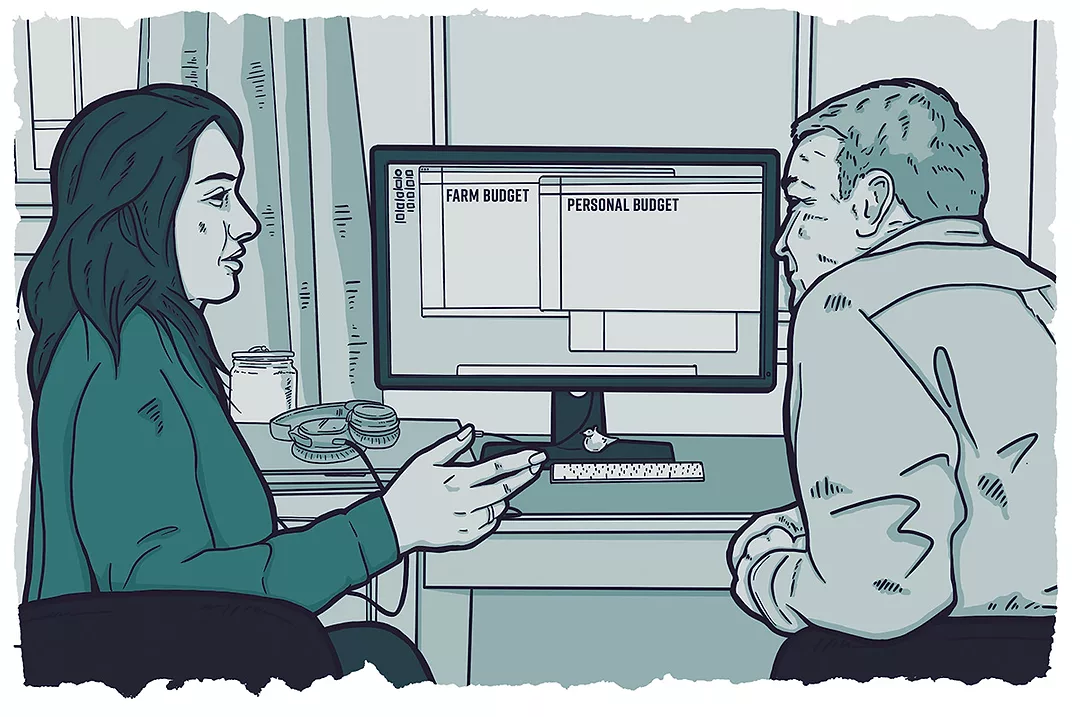
The farming industry is an ever-changing landscape. With each year that passes, new complexities and challenges arise that place pressures on Canadian farmers to continuously adapt their business practices to remain competitive. With these complexities comes the need to have a clear understanding of our financial capacity.

Farmers across the country are guilty of blurring the lines between what is a farm business expense and what is a personal lifestyle expense. These blurred lines often result from prioritizing the farm and its success over our own personal needs. However, as more layers of complexity are added to both our family and farming setups, the need for clarity of our personal expenses is greater than ever.
Maintaining a clean divide between personal and business expenses helps ease pressures around farm succession planning, reduces family conflicts and maintains long-term business sustainability.
Creating clarity around succession planning
As families work through the challenge of farm succession, the need for clarity between personal and farm expenses becomes more apparent than ever. Succession planning can result in income generation for the exiting generation through several strategies, such as the continuation of salaries, capital extraction, share redemption and rental agreements, just to name a few. Regardless of the approach to income generation, the most important question remains the same – how much is enough for the exiting generation?
Many of us wish to ensure the farm operation remains as viable as possible after succession to the next generation, and as such, we want to leave as much revenue or capital as possible within the operation. If we spend our farming career continuously utilizing farm resources to fund our personal lifestyles, it becomes difficult to truly identify what our personal income needs are when it comes to succession planning. If we are becoming reliant on the next generation for income support, they need to know what they are accountable for on an annual basis. If we are looking to extract capital through an event, such as an asset sale or through the redemption of corporate shares, we need to know how much capital is needed to sustain us in the “retirement” years.
Regardless of the strategy used, we need to be able to quantify our personal needs. If we already have an accurate history of our personal expenditures and a system in place for managing our personal finances, then it allows for smoother planning when it comes to the eventual succession of the family farm. The main reason this is so important is simple: Once the farm has been transitioned, it can be difficult to go back to our successors if we fail to plan properly and fall short of the retirement capital goals. Before we transition the financial security of the farming assets, we need confidence that our lifestyle plans are fully funded.
Personal financial clarity helps guide business planning efforts
In addition to how clean lines between personal and business expenses can help to ensure a smooth succession for the exiting generation of farm owners – it can also be equally as beneficial for the entering generation.
Having clear expectations around financial obligations owed to the exiting generation allows for more sustainable business planning practices for farm operations. The new generation of farm owners often want to inspire some degree of change in the operations. Whether it be an expansion through capital purchases, upgrades to infrastructure and technology, or the revitalization of current equipment – almost all changes led by the new generation have some form of impact on cash flow.
For these new farm owners, the more clarity they can have regarding their cash flow commitments to the exiting generation, the more certainty they can have with their cash expenditures. Too often we see families overcommit to new business ventures at the expense of personal finances. For the younger generation, the risks associated with this are minimized by having more time to recover from excessive expenditures. For the exiting generation, a lack of planning around farm cash flow can leave them overexposed to financial hardship if the right levels of protection have not been included in their succession planning efforts. With fewer options for income replacement and a shorter timeline for recovery, it is important to ensure that the personal cash flow commitments to the exiting generation are not jeopardized by future commitments of the farming operation.
In addition to gaining security for the exiting generation, having defined boundaries between personal and farm finances is also beneficial to farming successors. When we have clear metrics around commitments to those exiting the business, it allows us to plan with more certainty. This allows us to capitalize on opportunities quicker and more decisively without having to second-guess the impact on other stakeholders.
Clean divides for increased family harmony
The blurred lines between personal and business finances can lead to increased conflict and anxiety among family groups. Having clarity between the two can help promote family harmony, as the decisions around finances can be individualized. In agriculture, family and farm are so intertwined that it can be difficult to manage the priorities of each. This can lead to strained relationships between spouses, which can trickle down and impact the children in farm families. By having a separation between personal and business resources, each entity can plan without the anxiety of wondering how their financial decisions could be detrimental to the other side.
An example of this could be as simple as the family having a separate bank account for daily expenses (such as groceries, school supplies, children’s activities, etc.) with funds reserved strictly for nonfarm expenses. Although this concept sounds like a standard approach, our work as succession planners tells us that this is not the norm in our industry. Simply having a separation between sides allows our families to have certainty around cash flow for the daily expenses, which reduces stress, minimizes potential conflicts and provides greater flexibility in support opportunities for our children.
Best practices for maintaining financial separation
To help effectively create separation between personal and farm business expenses, here are some best practices to consider:
- Establish separate bank accounts: Maintaining distinct accounts for personal and business transactions helps to quantify the cash flow needs of each party.
- Utilize accounting software: Implementing accounting software to help record our revenues and expenses allows for more accurate tracking of cash flow. With the increasing complexity of farming, traditional paper and pen accounting practices are becoming more difficult to complete with real accuracy.
- Have a defined compensation plan: Having formal compensation allows us to create discipline around how we account for cash flow. This allows families to cover their day-to-day expenses and support children without having to seek approval for expenses from the farm operator.
- Establish professional support systems: Building a team of professionals to help support your financial, succession and business planning allows you to have peace of mind about how your decisions impact all stakeholders. As you establish your team of trusted partners, it is important to ensure communication remains open between each party to ensure each part of the team is working toward a common goal.
Conclusion
Although many of the concepts discussed in this article are simple in nature, putting them into practice is where many farms fall short. The discipline needed to allocate resources outside the farm operations can be tough, especially given the volatility of farming. However, creating this discipline – even with minimal contributions – can have significant positive impacts all around. A clean division of financial resources between family and farm can lead to better work-life balance, increased family harmony, enhanced clarity for eventual farm succession and more accurate data for informed business decisions.