A great feature of automated milking systems is the flexibility they can offer in terms of cow flow. For every producer interested in automated milking, the philosophy of, “If you can imagine it, it can become reality,” holds true, as there are a variety of cow traffic setups that can be used to help producers meet their goals.

Free-flow traffic
Free-flow traffic is the simplest traffic style, with no gates guiding cow movement. Cows always have access to the milking robots, bedding, feed and water. Free-flow traffic is very adaptable to existing barns, allowing us to retrofit older facilities because we don’t have to add gates and cow traffic lanes throughout the barn. We still need to consider how animals move through a facility to make smart decisions about robot placement, but we have less equipment, which causes less constraint on existing facilities. Another advantage to free-flow traffic is the ability for animals to move around the facility. If we are using a skid steer to clean the barn every day, animals can easily be moved from one side of the barn to the other when accessing the barn.
One downside: A cow that is reluctant to visit the milking system requires more labour to get them there. A well-designed fetch/training pen is essential for efficient cow handling in free-flow traffic designs. Training new animals requires at least three supervised milkings on day one, and three to four fetches per day for the first three to five days. Keep that training protocol in mind when planning out a barn layout. Many cows are easy to train, but stubborn animals exist, and we need to design the facility with them in mind. Temporary gates and man passes in the right places make all the difference, but additional labour is often needed to run these barns.
Another downside is the heavier reliance on high-quality pellets in a free-flow traffic system. We can train animals all we want, but pellets are still going to be a driver for cows to visit the milking robot regularly, which may mean using more pellets or a more expensive pellet than you would see in a different style of barn.

An example of free-flow cow traffic. Image courtesy of DeLaval.
Guided-flow traffic
Guided-flow traffic uses smart gates to control cow movement, placing gates between stalls and the feedbunk. This system optimizes milking robot usage by prioritizing access for fresh and high-producing cows while limiting lower-yielding cows to fewer visits. It also helps reduce labour, as the gates are essentially fetching the cows. Fresh feed delivery and push-ups encourage cows to approach the gates. If a cow isn’t due for milking, she goes straight to feed; otherwise, she must stop by the robots to be milked. Guided-flow traffic can potentially also lower feed costs, as the bunk drives movement to the gates and into the milking robots, leading to less reliance on pelletized feed.
However, success still requires a strict fresh-cow training program. In commingled guided-flow barns, where cows that are waiting to be milked and cows that have already been milked are sharing the same holding area, cows must learn not only to enter and use the milking robots but also how to exit holding areas. It’s wise to include this when training fresh cows so timid animals learn how to move through the facility and escape any boss cows they may encounter.
Planning fetch times around feeding schedules is crucial to prevent overcrowding in holding pens. When putting out feed, the holding pen will likely be full for up to an hour postdelivery. Try not to fetch fresh or overdue cows during this time, as there won’t be room, and they will be diverted to the feed lane, likely frustrating staff in the barn. A fetching routine needs to include clearing out the holding pen of cows who have already been milked before bringing new cows to the gate. Gates work like a second set of hands when managing the holding area properly.
Additionally, the guided-flow traffic system does require automated manure handling to avoid disrupting cow flow. This is a cost that needs to be considered during the design process.
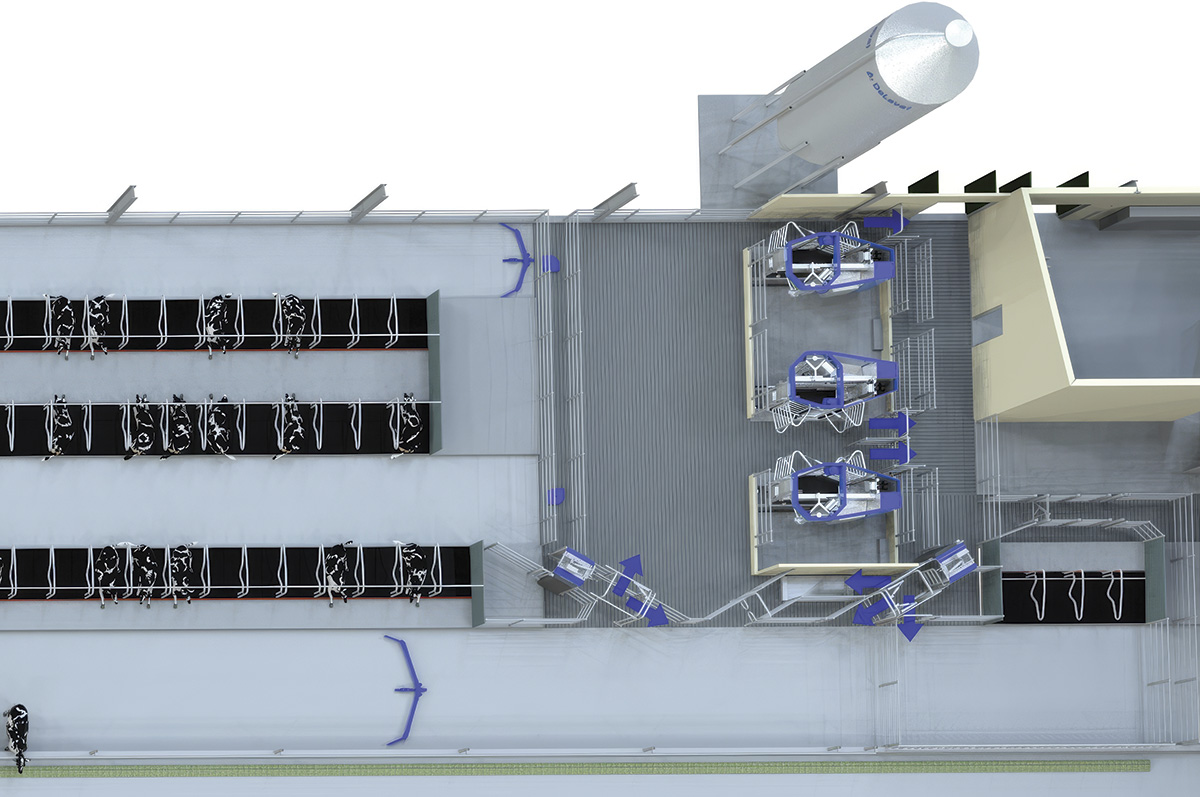
An example of guided-flow cow traffic. Image courtesy of DeLaval.
Modified guided-flow traffic
Modified guided-flow traffic blends aspects of free-flow and guided-flow traffic systems. One row of stalls has direct feed access without passing through a selection gate. This setup is easier to retrofit into existing barns but leaves one group of cows requiring more manual fetching.
The flow remains similar to guided barns where a gate makes the decision of which cow gets to access the milking robots but with one row of stalls not having to go through that decision-making process to get to feed. Just like guided-flow traffic, attention has to be paid to the number of cows in the holding pen. Ensure that fetching and feeding times are not close together because it is important to fetch to a sparse or empty holding pen.
For individuals not wanting to build a new barn or pour a whole separate lane for feed, modified guided-flow traffic is a great option to stay more economical while taking advantage of the efficiency gained with smart gates.
Batch milking
Batch milking replaces traditional parlours with milking robots and can be integrated into almost any facility. Cows are fetched two to three times a day, so feeding in the milking robots is unnecessary. This system has a holding pen with milking robots positioned at the front or to the side and smart gates to help sort cows needing health checks or breeding after they’ve been milked. One advantage of the batch milking system is that the existing cow housing can be utilized, and cows can be fed in the same manner as before. Additionally, cow groups can be managed as in the past, whereas, with other cow traffic systems of automated milking, management styles must shift to fit the new way of cow flow. Batch milking allows all of that to stay the same.
The challenge with batch milking is its complexity in scale. Farms switching to this model to reduce milking labour still need to invest in technical support, as robots require regular maintenance. Training new cows is also crucial – each new cow should be monitored for three milkings to ensure proper milking and system calibration, just as in the other cow flow designs. While batch milking dramatically reduces milking labour, trained personnel are still needed for system management and cow training.
This is the same for any automated milking facility, but because batch milking typically involves a larger quantity of machines, the technical capabilities on the farm need to match that. Maintaining a milking robot is not the same as maintaining a parlour or a rotary, and farms need to understand what is involved in that process before diving into this style of system.
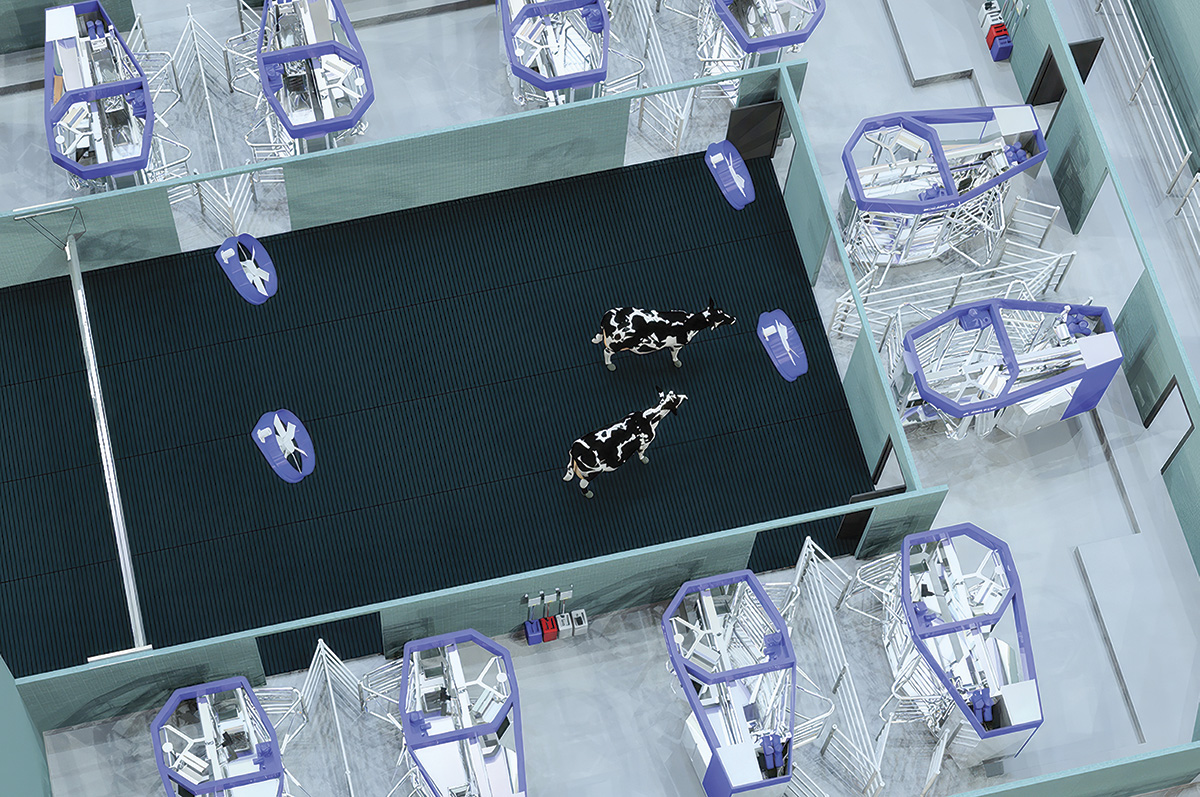
An example of batch milking. Image courtesy of DeLaval.
Making a decision
Each automated milking cow flow system has strengths and trade-offs. Choosing the right one depends on the facility layout, labour availability and management style. By carefully considering these factors, farmers can achieve their goals using the setup that works best for them to maximize efficiency and milk production while minimizing milking labour on their farms.