The dairy industry has spent the last few decades designing barns for automated milking, resulting in hundreds of different configurations – all of which have been a variation of two robot layouts: perpendicular and tollbooth.

Perpendicular
A perpendicular layout is where the robot room is situated between the scrape alleys along the length of the barn and the robot is parallel to the scrape alley (Image 1). In this configuration, multiple milking robots can be placed in one large robot room and set nose-to-tail in a row. In this scenario, the robot room is usually located between the scrape alleys along the length of the barn or across the width of the barn (Image 2).
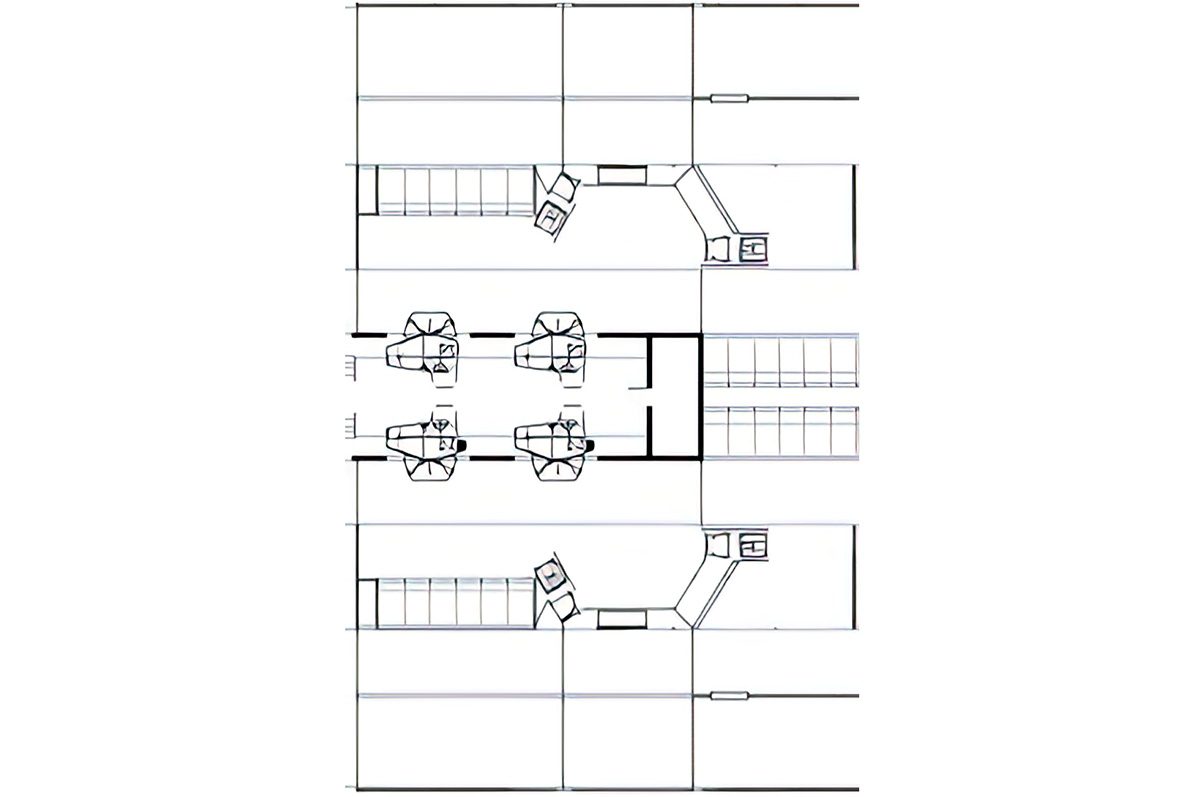
A perpendicular layout is where the robot room is situated between the scrape alleys along the length of the barn and the robot is parallel to the scrape alley. Image courtesy of DeLaval.
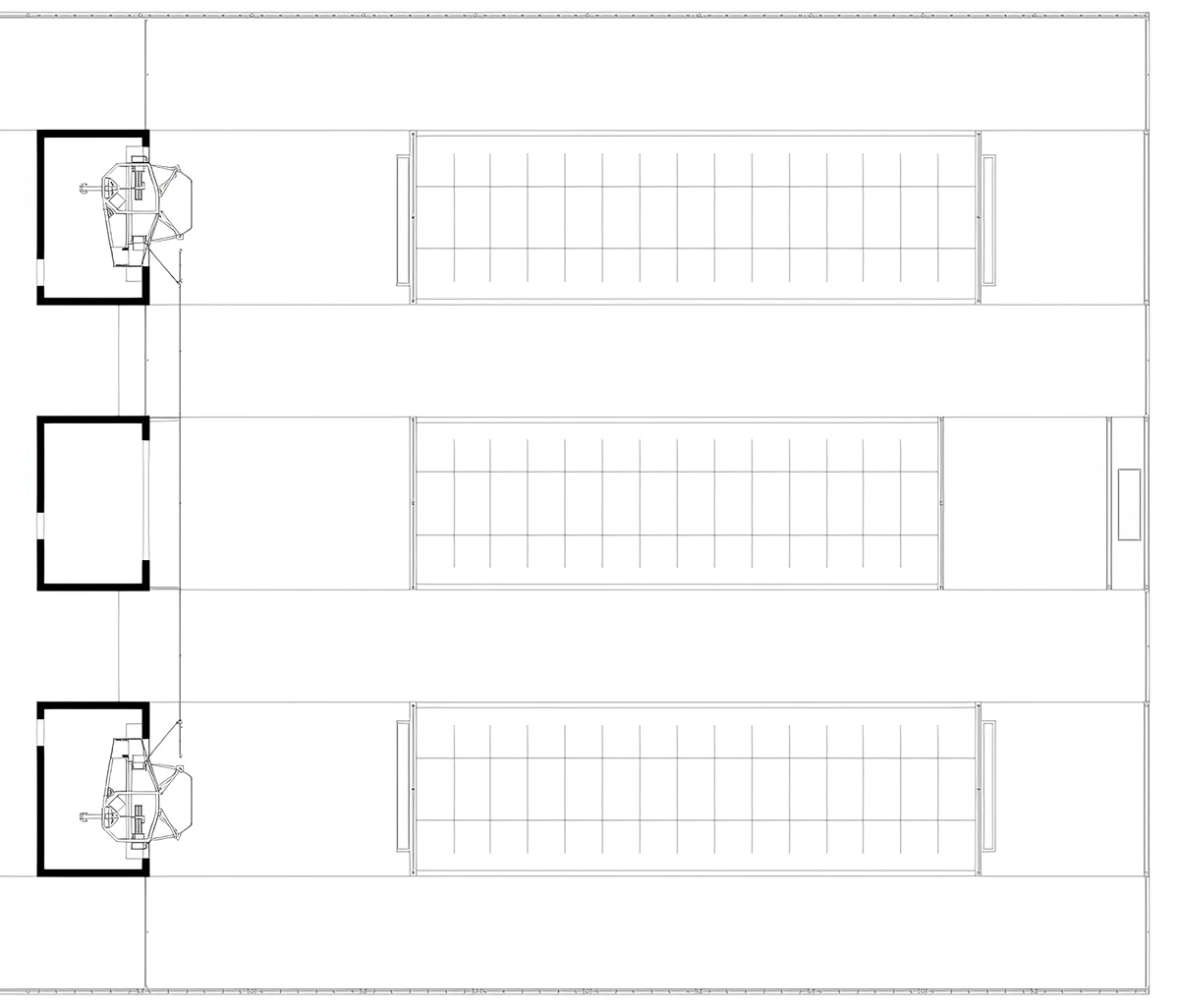
In a perpendicular layout, the robot room is usually located between the scrape alleys along the length of the barn or across the width of the barn. Image courtesy of DeLaval.
Tollbooth
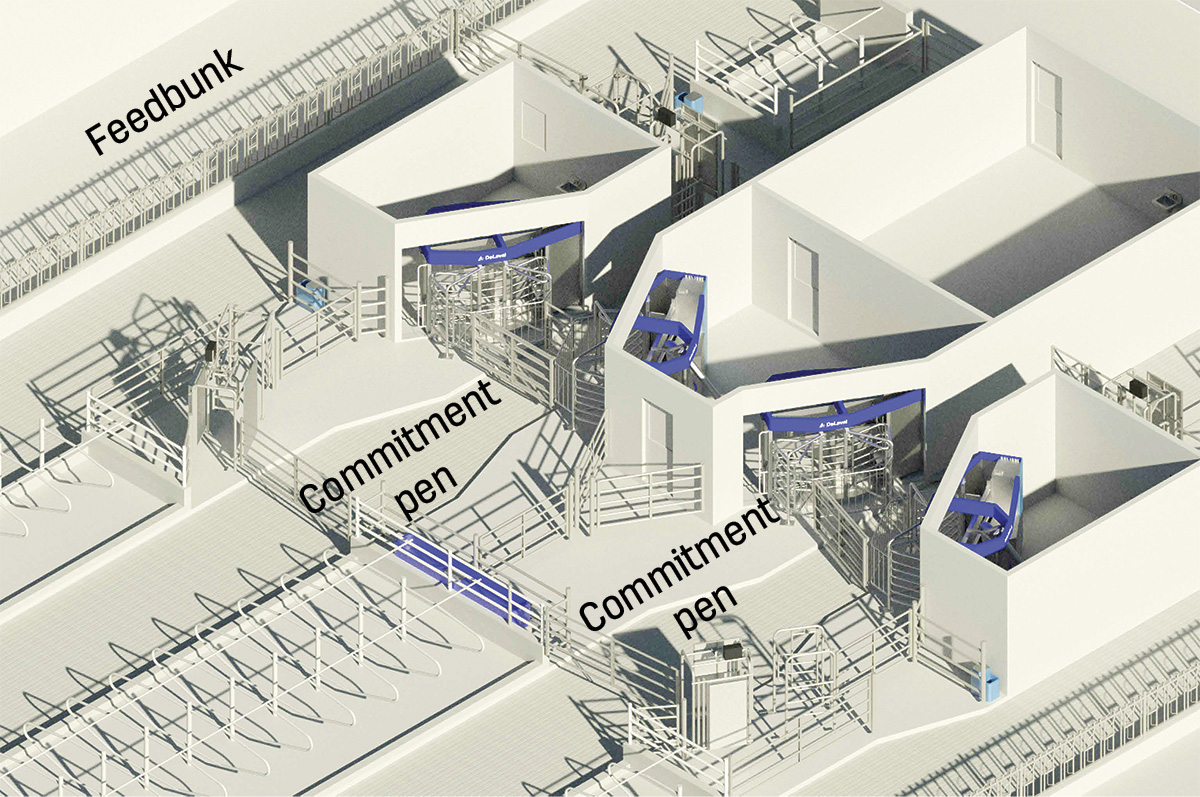
A tollbooth design places the milking robots parallel to the alleys or in a stacked configuration, which rotates the robot 90 degrees to the alley, with a commitment pen in front of the robot rooms (Image 3). In both scenarios, multiple robot rooms are required when two or more milking robots are involved. In this setup, cows must go through the milking robot to access another part of the barn (Image 4).
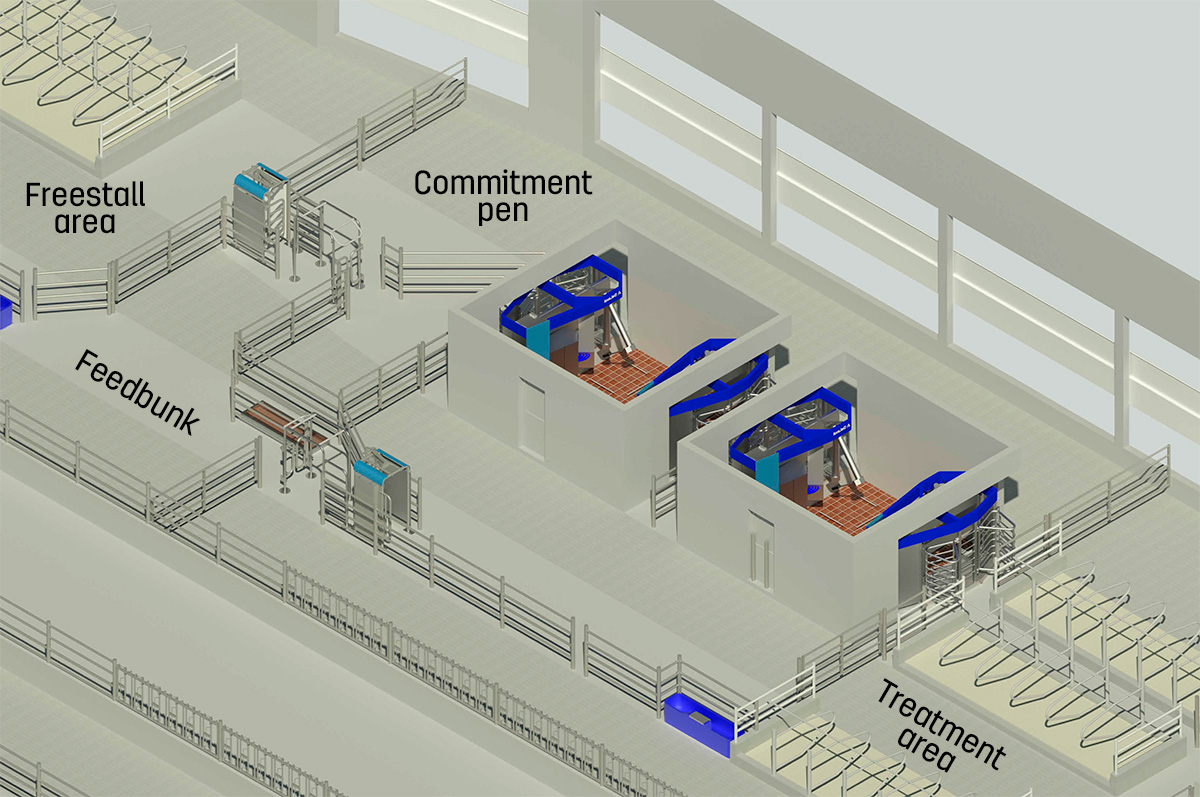
A tollbooth design places the robots parallel to the alleys or in a stacked configuration, which rotates the robot 90 degrees to the alley with a commitment pen in front of the robot rooms. Image courtesy of DeLaval.
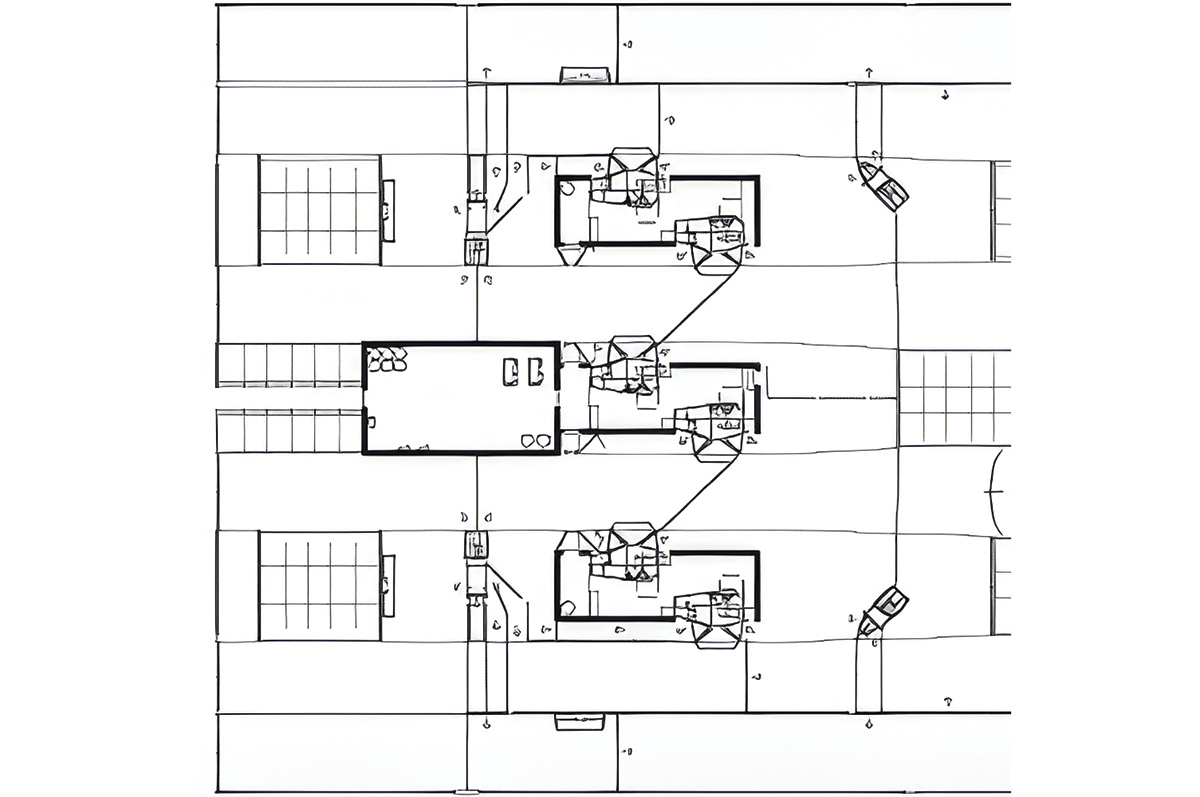
In a tollbooth setup, cows must go through the milking robot to access another part of the barn. Image courtesy of DeLaval.
Both perpendicular and tollbooth configurations have subvarieties with different cow flows, but the popularity of the tollbooth configuration has expanded the possibilities of automated milking barn design.
Barn design and cow flow
Cow flow has three basic concepts: free flow, modified-guided flow and guided flow. This decision seems to be both the easiest and hardest to make for dairy producers since it has many variables that can impact labor, operational costs and building costs.
Free flow is exactly what the name implies; cows have free rein to walk around the inside of the barn as they please, even to the milking robot. This may require more labor to increase fetching for milking and sorting cows post milking.
Modified-guided flow has some guidance; cows can walk around the barn freely, but when they are to be milked, they must enter a commitment pen in front of the robot room and be milked to exit the commitment pen.
Guided flow requires the cow to enter areas of the barn in a procession from space to space. For example, this flow may see a cow move from the commitment pen to the milking robot to the feed or treatment area to the resting area and back to the commitment pen. The latter two require properly positioned gating to have the cows flow as desired throughout the barn.
Why tollbooth?
Both tollbooth and perpendicular configurations can be used in all three cow flow scenarios, but modified-guided flow and guided flow are predominantly used with the tollbooth configuration. The tollbooth setup takes advantage of the milking robot since it acts as a gate from the commitment pen to the post-sorting area.
When designing a new automated milking facility, consider these advantages in tollbooth designs over perpendicular:
- No commingling of pre-milk and post-milk cows
- Ease of sorting cows with gates
- Efficiencies in cleaning and maintenance of the robot area
- Reduction in the length of milk lines used
- Can group multiple robots (four-plus) together in a stacked configuration
- Ease of management in the commitment pen
There are also some disadvantages when choosing tollbooth over perpendicular:
- The need for separate robot rooms when multiple robots are in one group
- Multiple robot rooms may be a disadvantage for service technicians
A tollbooth design can impact the initial construction costs, with a longer barn and multiple robot rooms, but the advantages of this configuration may pay off in the long run with operational efficiencies and savings.
What’s next?
In 2006, milking robots were installed in a barn in Australia where they combined a large holding area but milked the cows with robots. This was one of the earliest examples of batch milking, which combines the style of conventional milking with the efficiency of robots. The large holding area in a batch milking facility is like that of a conventional parlor, while the robots are set up in a tollbooth configuration to milk the cows, and the post-sorting area is similar to that of a conventional dairy (Image 5). The concept sat for more than a decade, but then it resurfaced in Holland in 2020 with eight milking robots. Today, there are more than a dozen batch milking installations around the world as interest grows in this style of automated milking.
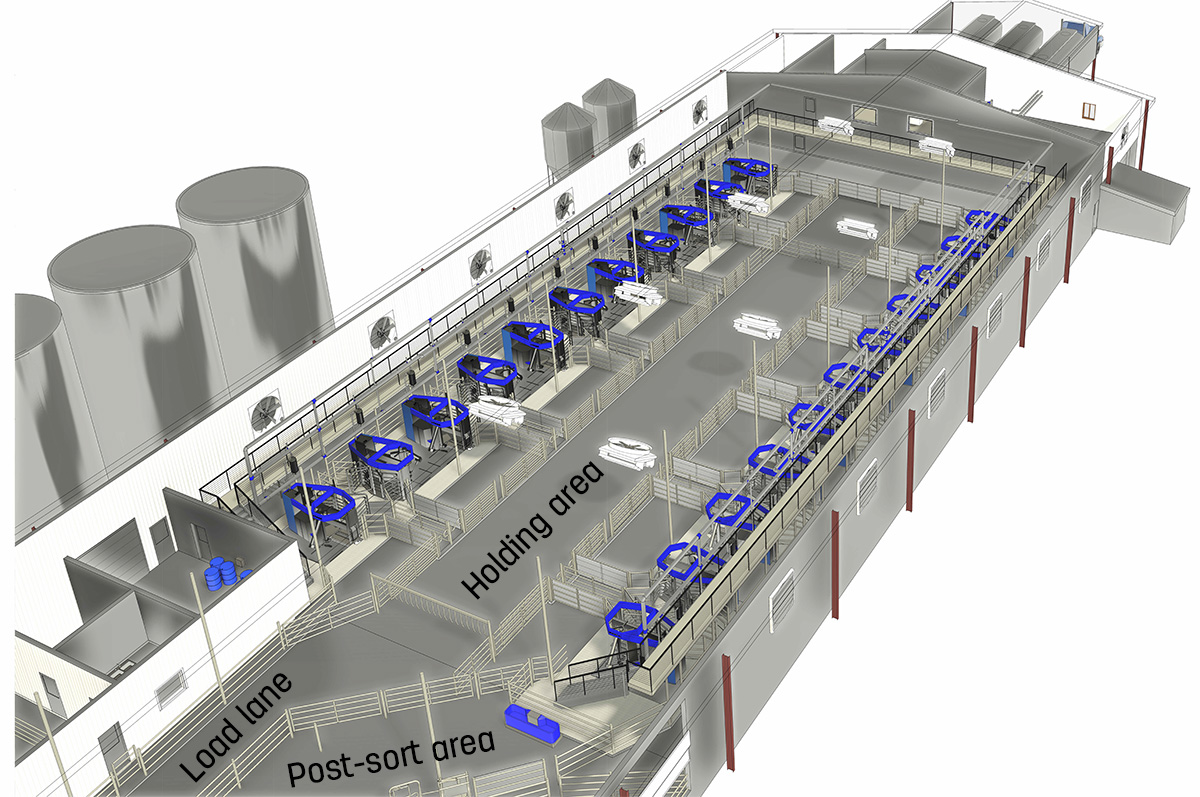
The large holding area in a batch milking facility is like that of a conventional parlor, while the robots are set up in a tollbooth configuration to milk the cows. Image courtesy of DeLaval.
The popularity of the tollbooth configuration enabled variations of the design, especially with its advantages in labor efficiency. The concept of the stacked tollbooth has been around for approximately a decade, with a dairy in Chile the first to try it. More recently, the perpendicular approach has caught traction in North America with a handful of Midwest dairies. Additionally, a dealership in Wisconsin has been rotating the milking robots a few degrees to ease the approach to the robots (Image 6). About a dozen or so dairies have been using this angled layout. These slight variations keep pushing the design envelope for possibilities with automated milking.
Milking robots are rotated a few degrees to ease the approach to the robots. Image courtesy of DeLaval.