Taking your calves to auction can feel like a gamble. But what if you could stack the deck in your favor so your calves have a better chance of fetching top dollar? Investing in the right management practices and health protocols can communicate that your calves are ready to face the challenges ahead and are a smart bet for buyers.

Merck Animal Health, Superior Livestock Auction and Kansas State University have partnered to evaluate the management decisions, programs and health protocols that drive the price per pound paid by buyers. The 2024 auction dataset includes information from 851,181 calves with an average weight of 572 pounds. The average price nationally was $2.94 per pound, which was 90% higher than the national average price in 2019.
Each trait was evaluated relative to a base with all other factors being constant. So an additive approach can be used when evaluating multiple traits.
Preconditioning pays
The data demonstrates buyers are willing to pay more for calves that are primed for their future. Preconditioning boosts the immune system and increases weight, helping equip calves to thrive in a backgrounder or feedyard phase. A successful preconditioning program includes a series of vaccinations and management practices, such as weaning, deworming and transitioning calves to dry feed, as well as possibly implanting, castrating and dehorning.
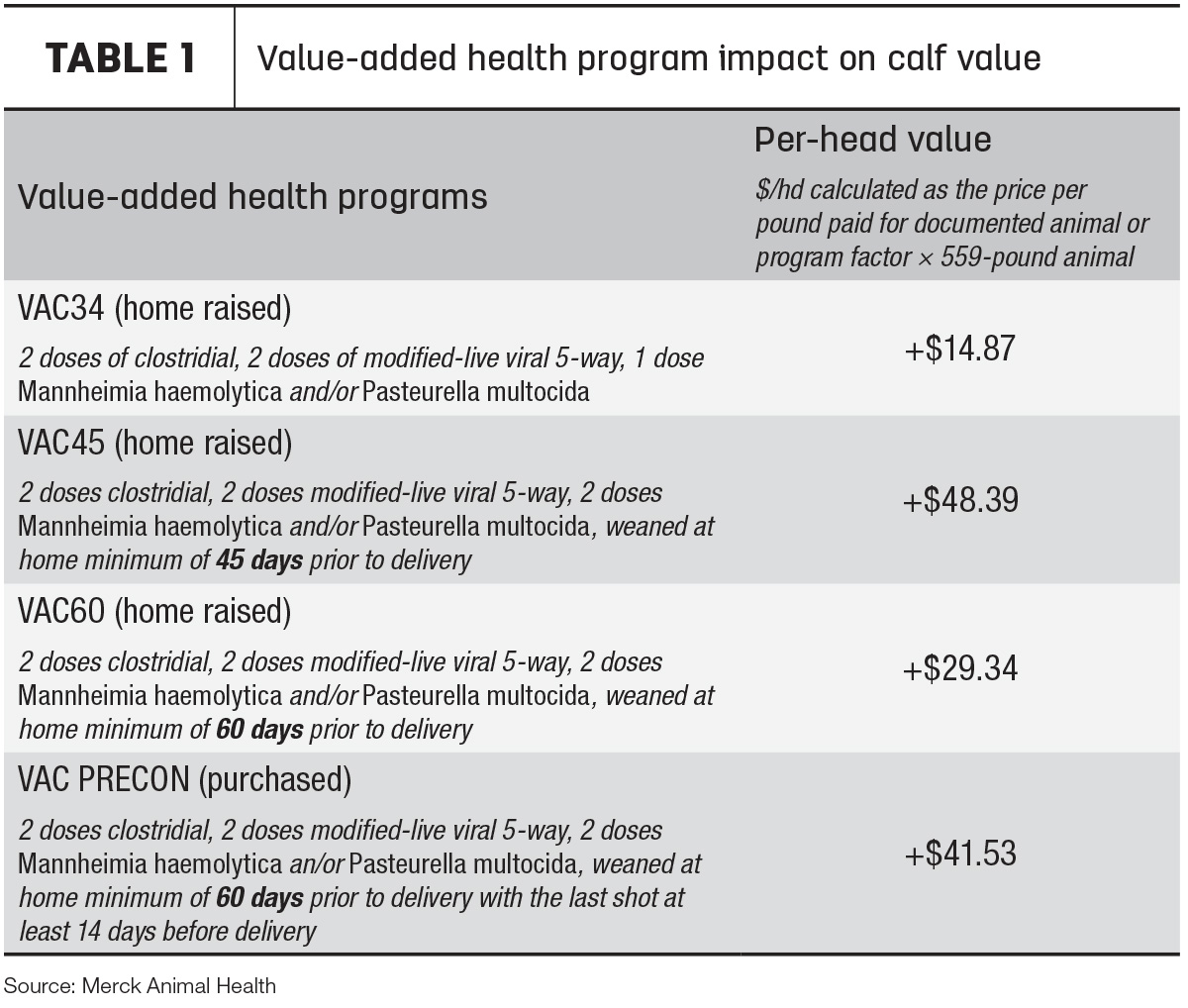
Preconditioning programs are generally grouped into the following classifications: VAC24, VAC34, VAC45, VAC60 and VAC PRECON. VAC45 calves, that is, those vaccinated with two doses of a clostridial vaccine, two doses of a 5-way modified-live viral vaccine and at least one dose of Mannheimia haemolytica and/or Pasteurella multocida vaccine, and weaned at home for 45 days before delivery, added $8.46 per hundredweight (cwt) compared to those receiving only one dose of each of the three vaccines and weaned at shipping.
Selling calves on a VAC45 program added $48 per head (Table 1).
Working with your veterinarian to follow a certified preconditioning program can clarify the steps needed to give calves the best start. You can demonstrate your preconditioning efforts with a certificate at auction and further establish a reputation for selling calves ready for the next step.
The implant advantage
Some management decisions do not impact the price paid for calves. Implants are one example. Over the past five years, in nearly 5 million head of cattle evaluated, there has not been a difference in price per pound paid between implanted and non-implanted calves. Nearly 40% of the calves sold in 2024 were not in a program that bans implants, according to the data. Implants can be a cost-effective opportunity to boost your revenue.
Implants consistently increase average daily gain by 20%. Calves implanted at 2 months old and older on average weigh 23 pounds heavier, are more muscular and have a slight increase in frame compared to non-implanted calves.
Applying calf prices during this period to the additional pounds gained equates to a $66-per-head advantage over calves that were not implanted. Simply by following a VAC45 program and implanting your calves, you can potentially add $115 per head.
Managing for more revenue
Other management factors continue to hold value for buyers. Calves without horns brought $18 more per head than those with horns. Buyers were willing to pay an additional $22 per head for calves with a medium or medium-large frame and $14 more per head for calves classified as light-medium fleshed (Table 2).
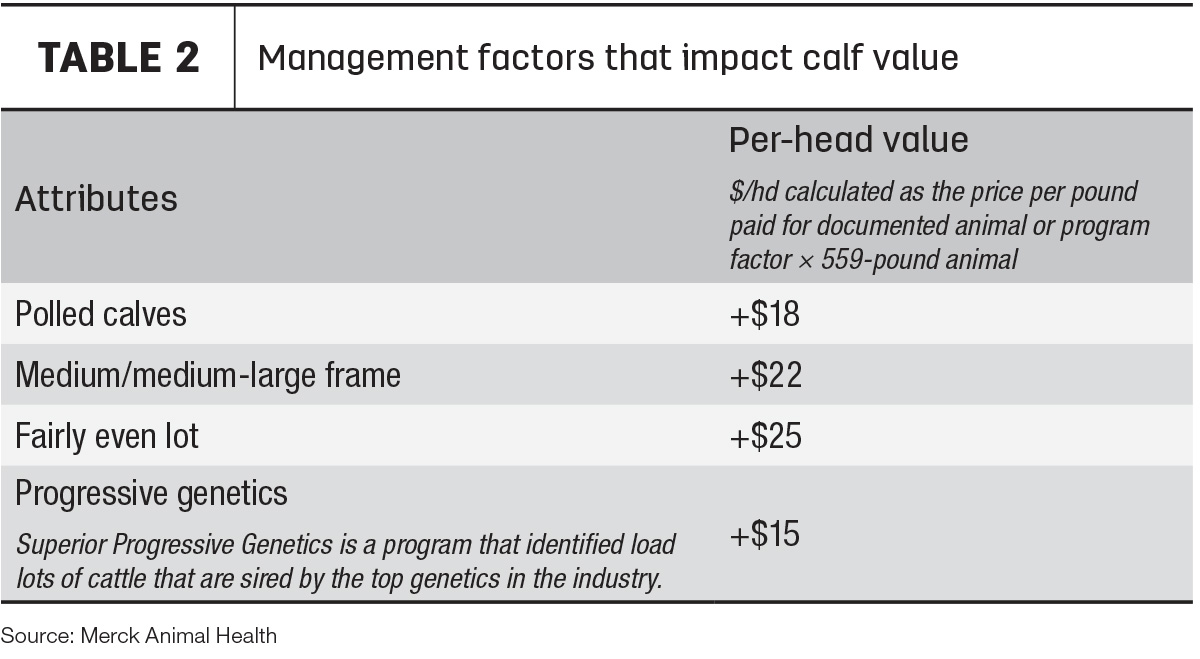
Significant weight variation in your calf crop can be more detrimental than you realize. Lots described as very uneven brought $3.29 per cwt less than those that were simply described as uneven or were missing a classification. Lots described as fairly even stood to gain an additional $1.14 per cwt, a total of $25 per head.
Tighter calving seasons can make a difference in producing uniform calves. A heat synchronization program paired with natural service can shorten your calving interval and get more cows bred earlier in the breeding season. Studies have shown that a single shot of a prostaglandin four or five days after bull turnout can result in heavier, more uniform calves.
Costs and benefits of value-added programs
Value-added programs may provide an opportunity to set your calves apart at sale and increase revenue. Keep in mind that some programs require inputs such as additional paperwork, audits and more. Consider the cost of participating in these programs versus the potential return on investment.
Cattle enrolled in a program such as Non-Hormone Treated Cattle (NHTC) or GAP brought $20 and $18 more per head, respectively, compared to calves not enrolled in a program.
Integrating top-tier genetics into your breeding program can also communicate value to buyers. Producers stood to gain an extra $15 per head if they utilized the Superior Progressive Genetics program through Superior Livestock Auction.
Buyers have the same goal as you: to produce healthy, high-performing calves for the next phase of production. When you know what buyers are willing to pay for, you can make strategic marketing decisions with your calves so you don’t leave money on the table. Preconditioning programs and certain management decisions provide the opportunity to make the most out of these historic calf prices.