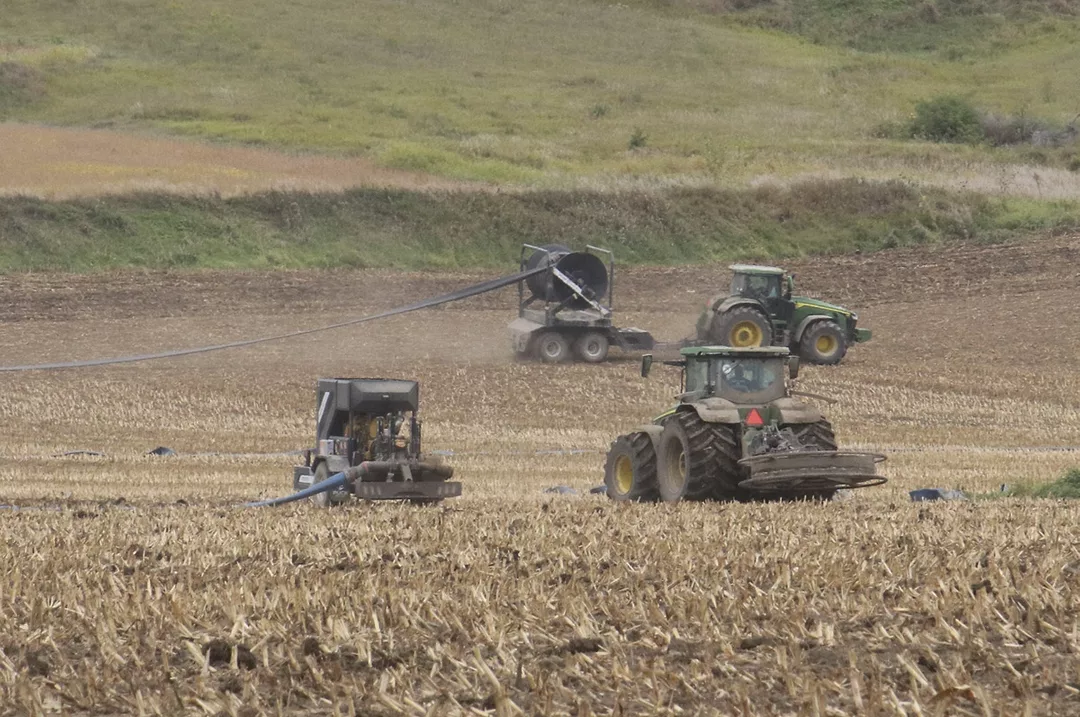
A dragline application system is one of the fastest and most efficient ways to move liquid manure from your storage facility to the fields. Choosing the correct equipment for your operation starts with understanding your goals and building upon them. Price, time and labor can all factor into the equipment choices.

Hose sizes and pressure loss
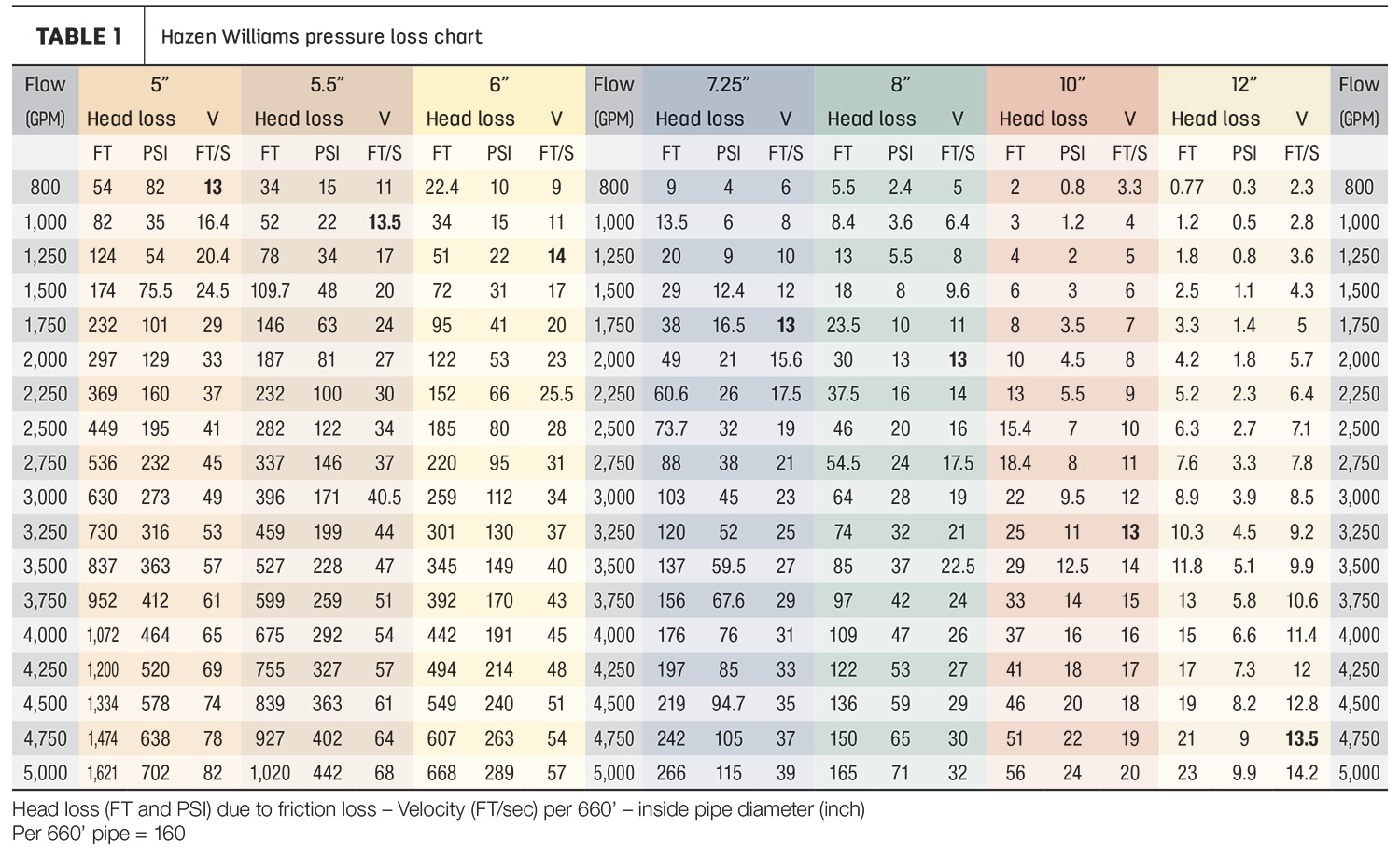
The most common large-diameter hose sizes for dragline operations are 6-, 8-, 10- and 12-inch hoses. Pressure in liquid manure transfer can be lost due to the resistance liquid encounters in the hose. Pressure loss decreases as you increase hose diameter, which expands capacity for liquid to flow. A single length (660 feet) of 6-inch hose with a flow rate of 2,000 gallons per minute (GPM) sees a pressure loss of 53 psi. However, with the same length and flow rate, an 8-inch hose sees only 13 psi pressure loss.
Alternatively, pressure loss increases as you increase flow rate, which forces more liquid through the line. The same 6-inch hose from before may see 53 psi pressure loss at 2,000 GPM, but that increases to 80 psi at 2,500 GPM. To maintain that flow rate without the increased pressure loss, increasing the hose size to 8-inch in diameter decreases the pressure loss to just 20 psi for the same length.
With that in mind, the decision to increase your hose diameter can make a significant change in flow rates and pressure loss. Utilizing a larger hose to go the same distance can either result in more gallons moved and safer, lower hose pressures or both. Applying the same flow rate with a larger hose can allow your line to go farther distances with fewer booster pumps. A Hazen Williams pressure loss chart (Table 1) can help estimate pressure loss in hose size based on flow rates.
We see a mix of hose sizes in the industry today; however, if you are running lower application rates (generally under 3,200 GPM), an 8-inch mainline hose is most often paired with 6-inch drag hoses. For rates greater than that, a 10-inch hose is most prevalent, with some crews venturing into a 12-inch mainline hose. These are often paired with 7.25-inch dragline hoses. With larger hose sizes come large hydraulic hose cart sizes. Widely-used hose carts can hold anywhere from a mile of 8-inch hose plus drags to 1.5 miles of 10-inch hose plus drags.
Comparing pump units
Pump units used for liquid manure transfer and application have changed dramatically in the last few decades. The industry has increased the average gallons pumped from 1,000 GPM to over 5,000 GPM in just the last 15 years. Most of this is attributed to larger mainline and drag hose sizes being used in the industry to keep up with larger hose diameters, larger horsepower engines, and more efficient and larger pumps are being used. In our experience with dairy manure, we have found success with three engine and pump sizes for the industry, depending on hose sizes and flow rate desired.
Deciding on the engine and pump for your lead and booster pump units depends on the desired flow rate for your operation. To achieve flow rates between 1,500 and 3,500 GPM, a Cat 9.3B engine with 456 horsepower (HP) powering a Cornell 6819MPC pump can get you that result. Increasing your engine to a Cat C13B to get 577 HP, or increasing your impeller size to Cornell’s 81020MP, can boost your flow rates up to the 2,500-4,000 GPM range with the right size hose. For the extra-large jobs, our largest pump unit, the WH 7582, uses a Cat C18 engine with a Cornell 81022MP and gets flow rates between 3,500 and 5,000 GPM.
The need for higher flow rates is driven by high volumes of liquid manure that need to be applied in a relatively short application window, with added challenges of reduced labor supply. These higher flow rates allow custom applicators to apply more gallons per day while maintaining desired application rates. As the number of custom applicators continues to decline, these higher rates have given the industry the capacity to continue to service the liquid manure application needs of the livestock industry.
Determining equipment needs as a custom applicator is dependent on the types of clientele you service and the versatility you require for the region. In recent years, as swine finishing manure has become more concentrated, requiring much lower application rates per acre (2,500-6,000 gallons per acre (GPA)) compared to dairy manure at 12,500-18,000 GPA, it has become harder to maintain the same level of versatility using the same equipment for both farm types.
Efficiency beyond your equipment choices
Flow rates are often the biggest talking point in regard to pumping manure, but crew efficiency is always our number one goal on the job. We have learned that GPM is only a small factor, and personnel training and crew efficiency play a large part in job quality. We want as little downtime as possible to keep our flow meters running. Training a crew to not only be safe but to think a few steps ahead during the job can save time and money.
Laying out hose ahead of the applicator tractor or using hose movers to cover larger sections of fields are key influences to make this happen. The most important factor is training the crews to work as a team and ensuring everyone fully understands their role on the team. Communication throughout the day is vital to the teamwork required to get the job done efficiently.
Additional equipment to improve efficiency
One piece of equipment that could help save time is a hydraulic hose cart. With a hose cart or turntable reel, your crew can easily pick up a mile or more of hose and transport it down the road to easily move sets between fields. Single-person operations from the tractor cab frees up other crew members to work on other tasks.
Another boost to efficiency would be an automated pump control system. Pump control systems can balance every pump in the line to give you full control from a single screen, monitoring machine vitals and operating parameters, as well as throttling the engines up or down to meet your preset parameters to ensure you reach your desired flows (Figure 1). This protects your pump from cavitation and maximizes flow rates.

There are many variables that go into choosing the right equipment for your liquid manure dragline operation. Although horsepower is important for achieving the desired flow rates to reach your application goals, it is only one aspect to consider. Keeping the same pump units and increasing hose size can make a difference, as well as in-depth training for crew members, such as participating in biannual pump school sessions. Consider ways to minimize downtime and maximize your flow rates within your equipment line.